

Dynamics of Water in Partially Crystallized Solutions of Glass …
189
4
5
6
7
-7
-6
-5
-4
-3
-2
-1
0
amorphous
tc = 30 min
60 min
150 min
390 min
570 min
1000/T [K
-1
]
T cryst = 215 K
log (τ)
PVP, c w = 55 wt%
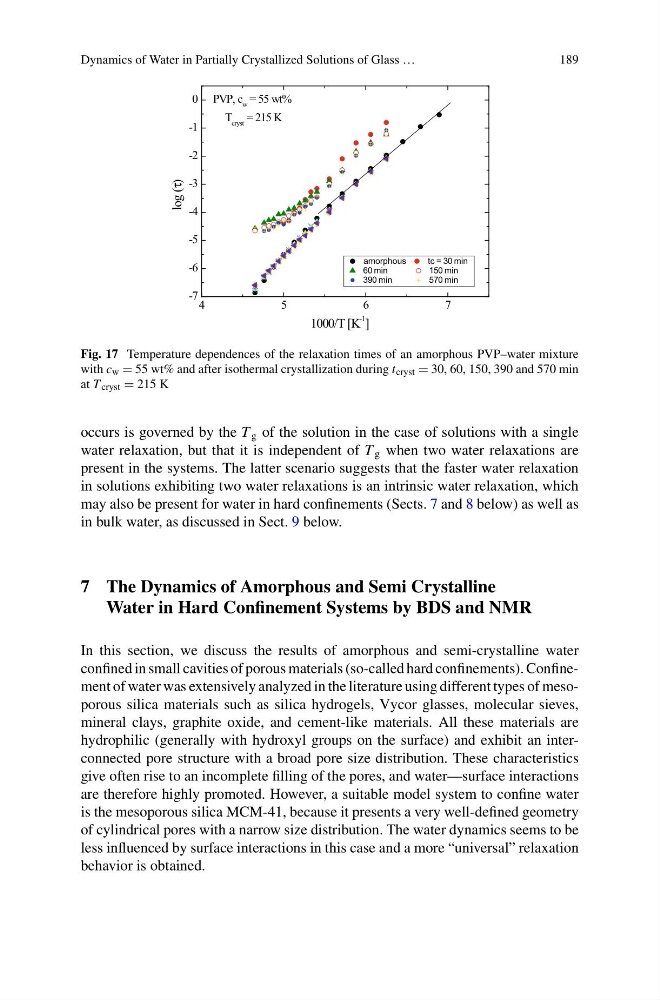
Fig. 17 Temperature dependences of the relaxation times of an amorphous PVP–water mixture
with c w = 55 wt% and after isothermal crystallization during t cryst = 30, 60, 150, 390 and 570 min
at T cryst = 215 K
occurs is governed by the T g of the solution in the case of solutions with a single
water relaxation, but that it is independent of T g when two water relaxations are
present in the systems. The latter scenario suggests that the faster water relaxation
in solutions exhibiting two water relaxations is an intrinsic water relaxation, which
may also be present for water in hard confinements (Sects. 7 and 8 below) as well as
in bulk water, as discussed in Sect. 9 below.
7 The Dynamics of Amorphous and Semi Crystalline
Water in Hard Confinement Systems by BDS and NMR
In this section, we discuss the results of amorphous and semi-crystalline water
confined in small cavities of porous materials (so-called hard confinements). Confinement of water was extensively analyzed in the literature using different types of mesoporous silica materials such as silica hydrogels, Vycor glasses, molecular sieves,
mineral clays, graphite oxide, and cement-like materials. All these materials are
hydrophilic (generally with hydroxyl groups on the surface) and exhibit an interconnected pore structure with a broad pore size distribution. These characteristics
give often rise to an incomplete filling of the pores, and water—surface interactions
are therefore highly promoted. However, a suitable model system to confine water
is the mesoporous silica MCM-41, because it presents a very well-defined geometry
of cylindrical pores with a narrow size distribution. The water dynamics seems to be
less influenced by surface interactions in this case and a more “universal” relaxation
behavior is obtained.
189
4
5
6
7
-7
-6
-5
-4
-3
-2
-1
0
amorphous
tc = 30 min
60 min
150 min
390 min
570 min
1000/T [K
-1
]
T cryst = 215 K
log (τ)
PVP, c w = 55 wt%
Fig. 17 Temperature dependences of the relaxation times of an amorphous PVP–water mixture
with c w = 55 wt% and after isothermal crystallization during t cryst = 30, 60, 150, 390 and 570 min
at T cryst = 215 K
occurs is governed by the T g of the solution in the case of solutions with a single
water relaxation, but that it is independent of T g when two water relaxations are
present in the systems. The latter scenario suggests that the faster water relaxation
in solutions exhibiting two water relaxations is an intrinsic water relaxation, which
may also be present for water in hard confinements (Sects. 7 and 8 below) as well as
in bulk water, as discussed in Sect. 9 below.
7 The Dynamics of Amorphous and Semi Crystalline
Water in Hard Confinement Systems by BDS and NMR
In this section, we discuss the results of amorphous and semi-crystalline water
confined in small cavities of porous materials (so-called hard confinements). Confinement of water was extensively analyzed in the literature using different types of mesoporous silica materials such as silica hydrogels, Vycor glasses, molecular sieves,
mineral clays, graphite oxide, and cement-like materials. All these materials are
hydrophilic (generally with hydroxyl groups on the surface) and exhibit an interconnected pore structure with a broad pore size distribution. These characteristics
give often rise to an incomplete filling of the pores, and water—surface interactions
are therefore highly promoted. However, a suitable model system to confine water
is the mesoporous silica MCM-41, because it presents a very well-defined geometry
of cylindrical pores with a narrow size distribution. The water dynamics seems to be
less influenced by surface interactions in this case and a more “universal” relaxation
behavior is obtained.