

Dynamics of Water in Partially Crystallized Solutions of Glass …
187
4
5
6
7
-7
-6
-5
-4
-3
-2
-1
0
Amorphous sample
Semi-crystalline sample
water relaxation
PVME, c w = 50 wt%
log (τ)
1000/T [K
-1
]
water relaxation
ice relaxation
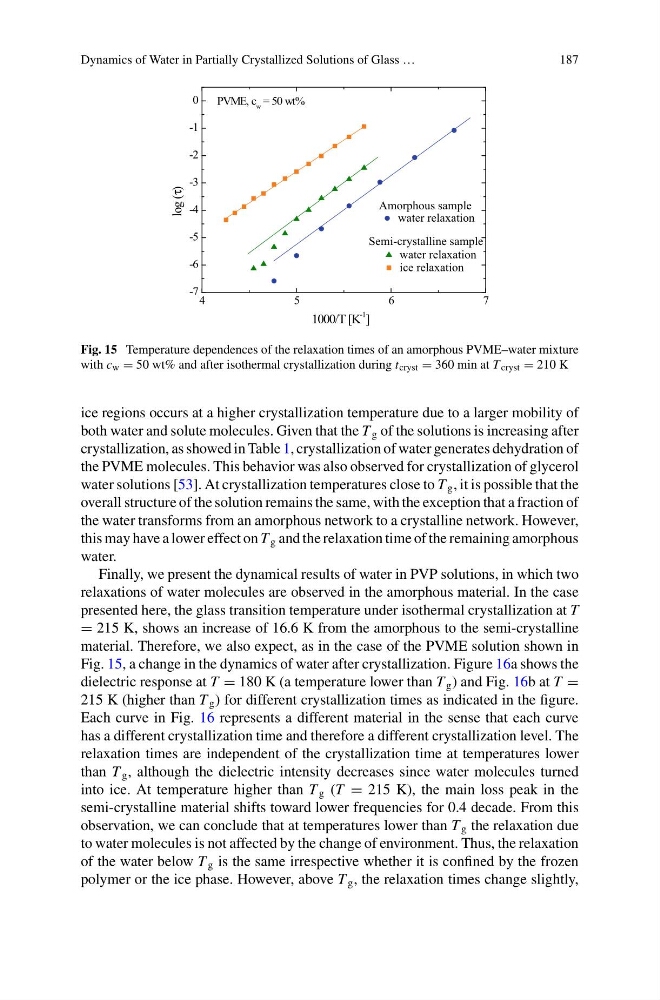
Fig. 15 Temperature dependences of the relaxation times of an amorphous PVME–water mixture
with c w = 50 wt% and after isothermal crystallization during t cryst = 360 min at T cryst = 210 K
ice regions occurs at a higher crystallization temperature due to a larger mobility of
both water and solute molecules. Given that the T g of the solutions is increasing after
crystallization, as showed in Table 1, crystallization of water generates dehydration of
the PVME molecules. This behavior was also observed for crystallization of glycerol
water solutions [53]. At crystallization temperatures close to T g , it is possible that the
overall structure of the solution remains the same, with the exception that a fraction of
the water transforms from an amorphous network to a crystalline network. However,
this may have a lower effect on T g and the relaxation time of the remaining amorphous
water.
Finally, we present the dynamical results of water in PVP solutions, in which two
relaxations of water molecules are observed in the amorphous material. In the case
presented here, the glass transition temperature under isothermal crystallization at T
= 215 K, shows an increase of 16.6 K from the amorphous to the semi-crystalline
material. Therefore, we also expect, as in the case of the PVME solution shown in
Fig. 15, a change in the dynamics of water after crystallization. Figure 16a shows the
dielectric response at T = 180 K (a temperature lower than T g ) and Fig. 16b at T =
215 K (higher than T g ) for different crystallization times as indicated in the figure.
Each curve in Fig. 16 represents a different material in the sense that each curve
has a different crystallization time and therefore a different crystallization level. The
relaxation times are independent of the crystallization time at temperatures lower
than T g , although the dielectric intensity decreases since water molecules turned
into ice. At temperature higher than T g (T = 215 K), the main loss peak in the
semi-crystalline material shifts toward lower frequencies for 0.4 decade. From this
observation, we can conclude that at temperatures lower than T g the relaxation due
to water molecules is not affected by the change of environment. Thus, the relaxation
of the water below T g is the same irrespective whether it is confined by the frozen
polymer or the ice phase. However, above T g , the relaxation times change slightly,
187
4
5
6
7
-7
-6
-5
-4
-3
-2
-1
0
Amorphous sample
Semi-crystalline sample
water relaxation
PVME, c w = 50 wt%
log (τ)
1000/T [K
-1
]
water relaxation
ice relaxation
Fig. 15 Temperature dependences of the relaxation times of an amorphous PVME–water mixture
with c w = 50 wt% and after isothermal crystallization during t cryst = 360 min at T cryst = 210 K
ice regions occurs at a higher crystallization temperature due to a larger mobility of
both water and solute molecules. Given that the T g of the solutions is increasing after
crystallization, as showed in Table 1, crystallization of water generates dehydration of
the PVME molecules. This behavior was also observed for crystallization of glycerol
water solutions [53]. At crystallization temperatures close to T g , it is possible that the
overall structure of the solution remains the same, with the exception that a fraction of
the water transforms from an amorphous network to a crystalline network. However,
this may have a lower effect on T g and the relaxation time of the remaining amorphous
water.
Finally, we present the dynamical results of water in PVP solutions, in which two
relaxations of water molecules are observed in the amorphous material. In the case
presented here, the glass transition temperature under isothermal crystallization at T
= 215 K, shows an increase of 16.6 K from the amorphous to the semi-crystalline
material. Therefore, we also expect, as in the case of the PVME solution shown in
Fig. 15, a change in the dynamics of water after crystallization. Figure 16a shows the
dielectric response at T = 180 K (a temperature lower than T g ) and Fig. 16b at T =
215 K (higher than T g ) for different crystallization times as indicated in the figure.
Each curve in Fig. 16 represents a different material in the sense that each curve
has a different crystallization time and therefore a different crystallization level. The
relaxation times are independent of the crystallization time at temperatures lower
than T g , although the dielectric intensity decreases since water molecules turned
into ice. At temperature higher than T g (T = 215 K), the main loss peak in the
semi-crystalline material shifts toward lower frequencies for 0.4 decade. From this
observation, we can conclude that at temperatures lower than T g the relaxation due
to water molecules is not affected by the change of environment. Thus, the relaxation
of the water below T g is the same irrespective whether it is confined by the frozen
polymer or the ice phase. However, above T g , the relaxation times change slightly,