

General Concepts of Crystallization: Some Recent …
9
Elastic stresses evolving as the result of crystal nucleation and growth are reduced
by relaxation processes. Consequently, the proper description of the interplay of stress
evolution and stress relaxation is of outstanding significance for the understanding
of crystal nucleation and growth. An overview of different results in this respect is
given in [6]. Here we concentrate on the effect of the interplay of stress evolution
and stress relaxation in crystal nucleation in the form as advanced first in [23, 24].
Below we present the basic ideas of this approach.
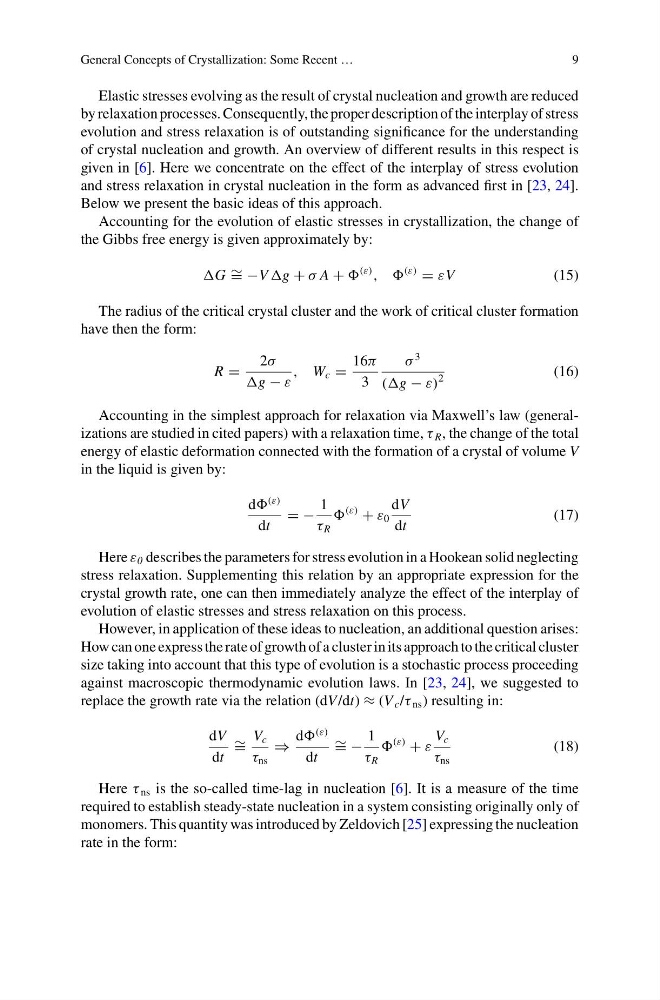
Accounting for the evolution of elastic stresses in crystallization, the change of
the Gibbs free energy is given approximately by:
G ∼ = −V g + σ A +
(ε)
, ,
(ε)
= εV
(15)
The radius of the critical crystal cluster and the work of critical cluster formation
have then the form:
R =
2σ
g − ε
, W c =
16π
3
σ
3
(g − ε)
2
(16)
Accounting in the simplest approach for relaxation via Maxwell’s law (generalizations are studied in cited papers) with a relaxation time, τ R , the change of the total
energy of elastic deformation connected with the formation of a crystal of volume V
in the liquid is given by:
d
(ε)
dt
= −
1
τ R
(ε)
+ ε 0
dV
dt
(17)
Here ε 0 describes the parameters for stress evolution in a Hookean solid neglecting
stress relaxation. Supplementing this relation by an appropriate expression for the
crystal growth rate, one can then immediately analyze the effect of the interplay of
evolution of elastic stresses and stress relaxation on this process.
However, in application of these ideas to nucleation, an additional question arises:
How can one express the rate of growth of a cluster in its approach to the critical cluster
size taking into account that this type of evolution is a stochastic process proceeding
against macroscopic thermodynamic evolution laws. In [23, 24], we suggested to
replace the growth rate via the relation (dV /dt) ≈ (V c /τ ns ) resulting in:
dV
dt
∼ =
V c
τ ns
⇒
d
(ε)
dt
∼ = −
1
τ R
(ε)
+ ε
V c
τ ns
(18)
Here τ ns is the so-called time-lag in nucleation [6]. It is a measure of the time
required to establish steady-state nucleation in a system consisting originally only of
monomers. This quantity was introduced by Zeldovich [25] expressing the nucleation
rate in the form:
9
Elastic stresses evolving as the result of crystal nucleation and growth are reduced
by relaxation processes. Consequently, the proper description of the interplay of stress
evolution and stress relaxation is of outstanding significance for the understanding
of crystal nucleation and growth. An overview of different results in this respect is
given in [6]. Here we concentrate on the effect of the interplay of stress evolution
and stress relaxation in crystal nucleation in the form as advanced first in [23, 24].
Below we present the basic ideas of this approach.
Accounting for the evolution of elastic stresses in crystallization, the change of
the Gibbs free energy is given approximately by:
G ∼ = −V g + σ A +
(ε)
, ,
(ε)
= εV
(15)
The radius of the critical crystal cluster and the work of critical cluster formation
have then the form:
R =
2σ
g − ε
, W c =
16π
3
σ
3
(g − ε)
2
(16)
Accounting in the simplest approach for relaxation via Maxwell’s law (generalizations are studied in cited papers) with a relaxation time, τ R , the change of the total
energy of elastic deformation connected with the formation of a crystal of volume V
in the liquid is given by:
d
(ε)
dt
= −
1
τ R
(ε)
+ ε 0
dV
dt
(17)
Here ε 0 describes the parameters for stress evolution in a Hookean solid neglecting
stress relaxation. Supplementing this relation by an appropriate expression for the
crystal growth rate, one can then immediately analyze the effect of the interplay of
evolution of elastic stresses and stress relaxation on this process.
However, in application of these ideas to nucleation, an additional question arises:
How can one express the rate of growth of a cluster in its approach to the critical cluster
size taking into account that this type of evolution is a stochastic process proceeding
against macroscopic thermodynamic evolution laws. In [23, 24], we suggested to
replace the growth rate via the relation (dV /dt) ≈ (V c /τ ns ) resulting in:
dV
dt
∼ =
V c
τ ns
⇒
d
(ε)
dt
∼ = −
1
τ R
(ε)
+ ε
V c
τ ns
(18)
Here τ ns is the so-called time-lag in nucleation [6]. It is a measure of the time
required to establish steady-state nucleation in a system consisting originally only of
monomers. This quantity was introduced by Zeldovich [25] expressing the nucleation
rate in the form: