

10
J. W. P. Schmelzer and C. Schick
J = J 0 exp
−
τ ns
t
exp
−
W c
k B T
(19)
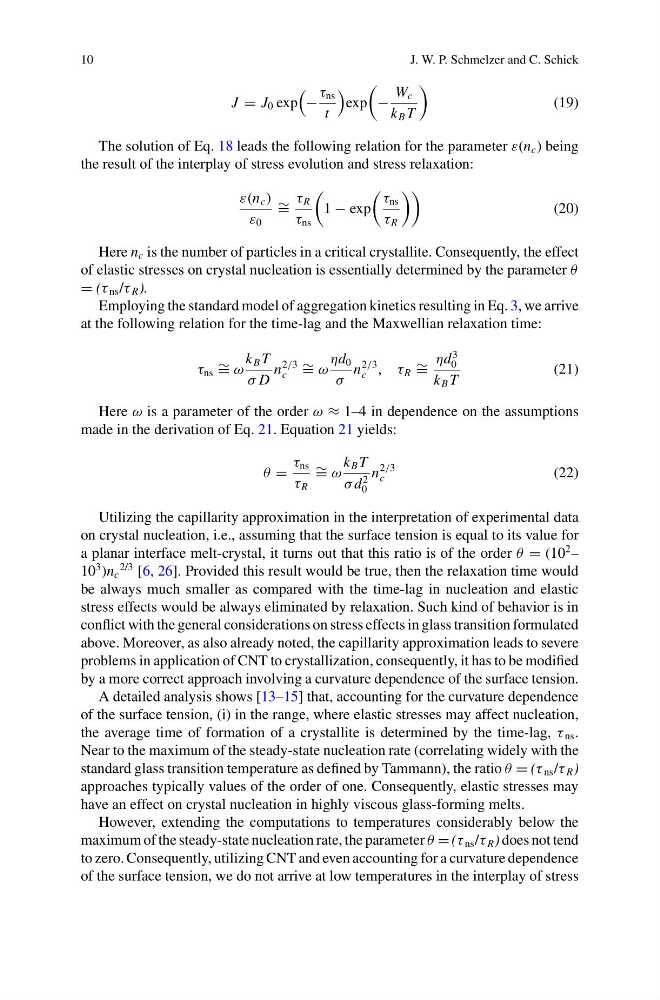
The solution of Eq. 18 leads the following relation for the parameter ε(n c ) being
the result of the interplay of stress evolution and stress relaxation:
ε(n c )
ε 0
∼ =
τ R
τ ns
1 − exp
τ ns
τ R
(20)
Here n c is the number of particles in a critical crystallite. Consequently, the effect
of elastic stresses on crystal nucleation is essentially determined by the parameter θ
= (τ ns /τ R ).
Employing the standard model of aggregation kinetics resulting in Eq. 3, we arrive
at the following relation for the time-lag and the Maxwellian relaxation time:
τ ns ∼ = ω
k B T
σ D
n
2/3
c
∼ = ω
ηd 0
σ
n
2/3
c , τ R ∼ =
ηd
3
0
k B T
(21)
Here ω is a parameter of the order ω ≈ 1–4 in dependence on the assumptions
made in the derivation of Eq. 21. Equation 21 yields:
θ =
τ ns
τ R
∼ = ω
k B T
σ d
2
0
n
2/3
c
(22)
Utilizing the capillarity approximation in the interpretation of experimental data
on crystal nucleation, i.e., assuming that the surface tension is equal to its value for
a planar interface melt-crystal, it turns out that this ratio is of the order θ = (10
2 –
10
3 )n c
2/3 [6, 26]. Provided this result would be true, then the relaxation time would
be always much smaller as compared with the time-lag in nucleation and elastic
stress effects would be always eliminated by relaxation. Such kind of behavior is in
conflict with the general considerations on stress effects in glass transition formulated
above. Moreover, as also already noted, the capillarity approximation leads to severe
problems in application of CNT to crystallization, consequently, it has to be modified
by a more correct approach involving a curvature dependence of the surface tension.
A detailed analysis shows [13–15] that, accounting for the curvature dependence
of the surface tension, (i) in the range, where elastic stresses may affect nucleation,
the average time of formation of a crystallite is determined by the time-lag, τ ns .
Near to the maximum of the steady-state nucleation rate (correlating widely with the
standard glass transition temperature as defined by Tammann), the ratio θ = (τ ns /τ R )
approaches typically values of the order of one. Consequently, elastic stresses may
have an effect on crystal nucleation in highly viscous glass-forming melts.
However, extending the computations to temperatures considerably below the
maximum of the steady-state nucleation rate, the parameter θ = (τ ns /τ R ) does not tend
to zero. Consequently, utilizing CNT and even accounting for a curvature dependence
of the surface tension, we do not arrive at low temperatures in the interplay of stress
J. W. P. Schmelzer and C. Schick
J = J 0 exp
−
τ ns
t
exp
−
W c
k B T
(19)
The solution of Eq. 18 leads the following relation for the parameter ε(n c ) being
the result of the interplay of stress evolution and stress relaxation:
ε(n c )
ε 0
∼ =
τ R
τ ns
1 − exp
τ ns
τ R
(20)
Here n c is the number of particles in a critical crystallite. Consequently, the effect
of elastic stresses on crystal nucleation is essentially determined by the parameter θ
= (τ ns /τ R ).
Employing the standard model of aggregation kinetics resulting in Eq. 3, we arrive
at the following relation for the time-lag and the Maxwellian relaxation time:
τ ns ∼ = ω
k B T
σ D
n
2/3
c
∼ = ω
ηd 0
σ
n
2/3
c , τ R ∼ =
ηd
3
0
k B T
(21)
Here ω is a parameter of the order ω ≈ 1–4 in dependence on the assumptions
made in the derivation of Eq. 21. Equation 21 yields:
θ =
τ ns
τ R
∼ = ω
k B T
σ d
2
0
n
2/3
c
(22)
Utilizing the capillarity approximation in the interpretation of experimental data
on crystal nucleation, i.e., assuming that the surface tension is equal to its value for
a planar interface melt-crystal, it turns out that this ratio is of the order θ = (10
2 –
10
3 )n c
2/3 [6, 26]. Provided this result would be true, then the relaxation time would
be always much smaller as compared with the time-lag in nucleation and elastic
stress effects would be always eliminated by relaxation. Such kind of behavior is in
conflict with the general considerations on stress effects in glass transition formulated
above. Moreover, as also already noted, the capillarity approximation leads to severe
problems in application of CNT to crystallization, consequently, it has to be modified
by a more correct approach involving a curvature dependence of the surface tension.
A detailed analysis shows [13–15] that, accounting for the curvature dependence
of the surface tension, (i) in the range, where elastic stresses may affect nucleation,
the average time of formation of a crystallite is determined by the time-lag, τ ns .
Near to the maximum of the steady-state nucleation rate (correlating widely with the
standard glass transition temperature as defined by Tammann), the ratio θ = (τ ns /τ R )
approaches typically values of the order of one. Consequently, elastic stresses may
have an effect on crystal nucleation in highly viscous glass-forming melts.
However, extending the computations to temperatures considerably below the
maximum of the steady-state nucleation rate, the parameter θ = (τ ns /τ R ) does not tend
to zero. Consequently, utilizing CNT and even accounting for a curvature dependence
of the surface tension, we do not arrive at low temperatures in the interplay of stress