

8
J. W. P. Schmelzer and C. Schick
δ
( p)
∞
∼ = σ ∞
T m α p (T m , p m )
v m h m
at T = T m
(14)
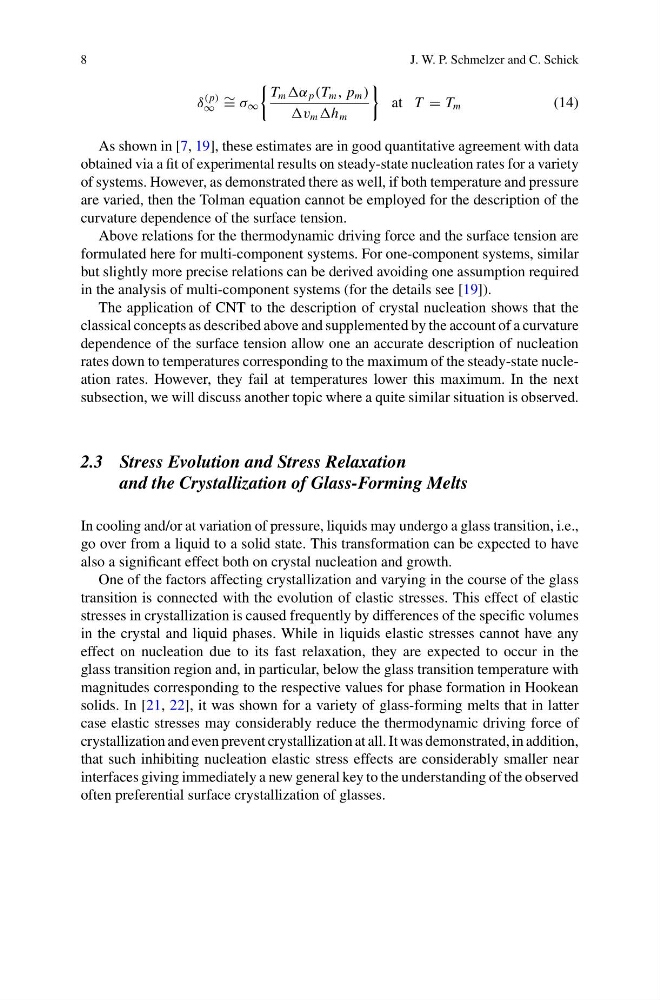
As shown in [7, 19], these estimates are in good quantitative agreement with data
obtained via a fit of experimental results on steady-state nucleation rates for a variety
of systems. However, as demonstrated there as well, if both temperature and pressure
are varied, then the Tolman equation cannot be employed for the description of the
curvature dependence of the surface tension.
Above relations for the thermodynamic driving force and the surface tension are
formulated here for multi-component systems. For one-component systems, similar
but slightly more precise relations can be derived avoiding one assumption required
in the analysis of multi-component systems (for the details see [19]).
The application of CNT to the description of crystal nucleation shows that the
classical concepts as described above and supplemented by the account of a curvature
dependence of the surface tension allow one an accurate description of nucleation
rates down to temperatures corresponding to the maximum of the steady-state nucleation rates. However, they fail at temperatures lower this maximum. In the next
subsection, we will discuss another topic where a quite similar situation is observed.
2.3 Stress Evolution and Stress Relaxation
and the Crystallization of Glass-Forming Melts
In cooling and/or at variation of pressure, liquids may undergo a glass transition, i.e.,
go over from a liquid to a solid state. This transformation can be expected to have
also a significant effect both on crystal nucleation and growth.
One of the factors affecting crystallization and varying in the course of the glass
transition is connected with the evolution of elastic stresses. This effect of elastic
stresses in crystallization is caused frequently by differences of the specific volumes
in the crystal and liquid phases. While in liquids elastic stresses cannot have any
effect on nucleation due to its fast relaxation, they are expected to occur in the
glass transition region and, in particular, below the glass transition temperature with
magnitudes corresponding to the respective values for phase formation in Hookean
solids. In [21, 22], it was shown for a variety of glass-forming melts that in latter
case elastic stresses may considerably reduce the thermodynamic driving force of
crystallization and even prevent crystallization at all. It was demonstrated, in addition,
that such inhibiting nucleation elastic stress effects are considerably smaller near
interfaces giving immediately a new general key to the understanding of the observed
often preferential surface crystallization of glasses.
J. W. P. Schmelzer and C. Schick
δ
( p)
∞
∼ = σ ∞
T m α p (T m , p m )
v m h m
at T = T m
(14)
As shown in [7, 19], these estimates are in good quantitative agreement with data
obtained via a fit of experimental results on steady-state nucleation rates for a variety
of systems. However, as demonstrated there as well, if both temperature and pressure
are varied, then the Tolman equation cannot be employed for the description of the
curvature dependence of the surface tension.
Above relations for the thermodynamic driving force and the surface tension are
formulated here for multi-component systems. For one-component systems, similar
but slightly more precise relations can be derived avoiding one assumption required
in the analysis of multi-component systems (for the details see [19]).
The application of CNT to the description of crystal nucleation shows that the
classical concepts as described above and supplemented by the account of a curvature
dependence of the surface tension allow one an accurate description of nucleation
rates down to temperatures corresponding to the maximum of the steady-state nucleation rates. However, they fail at temperatures lower this maximum. In the next
subsection, we will discuss another topic where a quite similar situation is observed.
2.3 Stress Evolution and Stress Relaxation
and the Crystallization of Glass-Forming Melts
In cooling and/or at variation of pressure, liquids may undergo a glass transition, i.e.,
go over from a liquid to a solid state. This transformation can be expected to have
also a significant effect both on crystal nucleation and growth.
One of the factors affecting crystallization and varying in the course of the glass
transition is connected with the evolution of elastic stresses. This effect of elastic
stresses in crystallization is caused frequently by differences of the specific volumes
in the crystal and liquid phases. While in liquids elastic stresses cannot have any
effect on nucleation due to its fast relaxation, they are expected to occur in the
glass transition region and, in particular, below the glass transition temperature with
magnitudes corresponding to the respective values for phase formation in Hookean
solids. In [21, 22], it was shown for a variety of glass-forming melts that in latter
case elastic stresses may considerably reduce the thermodynamic driving force of
crystallization and even prevent crystallization at all. It was demonstrated, in addition,
that such inhibiting nucleation elastic stress effects are considerably smaller near
interfaces giving immediately a new general key to the understanding of the observed
often preferential surface crystallization of glasses.