

162
K. Adrjanowicz and R. Richert
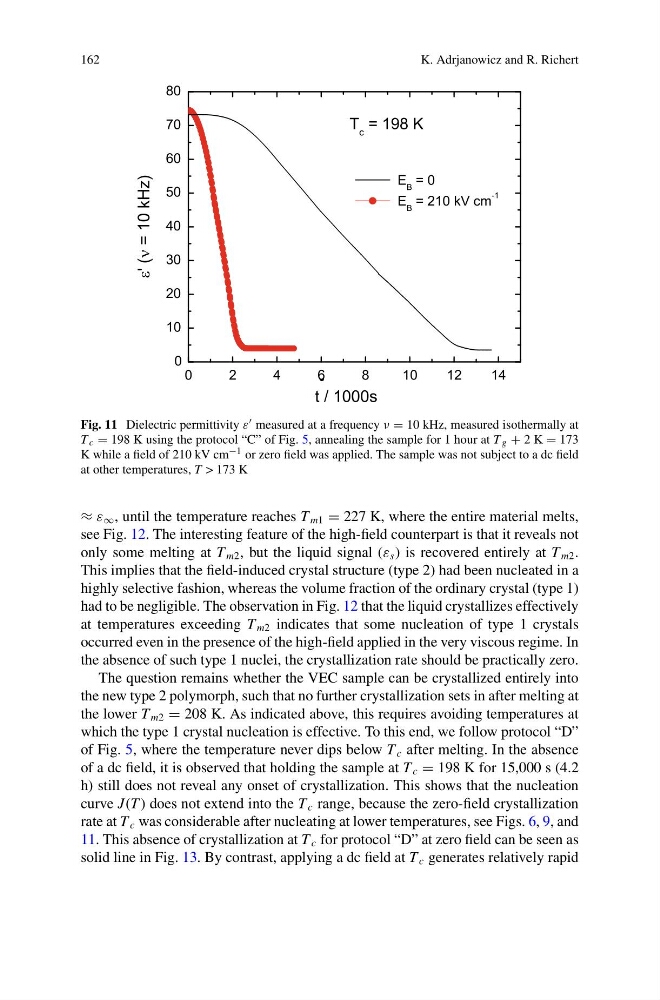
Fig. 11 Dielectric permittivity ε measured at a frequency ν = 10 kHz, measured isothermally at
T c = 198 K using the protocol “C” of Fig. 5, annealing the sample for 1 hour at T g + 2 K = 173
K while a field of 210 kV cm −1 or zero field was applied. The sample was not subject to a dc field
at other temperatures, T > 173 K
≈ ε ∞ , until the temperature reaches T m1 = 227 K, where the entire material melts,
see Fig. 12. The interesting feature of the high-field counterpart is that it reveals not
only some melting at T m2 , but the liquid signal (ε s ) is recovered entirely at T m2 .
This implies that the field-induced crystal structure (type 2) had been nucleated in a
highly selective fashion, whereas the volume fraction of the ordinary crystal (type 1)
had to be negligible. The observation in Fig. 12 that the liquid crystallizes effectively
at temperatures exceeding T m2 indicates that some nucleation of type 1 crystals
occurred even in the presence of the high-field applied in the very viscous regime. In
the absence of such type 1 nuclei, the crystallization rate should be practically zero.
The question remains whether the VEC sample can be crystallized entirely into
the new type 2 polymorph, such that no further crystallization sets in after melting at
the lower T m2 = 208 K. As indicated above, this requires avoiding temperatures at
which the type 1 crystal nucleation is effective. To this end, we follow protocol “D”
of Fig. 5, where the temperature never dips below T c after melting. In the absence
of a dc field, it is observed that holding the sample at T c = 198 K for 15,000 s (4.2
h) still does not reveal any onset of crystallization. This shows that the nucleation
curve J(T ) does not extend into the T c range, because the zero-field crystallization
rate at T c was considerable after nucleating at lower temperatures, see Figs. 6, 9, and
11. This absence of crystallization at T c for protocol “D” at zero field can be seen as
solid line in Fig. 13. By contrast, applying a dc field at T c generates relatively rapid
K. Adrjanowicz and R. Richert
Fig. 11 Dielectric permittivity ε measured at a frequency ν = 10 kHz, measured isothermally at
T c = 198 K using the protocol “C” of Fig. 5, annealing the sample for 1 hour at T g + 2 K = 173
K while a field of 210 kV cm −1 or zero field was applied. The sample was not subject to a dc field
at other temperatures, T > 173 K
≈ ε ∞ , until the temperature reaches T m1 = 227 K, where the entire material melts,
see Fig. 12. The interesting feature of the high-field counterpart is that it reveals not
only some melting at T m2 , but the liquid signal (ε s ) is recovered entirely at T m2 .
This implies that the field-induced crystal structure (type 2) had been nucleated in a
highly selective fashion, whereas the volume fraction of the ordinary crystal (type 1)
had to be negligible. The observation in Fig. 12 that the liquid crystallizes effectively
at temperatures exceeding T m2 indicates that some nucleation of type 1 crystals
occurred even in the presence of the high-field applied in the very viscous regime. In
the absence of such type 1 nuclei, the crystallization rate should be practically zero.
The question remains whether the VEC sample can be crystallized entirely into
the new type 2 polymorph, such that no further crystallization sets in after melting at
the lower T m2 = 208 K. As indicated above, this requires avoiding temperatures at
which the type 1 crystal nucleation is effective. To this end, we follow protocol “D”
of Fig. 5, where the temperature never dips below T c after melting. In the absence
of a dc field, it is observed that holding the sample at T c = 198 K for 15,000 s (4.2
h) still does not reveal any onset of crystallization. This shows that the nucleation
curve J(T ) does not extend into the T c range, because the zero-field crystallization
rate at T c was considerable after nucleating at lower temperatures, see Figs. 6, 9, and
11. This absence of crystallization at T c for protocol “D” at zero field can be seen as
solid line in Fig. 13. By contrast, applying a dc field at T c generates relatively rapid