

158
K. Adrjanowicz and R. Richert
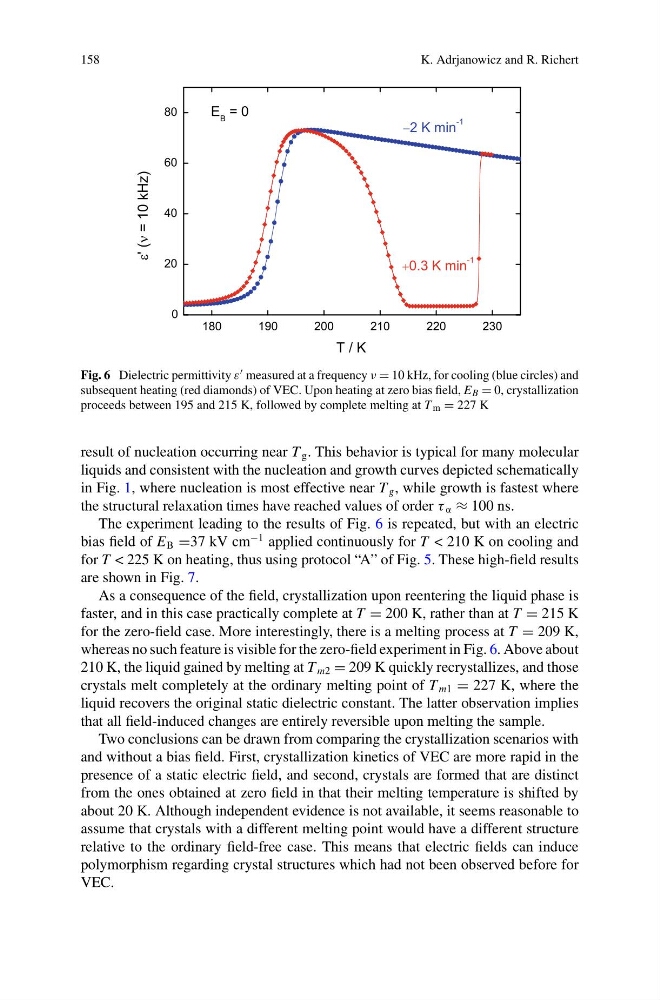
Fig. 6 Dielectric permittivity ε measured at a frequency ν = 10 kHz, for cooling (blue circles) and
subsequent heating (red diamonds) of VEC. Upon heating at zero bias field, E B = 0, crystallization
proceeds between 195 and 215 K, followed by complete melting at T m = 227 K
result of nucleation occurring near T g . This behavior is typical for many molecular
liquids and consistent with the nucleation and growth curves depicted schematically
in Fig. 1, where nucleation is most effective near T g , while growth is fastest where
the structural relaxation times have reached values of order τ α ≈ 100 ns.
The experiment leading to the results of Fig. 6 is repeated, but with an electric
bias field of E B =37 kV cm
−1 applied continuously for T < 210 K on cooling and
for T < 225 K on heating, thus using protocol “A” of Fig. 5. These high-field results
are shown in Fig. 7.
As a consequence of the field, crystallization upon reentering the liquid phase is
faster, and in this case practically complete at T = 200 K, rather than at T = 215 K
for the zero-field case. More interestingly, there is a melting process at T = 209 K,
whereas no such feature is visible for the zero-field experiment in Fig. 6. Above about
210 K, the liquid gained by melting at T m2 = 209 K quickly recrystallizes, and those
crystals melt completely at the ordinary melting point of T m1 = 227 K, where the
liquid recovers the original static dielectric constant. The latter observation implies
that all field-induced changes are entirely reversible upon melting the sample.
Two conclusions can be drawn from comparing the crystallization scenarios with
and without a bias field. First, crystallization kinetics of VEC are more rapid in the
presence of a static electric field, and second, crystals are formed that are distinct
from the ones obtained at zero field in that their melting temperature is shifted by
about 20 K. Although independent evidence is not available, it seems reasonable to
assume that crystals with a different melting point would have a different structure
relative to the ordinary field-free case. This means that electric fields can induce
polymorphism regarding crystal structures which had not been observed before for
VEC.
K. Adrjanowicz and R. Richert
Fig. 6 Dielectric permittivity ε measured at a frequency ν = 10 kHz, for cooling (blue circles) and
subsequent heating (red diamonds) of VEC. Upon heating at zero bias field, E B = 0, crystallization
proceeds between 195 and 215 K, followed by complete melting at T m = 227 K
result of nucleation occurring near T g . This behavior is typical for many molecular
liquids and consistent with the nucleation and growth curves depicted schematically
in Fig. 1, where nucleation is most effective near T g , while growth is fastest where
the structural relaxation times have reached values of order τ α ≈ 100 ns.
The experiment leading to the results of Fig. 6 is repeated, but with an electric
bias field of E B =37 kV cm
−1 applied continuously for T < 210 K on cooling and
for T < 225 K on heating, thus using protocol “A” of Fig. 5. These high-field results
are shown in Fig. 7.
As a consequence of the field, crystallization upon reentering the liquid phase is
faster, and in this case practically complete at T = 200 K, rather than at T = 215 K
for the zero-field case. More interestingly, there is a melting process at T = 209 K,
whereas no such feature is visible for the zero-field experiment in Fig. 6. Above about
210 K, the liquid gained by melting at T m2 = 209 K quickly recrystallizes, and those
crystals melt completely at the ordinary melting point of T m1 = 227 K, where the
liquid recovers the original static dielectric constant. The latter observation implies
that all field-induced changes are entirely reversible upon melting the sample.
Two conclusions can be drawn from comparing the crystallization scenarios with
and without a bias field. First, crystallization kinetics of VEC are more rapid in the
presence of a static electric field, and second, crystals are formed that are distinct
from the ones obtained at zero field in that their melting temperature is shifted by
about 20 K. Although independent evidence is not available, it seems reasonable to
assume that crystals with a different melting point would have a different structure
relative to the ordinary field-free case. This means that electric fields can induce
polymorphism regarding crystal structures which had not been observed before for
VEC.