

Ordering Transitions in Short-Chain Alcohols
111
general phenomenon in the field of semi-crystalline polymers [68]. Here, the stability
of this residual relaxation was confirmed over more than 24 h without any indication
of losing intensity, broadening, or shifting in frequency. It is worth mentioning that
the dynamics of this remaining liquid phase was studied as a function of temperature
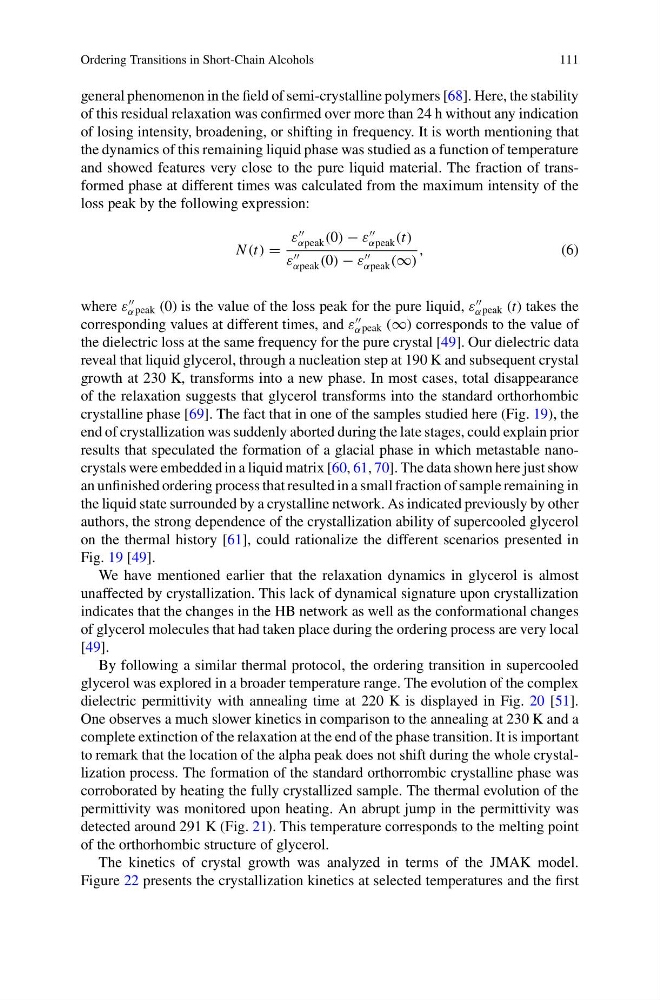
and showed features very close to the pure liquid material. The fraction of transformed phase at different times was calculated from the maximum intensity of the
loss peak by the following expression:
N (t) =
ε
αpeak (0) − ε
αpeak (t)
ε
αpeak (0) − ε
αpeak (∞)
,
(6)
where ε
α peak (0) is the value of the loss peak for the pure liquid, ε
α peak (t) takes the
corresponding values at different times, and ε
α peak (∞) corresponds to the value of
the dielectric loss at the same frequency for the pure crystal [49]. Our dielectric data
reveal that liquid glycerol, through a nucleation step at 190 K and subsequent crystal
growth at 230 K, transforms into a new phase. In most cases, total disappearance
of the relaxation suggests that glycerol transforms into the standard orthorhombic
crystalline phase [69]. The fact that in one of the samples studied here (Fig. 19), the
end of crystallization was suddenly aborted during the late stages, could explain prior
results that speculated the formation of a glacial phase in which metastable nanocrystals were embedded in a liquid matrix [60, 61, 70]. The data shown here just show
an unfinished ordering process that resulted in a small fraction of sample remaining in
the liquid state surrounded by a crystalline network. As indicated previously by other
authors, the strong dependence of the crystallization ability of supercooled glycerol
on the thermal history [61], could rationalize the different scenarios presented in
Fig. 19 [49].
We have mentioned earlier that the relaxation dynamics in glycerol is almost
unaffected by crystallization. This lack of dynamical signature upon crystallization
indicates that the changes in the HB network as well as the conformational changes
of glycerol molecules that had taken place during the ordering process are very local
[49].
By following a similar thermal protocol, the ordering transition in supercooled
glycerol was explored in a broader temperature range. The evolution of the complex
dielectric permittivity with annealing time at 220 K is displayed in Fig. 20 [51].
One observes a much slower kinetics in comparison to the annealing at 230 K and a
complete extinction of the relaxation at the end of the phase transition. It is important
to remark that the location of the alpha peak does not shift during the whole crystallization process. The formation of the standard orthorrombic crystalline phase was
corroborated by heating the fully crystallized sample. The thermal evolution of the
permittivity was monitored upon heating. An abrupt jump in the permittivity was
detected around 291 K (Fig. 21). This temperature corresponds to the melting point
of the orthorhombic structure of glycerol.
The kinetics of crystal growth was analyzed in terms of the JMAK model.
Figure 22 presents the crystallization kinetics at selected temperatures and the first
111
general phenomenon in the field of semi-crystalline polymers [68]. Here, the stability
of this residual relaxation was confirmed over more than 24 h without any indication
of losing intensity, broadening, or shifting in frequency. It is worth mentioning that
the dynamics of this remaining liquid phase was studied as a function of temperature
and showed features very close to the pure liquid material. The fraction of transformed phase at different times was calculated from the maximum intensity of the
loss peak by the following expression:
N (t) =
ε
αpeak (0) − ε
αpeak (t)
ε
αpeak (0) − ε
αpeak (∞)
,
(6)
where ε
α peak (0) is the value of the loss peak for the pure liquid, ε
α peak (t) takes the
corresponding values at different times, and ε
α peak (∞) corresponds to the value of
the dielectric loss at the same frequency for the pure crystal [49]. Our dielectric data
reveal that liquid glycerol, through a nucleation step at 190 K and subsequent crystal
growth at 230 K, transforms into a new phase. In most cases, total disappearance
of the relaxation suggests that glycerol transforms into the standard orthorhombic
crystalline phase [69]. The fact that in one of the samples studied here (Fig. 19), the
end of crystallization was suddenly aborted during the late stages, could explain prior
results that speculated the formation of a glacial phase in which metastable nanocrystals were embedded in a liquid matrix [60, 61, 70]. The data shown here just show
an unfinished ordering process that resulted in a small fraction of sample remaining in
the liquid state surrounded by a crystalline network. As indicated previously by other
authors, the strong dependence of the crystallization ability of supercooled glycerol
on the thermal history [61], could rationalize the different scenarios presented in
Fig. 19 [49].
We have mentioned earlier that the relaxation dynamics in glycerol is almost
unaffected by crystallization. This lack of dynamical signature upon crystallization
indicates that the changes in the HB network as well as the conformational changes
of glycerol molecules that had taken place during the ordering process are very local
[49].
By following a similar thermal protocol, the ordering transition in supercooled
glycerol was explored in a broader temperature range. The evolution of the complex
dielectric permittivity with annealing time at 220 K is displayed in Fig. 20 [51].
One observes a much slower kinetics in comparison to the annealing at 230 K and a
complete extinction of the relaxation at the end of the phase transition. It is important
to remark that the location of the alpha peak does not shift during the whole crystallization process. The formation of the standard orthorrombic crystalline phase was
corroborated by heating the fully crystallized sample. The thermal evolution of the
permittivity was monitored upon heating. An abrupt jump in the permittivity was
detected around 291 K (Fig. 21). This temperature corresponds to the melting point
of the orthorhombic structure of glycerol.
The kinetics of crystal growth was analyzed in terms of the JMAK model.
Figure 22 presents the crystallization kinetics at selected temperatures and the first