

110
A. Sanz
remark that the location of the alpha peak remained unchanged during the whole
process, suggesting that the intrinsic nature of the structural relaxation of glycerol
remains unaltered in the course of crystallization.
Over the past years, the solidification of glycerol near T g has been the subject
of discussion and some authors have speculated on the existence of a glacial phase
[60], similar to that shown by other molecular liquids such as triphenyl phosphate
and n-butanol [64–66]. Elucidating the microscopic structure of the glacial phase
in those systems has been the subject of intense research activity during the past
decades [64, 65, 67]. Either a second amorphous state or a frustrated crystal with a
high degree of defects and disorder could explain the existence of the so-called glacial
phases. Two years later, by employing time-resolved neutron scattering, Yuan and
co-authors [61] aimed to unravel the structural nature of this solid-like in glycerol,
revealing, in agreement with one of the interpretations given by Möbius et al., the
formation of nano-crystals at temperatures near T g .
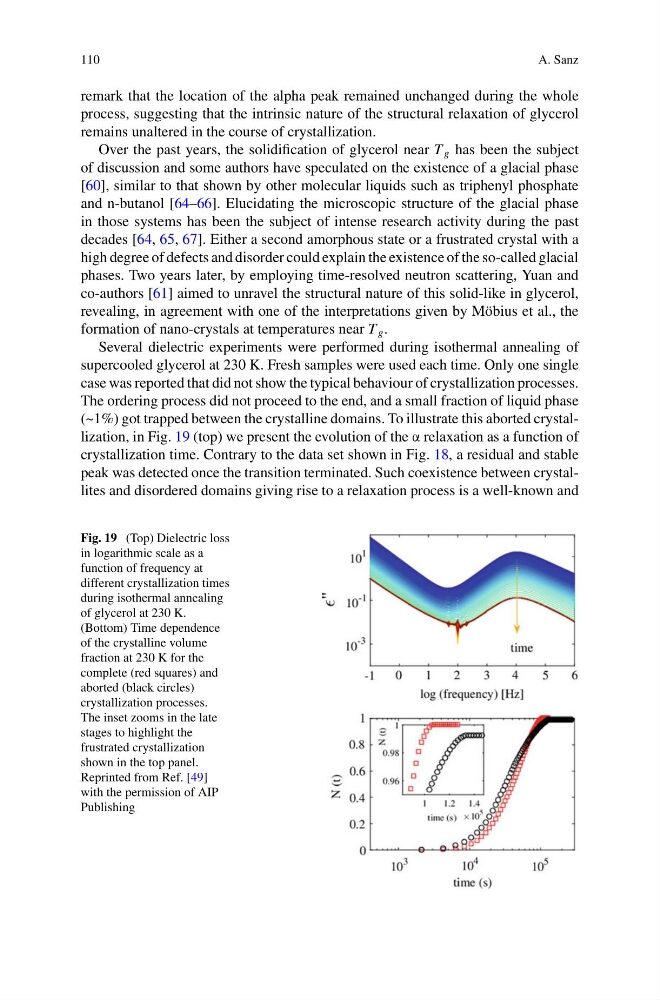
Several dielectric experiments were performed during isothermal annealing of
supercooled glycerol at 230 K. Fresh samples were used each time. Only one single
case was reported that did not show the typical behaviour of crystallization processes.
The ordering process did not proceed to the end, and a small fraction of liquid phase
(~1%) got trapped between the crystalline domains. To illustrate this aborted crystallization, in Fig. 19 (top) we present the evolution of the α relaxation as a function of
crystallization time. Contrary to the data set shown in Fig. 18, a residual and stable
peak was detected once the transition terminated. Such coexistence between crystallites and disordered domains giving rise to a relaxation process is a well-known and
Fig. 19 (Top) Dielectric loss
in logarithmic scale as a
function of frequency at
different crystallization times
during isothermal annealing
of glycerol at 230 K.
(Bottom) Time dependence
of the crystalline volume
fraction at 230 K for the
complete (red squares) and
aborted (black circles)
crystallization processes.
The inset zooms in the late
stages to highlight the
frustrated crystallization
shown in the top panel.
Reprinted from Ref. [49]
with the permission of AIP
Publishing
A. Sanz
remark that the location of the alpha peak remained unchanged during the whole
process, suggesting that the intrinsic nature of the structural relaxation of glycerol
remains unaltered in the course of crystallization.
Over the past years, the solidification of glycerol near T g has been the subject
of discussion and some authors have speculated on the existence of a glacial phase
[60], similar to that shown by other molecular liquids such as triphenyl phosphate
and n-butanol [64–66]. Elucidating the microscopic structure of the glacial phase
in those systems has been the subject of intense research activity during the past
decades [64, 65, 67]. Either a second amorphous state or a frustrated crystal with a
high degree of defects and disorder could explain the existence of the so-called glacial
phases. Two years later, by employing time-resolved neutron scattering, Yuan and
co-authors [61] aimed to unravel the structural nature of this solid-like in glycerol,
revealing, in agreement with one of the interpretations given by Möbius et al., the
formation of nano-crystals at temperatures near T g .
Several dielectric experiments were performed during isothermal annealing of
supercooled glycerol at 230 K. Fresh samples were used each time. Only one single
case was reported that did not show the typical behaviour of crystallization processes.
The ordering process did not proceed to the end, and a small fraction of liquid phase
(~1%) got trapped between the crystalline domains. To illustrate this aborted crystallization, in Fig. 19 (top) we present the evolution of the α relaxation as a function of
crystallization time. Contrary to the data set shown in Fig. 18, a residual and stable
peak was detected once the transition terminated. Such coexistence between crystallites and disordered domains giving rise to a relaxation process is a well-known and
Fig. 19 (Top) Dielectric loss
in logarithmic scale as a
function of frequency at
different crystallization times
during isothermal annealing
of glycerol at 230 K.
(Bottom) Time dependence
of the crystalline volume
fraction at 230 K for the
complete (red squares) and
aborted (black circles)
crystallization processes.
The inset zooms in the late
stages to highlight the
frustrated crystallization
shown in the top panel.
Reprinted from Ref. [49]
with the permission of AIP
Publishing