

108
A. Sanz
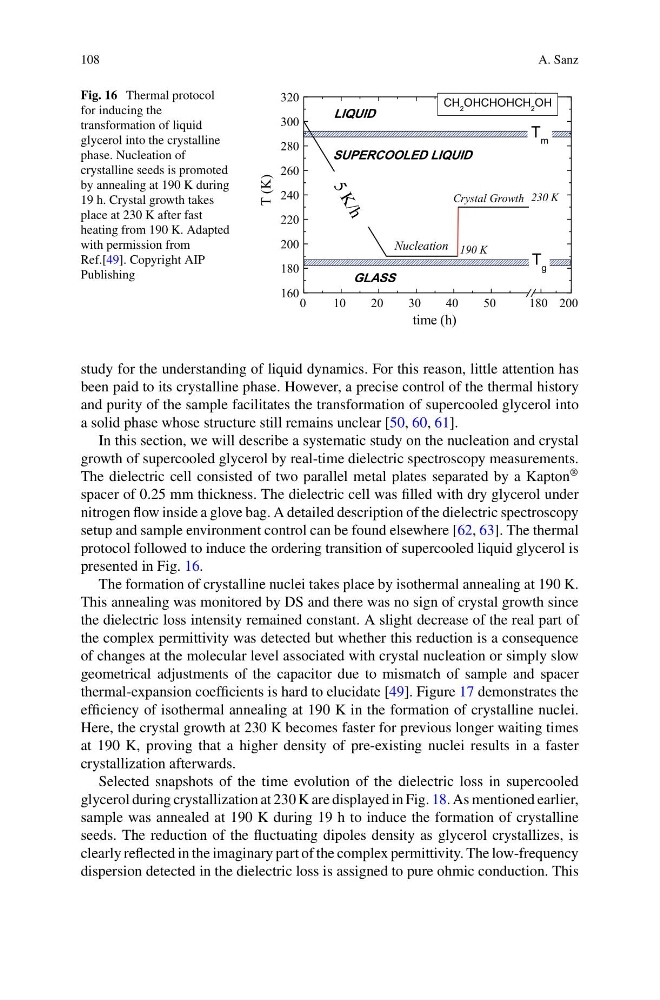
Fig. 16 Thermal protocol
for inducing the
transformation of liquid
glycerol into the crystalline
phase. Nucleation of
crystalline seeds is promoted
by annealing at 190 K during
19 h. Crystal growth takes
place at 230 K after fast
heating from 190 K. Adapted
with permission from
Ref.[49]. Copyright AIP
Publishing
0
10
20
30
40
50
180 200
160
180
200
220
240
260
280
300
320
230 K
GLASS
SUPERCOOLED LIQUID
Crystal Growth
5 K / h
T (K)
time (h)
Nucleation
LIQUID
T m
T g
190 K
CH 2 OHCHOHCH 2 OH
study for the understanding of liquid dynamics. For this reason, little attention has
been paid to its crystalline phase. However, a precise control of the thermal history
and purity of the sample facilitates the transformation of supercooled glycerol into
a solid phase whose structure still remains unclear [50, 60, 61].
In this section, we will describe a systematic study on the nucleation and crystal
growth of supercooled glycerol by real-time dielectric spectroscopy measurements.
The dielectric cell consisted of two parallel metal plates separated by a Kapton
®
spacer of 0.25 mm thickness. The dielectric cell was filled with dry glycerol under
nitrogen flow inside a glove bag. A detailed description of the dielectric spectroscopy
setup and sample environment control can be found elsewhere [62, 63]. The thermal
protocol followed to induce the ordering transition of supercooled liquid glycerol is
presented in Fig. 16.
The formation of crystalline nuclei takes place by isothermal annealing at 190 K.
This annealing was monitored by DS and there was no sign of crystal growth since
the dielectric loss intensity remained constant. A slight decrease of the real part of
the complex permittivity was detected but whether this reduction is a consequence
of changes at the molecular level associated with crystal nucleation or simply slow
geometrical adjustments of the capacitor due to mismatch of sample and spacer
thermal-expansion coefficients is hard to elucidate [49]. Figure 17 demonstrates the
efficiency of isothermal annealing at 190 K in the formation of crystalline nuclei.
Here, the crystal growth at 230 K becomes faster for previous longer waiting times
at 190 K, proving that a higher density of pre-existing nuclei results in a faster
crystallization afterwards.
Selected snapshots of the time evolution of the dielectric loss in supercooled
glycerol during crystallization at 230 K are displayed in Fig. 18. As mentioned earlier,
sample was annealed at 190 K during 19 h to induce the formation of crystalline
seeds. The reduction of the fluctuating dipoles density as glycerol crystallizes, is
clearly reflected in the imaginary part of the complex permittivity. The low-frequency
dispersion detected in the dielectric loss is assigned to pure ohmic conduction. This
A. Sanz
Fig. 16 Thermal protocol
for inducing the
transformation of liquid
glycerol into the crystalline
phase. Nucleation of
crystalline seeds is promoted
by annealing at 190 K during
19 h. Crystal growth takes
place at 230 K after fast
heating from 190 K. Adapted
with permission from
Ref.[49]. Copyright AIP
Publishing
0
10
20
30
40
50
180 200
160
180
200
220
240
260
280
300
320
230 K
GLASS
SUPERCOOLED LIQUID
Crystal Growth
5 K / h
T (K)
time (h)
Nucleation
LIQUID
T m
T g
190 K
CH 2 OHCHOHCH 2 OH
study for the understanding of liquid dynamics. For this reason, little attention has
been paid to its crystalline phase. However, a precise control of the thermal history
and purity of the sample facilitates the transformation of supercooled glycerol into
a solid phase whose structure still remains unclear [50, 60, 61].
In this section, we will describe a systematic study on the nucleation and crystal
growth of supercooled glycerol by real-time dielectric spectroscopy measurements.
The dielectric cell consisted of two parallel metal plates separated by a Kapton
®
spacer of 0.25 mm thickness. The dielectric cell was filled with dry glycerol under
nitrogen flow inside a glove bag. A detailed description of the dielectric spectroscopy
setup and sample environment control can be found elsewhere [62, 63]. The thermal
protocol followed to induce the ordering transition of supercooled liquid glycerol is
presented in Fig. 16.
The formation of crystalline nuclei takes place by isothermal annealing at 190 K.
This annealing was monitored by DS and there was no sign of crystal growth since
the dielectric loss intensity remained constant. A slight decrease of the real part of
the complex permittivity was detected but whether this reduction is a consequence
of changes at the molecular level associated with crystal nucleation or simply slow
geometrical adjustments of the capacitor due to mismatch of sample and spacer
thermal-expansion coefficients is hard to elucidate [49]. Figure 17 demonstrates the
efficiency of isothermal annealing at 190 K in the formation of crystalline nuclei.
Here, the crystal growth at 230 K becomes faster for previous longer waiting times
at 190 K, proving that a higher density of pre-existing nuclei results in a faster
crystallization afterwards.
Selected snapshots of the time evolution of the dielectric loss in supercooled
glycerol during crystallization at 230 K are displayed in Fig. 18. As mentioned earlier,
sample was annealed at 190 K during 19 h to induce the formation of crystalline
seeds. The reduction of the fluctuating dipoles density as glycerol crystallizes, is
clearly reflected in the imaginary part of the complex permittivity. The low-frequency
dispersion detected in the dielectric loss is assigned to pure ohmic conduction. This