

Ordering Transitions in Short-Chain Alcohols
103
10
-2
10
-1
10
0
10
1
10
2
Experimental
fit
SCL
Precursor
PC
105 K
2.5 h
(arb. units)
F (Hz)
(a)
0.0
0.2
0.4
0.6
0.8
1.0
-0.4
0.0
0.4
log
τ
PRECURSOR
(s)
N PC
(d)
0.0
0.2
0.4
0.6
0.8
1.0
0.0
0.2
0.4
0.6
0.8
1.0
N PC
(c)
SCL
Precursor
N (t)
0
2
4
6
8 10 12 14 16
0.0
0.2
0.4
0.6
0.8
1.0
PC (ND)
SCL (DS)
Precursor (DS)
Total Δε (DS)
N (t)
time (h)
(b)
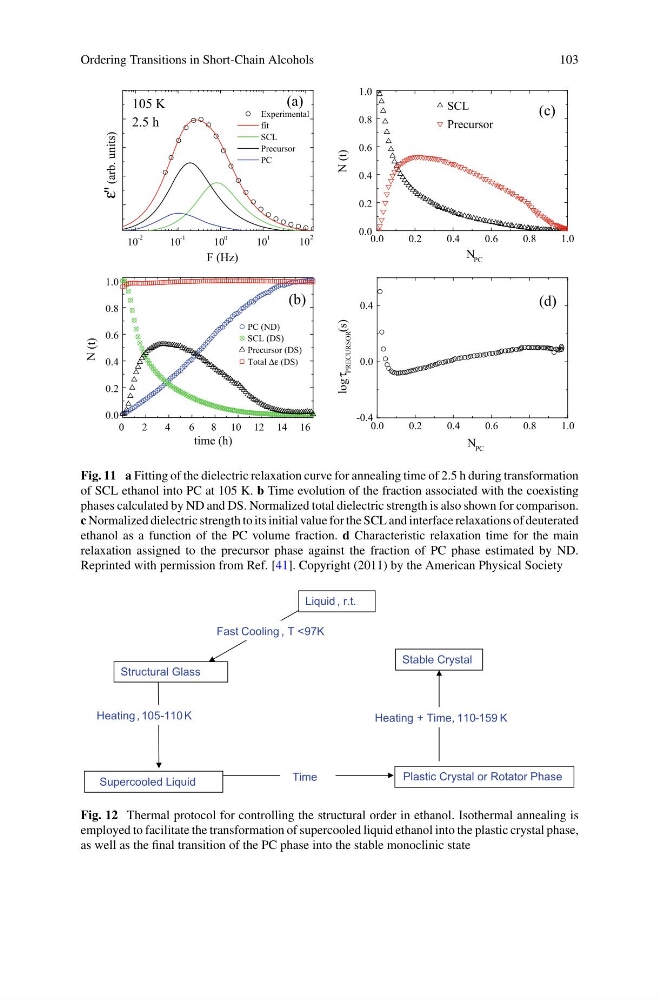
Fig. 11 a Fitting of the dielectric relaxation curve for annealing time of 2.5 h during transformation
of SCL ethanol into PC at 105 K. b Time evolution of the fraction associated with the coexisting
phases calculated by ND and DS. Normalized total dielectric strength is also shown for comparison.
c Normalized dielectric strength to its initial value for the SCL and interface relaxations of deuterated
ethanol as a function of the PC volume fraction. d Characteristic relaxation time for the main
relaxation assigned to the precursor phase against the fraction of PC phase estimated by ND.
Reprinted with permission from Ref. [41]. Copyright (2011) by the American Physical Society
Fast Cooling , T < 97K
Liquid , r.t.
Heating , 105-110 K
Time
Plastic Crystal or Rotator Phase
Heating + Time, 110-159 K
Stable Crystal
Supercooled Liquid
Structural Glass
Fig. 12 Thermal protocol for controlling the structural order in ethanol. Isothermal annealing is
employed to facilitate the transformation of supercooled liquid ethanol into the plastic crystal phase,
as well as the final transition of the PC phase into the stable monoclinic state
103
10
-2
10
-1
10
0
10
1
10
2
Experimental
fit
SCL
Precursor
PC
105 K
2.5 h
(arb. units)
F (Hz)
(a)
0.0
0.2
0.4
0.6
0.8
1.0
-0.4
0.0
0.4
log
τ
PRECURSOR
(s)
N PC
(d)
0.0
0.2
0.4
0.6
0.8
1.0
0.0
0.2
0.4
0.6
0.8
1.0
N PC
(c)
SCL
Precursor
N (t)
0
2
4
6
8 10 12 14 16
0.0
0.2
0.4
0.6
0.8
1.0
PC (ND)
SCL (DS)
Precursor (DS)
Total Δε (DS)
N (t)
time (h)
(b)
Fig. 11 a Fitting of the dielectric relaxation curve for annealing time of 2.5 h during transformation
of SCL ethanol into PC at 105 K. b Time evolution of the fraction associated with the coexisting
phases calculated by ND and DS. Normalized total dielectric strength is also shown for comparison.
c Normalized dielectric strength to its initial value for the SCL and interface relaxations of deuterated
ethanol as a function of the PC volume fraction. d Characteristic relaxation time for the main
relaxation assigned to the precursor phase against the fraction of PC phase estimated by ND.
Reprinted with permission from Ref. [41]. Copyright (2011) by the American Physical Society
Fast Cooling , T < 97K
Liquid , r.t.
Heating , 105-110 K
Time
Plastic Crystal or Rotator Phase
Heating + Time, 110-159 K
Stable Crystal
Supercooled Liquid
Structural Glass
Fig. 12 Thermal protocol for controlling the structural order in ethanol. Isothermal annealing is
employed to facilitate the transformation of supercooled liquid ethanol into the plastic crystal phase,
as well as the final transition of the PC phase into the stable monoclinic state