

86
K. K. Leelamma
3 q-Anharmonic Oscillator (q-AO) with quartic Interaction
The q-deformation of an anharmonic oscillator with quartic interaction is studied in
the first-order perturbation theory and the energy spectrum is investigated using the
boson realisation of the unperturbed q-oscillator eigenstates. The partition function,
entropy and free energy are also evaluated [18].
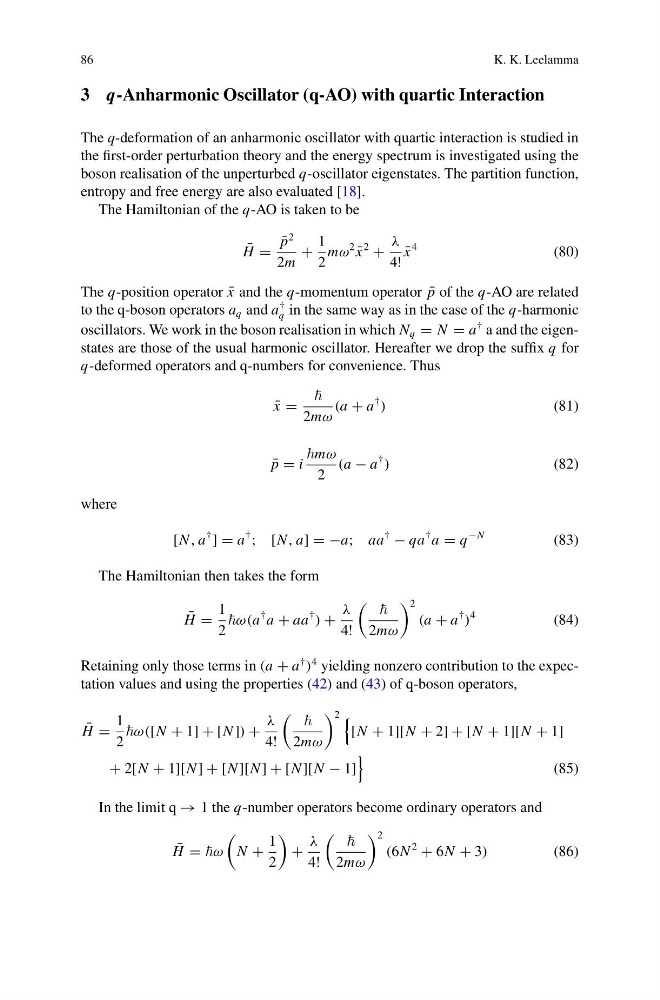
The Hamiltonian of the q-AO is taken to be
¯
H =
¯
p
2
2m
+
1
2
mω
2
¯
x
2
+
λ
4!
¯
x
4
(80)
The q-position operator ¯
x and the q-momentum operator ¯
p of the q-AO are related
to the q-boson operators a q and a
†
q in the same way as in the case of the q-harmonic
oscillators. We work in the boson realisation in which N q = N = a
† a and the eigenstates are those of the usual harmonic oscillator. Hereafter we drop the suffix q for
q-deformed operators and q-numbers for convenience. Thus
¯
x =
2mω
(a + a
†
)
(81)
¯
p = i
mω
2
(a − a
†
)
(82)
where
[N , a
†
] = a
†
; [N , a] = −a; aa
†
− qa
† a = q
−N
(83)
The Hamiltonian then takes the form
¯
H =
1
2
ω(a
† a + aa
†
) +
λ
4!
2mω
2
(a + a
†
)
4
(84)
Retaining only those terms in (a + a
†
)
4 yielding nonzero contribution to the expectation values and using the properties (42) and (43) of q-boson operators,
¯
H =
1
2
ω([N + 1] + [N ]) +
λ
4!
2mω
2
[N + 1][N + 2] + [N + 1][N + 1]
+ 2[N + 1][N ] + [N ][N ] + [N ][N − 1]
(85)
In the limit q → 1 the q-number operators become ordinary operators and
¯
H = ω
N +
1
2
+
λ
4!
2mω
2
(6N
2
+ 6N + 3)
(86)
K. K. Leelamma
3 q-Anharmonic Oscillator (q-AO) with quartic Interaction
The q-deformation of an anharmonic oscillator with quartic interaction is studied in
the first-order perturbation theory and the energy spectrum is investigated using the
boson realisation of the unperturbed q-oscillator eigenstates. The partition function,
entropy and free energy are also evaluated [18].
The Hamiltonian of the q-AO is taken to be
¯
H =
¯
p
2
2m
+
1
2
mω
2
¯
x
2
+
λ
4!
¯
x
4
(80)
The q-position operator ¯
x and the q-momentum operator ¯
p of the q-AO are related
to the q-boson operators a q and a
†
q in the same way as in the case of the q-harmonic
oscillators. We work in the boson realisation in which N q = N = a
† a and the eigenstates are those of the usual harmonic oscillator. Hereafter we drop the suffix q for
q-deformed operators and q-numbers for convenience. Thus
¯
x =
2mω
(a + a
†
)
(81)
¯
p = i
mω
2
(a − a
†
)
(82)
where
[N , a
†
] = a
†
; [N , a] = −a; aa
†
− qa
† a = q
−N
(83)
The Hamiltonian then takes the form
¯
H =
1
2
ω(a
† a + aa
†
) +
λ
4!
2mω
2
(a + a
†
)
4
(84)
Retaining only those terms in (a + a
†
)
4 yielding nonzero contribution to the expectation values and using the properties (42) and (43) of q-boson operators,
¯
H =
1
2
ω([N + 1] + [N ]) +
λ
4!
2mω
2
[N + 1][N + 2] + [N + 1][N + 1]
+ 2[N + 1][N ] + [N ][N ] + [N ][N − 1]
(85)
In the limit q → 1 the q-number operators become ordinary operators and
¯
H = ω
N +
1
2
+
λ
4!
2mω
2
(6N
2
+ 6N + 3)
(86)