

q-Oscillators and a q-deformed Debye Model for Lattice Heat Capacity
87
which is the same as the Hamiltonian of the ordinary anharmonic oscillator. To get
an explicit expression for the Hamiltonian ¯
H of the q-AO, we consider only slight
deformations for which q is very close to unity or η is very close to zero. Also q is
chosen to be real of the form q = e
η . Then
[N ] =
sinh(N η)
sinh(η)
(87)
The hyperbolic functions are expanded in Taylor series in powers of η and we retain
only terms upto O(η
2
) in ¯
H . The Hamiltonian for the slightly deformed anharmonic
oscillator (SDAO) is obtained as
¯
H S D AO =
1
2
ω(2N + 1) +
η
2
3!
1
2
ω((N + 1)
3
+ N
3
− (2N + 1))
+
λ
4!
2mω
2
(6N
2
+ 6N + 3)
+
η
2
3!
λ
4!
2mω
2
(12N
4
+ 24N
3
+ 36N
2
+ 24N + 6)
= H 0 +
η
2
3!
H 1 + H
+
η
2
3!
H
(88)
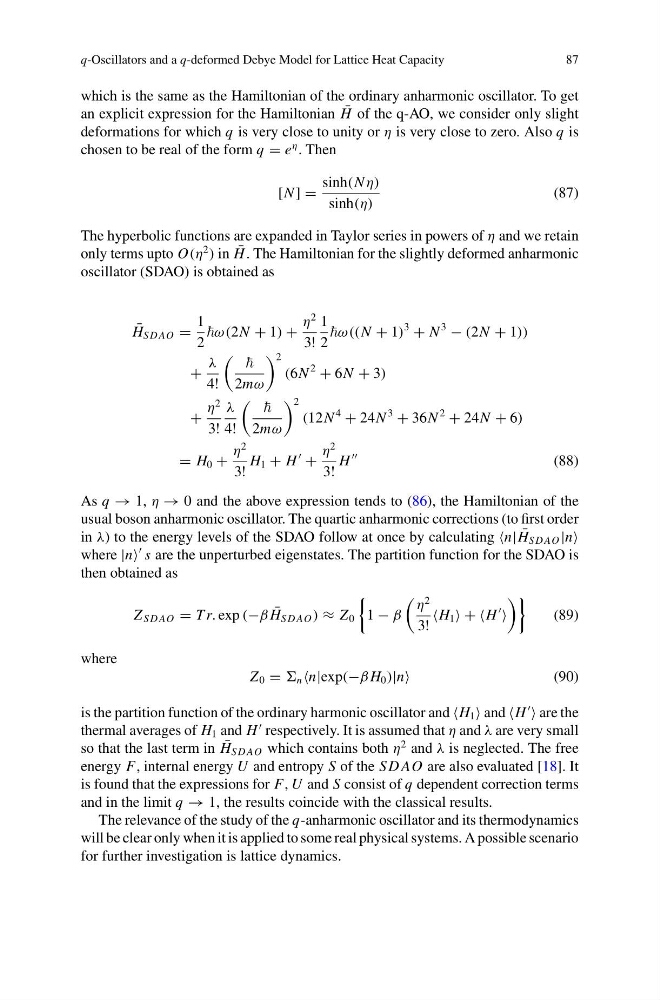
As q → 1, η → 0 and the above expression tends to (86), the Hamiltonian of the
usual boson anharmonic oscillator. The quartic anharmonic corrections (to first order
in λ) to the energy levels of the SDAO follow at once by calculating n| ¯
H S D AO |n
where |n
s are the unperturbed eigenstates. The partition function for the SDAO is
then obtained as
Z S D AO = T r. exp (−β ¯
H S D AO ) ≈ Z 0
1 − β
η
2
3!
H 1 + +H
(89)
where
Z 0 = n n|exp(−β H 0 )|n
(90)
is the partition function of the ordinary harmonic oscillator and H 1 and H
are the
thermal averages of H 1 and H
respectively. It is assumed that η and λ are very small
so that the last term in ¯
H S D AO which contains both η
2 and λ is neglected. The free
energy F, internal energy U and entropy S of the S D AO are also evaluated [18]. It
is found that the expressions for F, U and S consist of q dependent correction terms
and in the limit q → 1, the results coincide with the classical results.
The relevance of the study of the q-anharmonic oscillator and its thermodynamics
will be clear only when it is applied to some real physical systems. A possible scenario
for further investigation is lattice dynamics.
87
which is the same as the Hamiltonian of the ordinary anharmonic oscillator. To get
an explicit expression for the Hamiltonian ¯
H of the q-AO, we consider only slight
deformations for which q is very close to unity or η is very close to zero. Also q is
chosen to be real of the form q = e
η . Then
[N ] =
sinh(N η)
sinh(η)
(87)
The hyperbolic functions are expanded in Taylor series in powers of η and we retain
only terms upto O(η
2
) in ¯
H . The Hamiltonian for the slightly deformed anharmonic
oscillator (SDAO) is obtained as
¯
H S D AO =
1
2
ω(2N + 1) +
η
2
3!
1
2
ω((N + 1)
3
+ N
3
− (2N + 1))
+
λ
4!
2mω
2
(6N
2
+ 6N + 3)
+
η
2
3!
λ
4!
2mω
2
(12N
4
+ 24N
3
+ 36N
2
+ 24N + 6)
= H 0 +
η
2
3!
H 1 + H
+
η
2
3!
H
(88)
As q → 1, η → 0 and the above expression tends to (86), the Hamiltonian of the
usual boson anharmonic oscillator. The quartic anharmonic corrections (to first order
in λ) to the energy levels of the SDAO follow at once by calculating n| ¯
H S D AO |n
where |n
s are the unperturbed eigenstates. The partition function for the SDAO is
then obtained as
Z S D AO = T r. exp (−β ¯
H S D AO ) ≈ Z 0
1 − β
η
2
3!
H 1 + +H
(89)
where
Z 0 = n n|exp(−β H 0 )|n
(90)
is the partition function of the ordinary harmonic oscillator and H 1 and H
are the
thermal averages of H 1 and H
respectively. It is assumed that η and λ are very small
so that the last term in ¯
H S D AO which contains both η
2 and λ is neglected. The free
energy F, internal energy U and entropy S of the S D AO are also evaluated [18]. It
is found that the expressions for F, U and S consist of q dependent correction terms
and in the limit q → 1, the results coincide with the classical results.
The relevance of the study of the q-anharmonic oscillator and its thermodynamics
will be clear only when it is applied to some real physical systems. A possible scenario
for further investigation is lattice dynamics.