

q-Oscillators and a q-deformed Debye Model for Lattice Heat Capacity
85
(a) T << θ D :
C v =
12π
4
5
N 0 k B
T
θ D
3
1 +
45
2
η
2
π 2
(78)
Comparing this with Eq. (73), we see that q-deformation brings in a q-dependent
correction which is negligible. Thus the model coincides with the Debye model in
the low temperature limit.
(b) T >> θ D :
C v = 3N 0 k B
1 + η
2 18T
2
θ
2
D
(79)
= 3R(1 + η
2 18T
2
θ
2
D
)/per g. atom for a monoatomic solid.
This expression exhibits a T
2 dependence in contrast to Eq. (74). The lattice heat
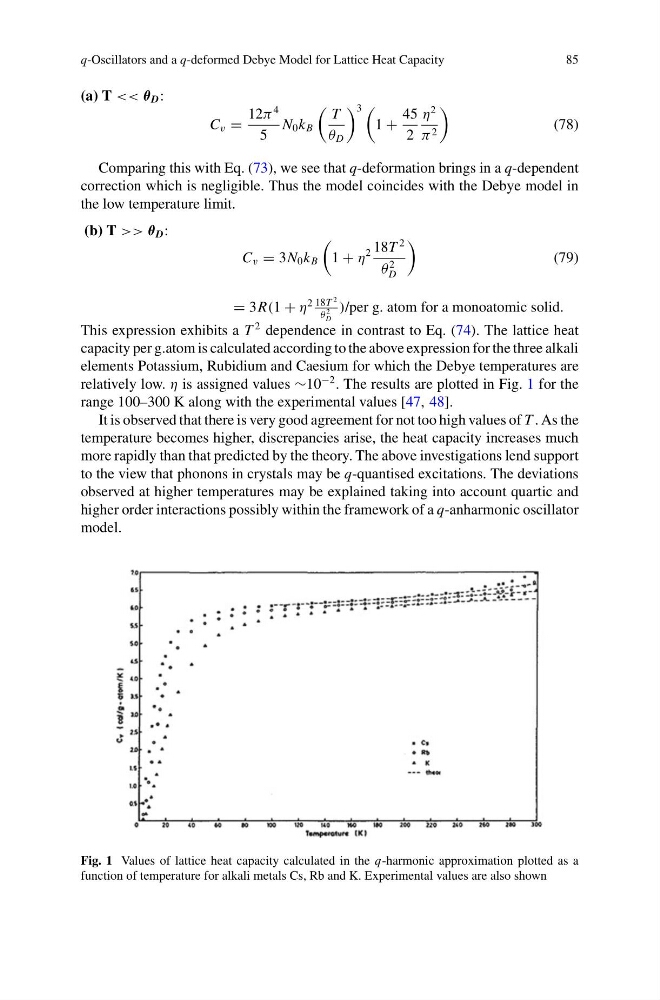
capacity per g.atom is calculated according to the above expression for the three alkali
elements Potassium, Rubidium and Caesium for which the Debye temperatures are
relatively low. η is assigned values ∼10
−2 . The results are plotted in Fig. 1 for the
range 100–300 K along with the experimental values [47, 48].
It is observed that there is very good agreement for not too high values of T . As the
temperature becomes higher, discrepancies arise, the heat capacity increases much
more rapidly than that predicted by the theory. The above investigations lend support
to the view that phonons in crystals may be q-quantised excitations. The deviations
observed at higher temperatures may be explained taking into account quartic and
higher order interactions possibly within the framework of a q-anharmonic oscillator
model.
Fig. 1 Values of lattice heat capacity calculated in the q-harmonic approximation plotted as a
function of temperature for alkali metals Cs, Rb and K. Experimental values are also shown
85
(a) T << θ D :
C v =
12π
4
5
N 0 k B
T
θ D
3
1 +
45
2
η
2
π 2
(78)
Comparing this with Eq. (73), we see that q-deformation brings in a q-dependent
correction which is negligible. Thus the model coincides with the Debye model in
the low temperature limit.
(b) T >> θ D :
C v = 3N 0 k B
1 + η
2 18T
2
θ
2
D
(79)
= 3R(1 + η
2 18T
2
θ
2
D
)/per g. atom for a monoatomic solid.
This expression exhibits a T
2 dependence in contrast to Eq. (74). The lattice heat
capacity per g.atom is calculated according to the above expression for the three alkali
elements Potassium, Rubidium and Caesium for which the Debye temperatures are
relatively low. η is assigned values ∼10
−2 . The results are plotted in Fig. 1 for the
range 100–300 K along with the experimental values [47, 48].
It is observed that there is very good agreement for not too high values of T . As the
temperature becomes higher, discrepancies arise, the heat capacity increases much
more rapidly than that predicted by the theory. The above investigations lend support
to the view that phonons in crystals may be q-quantised excitations. The deviations
observed at higher temperatures may be explained taking into account quartic and
higher order interactions possibly within the framework of a q-anharmonic oscillator
model.
Fig. 1 Values of lattice heat capacity calculated in the q-harmonic approximation plotted as a
function of temperature for alkali metals Cs, Rb and K. Experimental values are also shown