

84
K. K. Leelamma
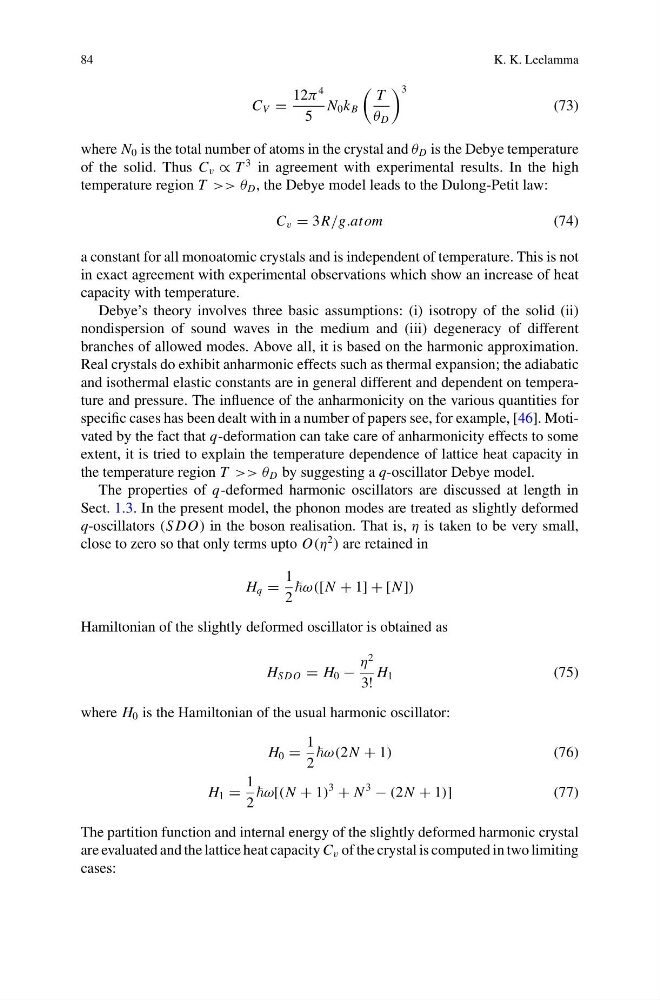
C V =
12π
4
5
N 0 k B
T
θ D
3
(73)
where N 0 is the total number of atoms in the crystal and θ D is the Debye temperature
of the solid. Thus C v ∝ T
3 in agreement with experimental results. In the high
temperature region T >> θ D , the Debye model leads to the Dulong-Petit law:
C v = 3R/g.atom
(74)
a constant for all monoatomic crystals and is independent of temperature. This is not
in exact agreement with experimental observations which show an increase of heat
capacity with temperature.
Debye’s theory involves three basic assumptions: (i) isotropy of the solid (ii)
nondispersion of sound waves in the medium and (iii) degeneracy of different
branches of allowed modes. Above all, it is based on the harmonic approximation.
Real crystals do exhibit anharmonic effects such as thermal expansion; the adiabatic
and isothermal elastic constants are in general different and dependent on temperature and pressure. The influence of the anharmonicity on the various quantities for
specific cases has been dealt with in a number of papers see, for example, [46]. Motivated by the fact that q-deformation can take care of anharmonicity effects to some
extent, it is tried to explain the temperature dependence of lattice heat capacity in
the temperature region T >> θ D by suggesting a q-oscillator Debye model.
The properties of q-deformed harmonic oscillators are discussed at length in
Sect. 1.3. In the present model, the phonon modes are treated as slightly deformed
q-oscillators (S DO) in the boson realisation. That is, η is taken to be very small,
close to zero so that only terms upto O(η
2
) are retained in
H q =
1
2
ω([N + 1] + [N ])
Hamiltonian of the slightly deformed oscillator is obtained as
H S DO = H 0 −
η
2
3!
H 1
(75)
where H 0 is the Hamiltonian of the usual harmonic oscillator:
H 0 =
1
2
ω(2N + 1)
(76)
H 1 =
1
2
ω[(N + 1)
3
+ N
3
− (2N + 1)]
(77)
The partition function and internal energy of the slightly deformed harmonic crystal
are evaluated and the lattice heat capacity C v of the crystal is computed in two limiting
cases:
K. K. Leelamma
C V =
12π
4
5
N 0 k B
T
θ D
3
(73)
where N 0 is the total number of atoms in the crystal and θ D is the Debye temperature
of the solid. Thus C v ∝ T
3 in agreement with experimental results. In the high
temperature region T >> θ D , the Debye model leads to the Dulong-Petit law:
C v = 3R/g.atom
(74)
a constant for all monoatomic crystals and is independent of temperature. This is not
in exact agreement with experimental observations which show an increase of heat
capacity with temperature.
Debye’s theory involves three basic assumptions: (i) isotropy of the solid (ii)
nondispersion of sound waves in the medium and (iii) degeneracy of different
branches of allowed modes. Above all, it is based on the harmonic approximation.
Real crystals do exhibit anharmonic effects such as thermal expansion; the adiabatic
and isothermal elastic constants are in general different and dependent on temperature and pressure. The influence of the anharmonicity on the various quantities for
specific cases has been dealt with in a number of papers see, for example, [46]. Motivated by the fact that q-deformation can take care of anharmonicity effects to some
extent, it is tried to explain the temperature dependence of lattice heat capacity in
the temperature region T >> θ D by suggesting a q-oscillator Debye model.
The properties of q-deformed harmonic oscillators are discussed at length in
Sect. 1.3. In the present model, the phonon modes are treated as slightly deformed
q-oscillators (S DO) in the boson realisation. That is, η is taken to be very small,
close to zero so that only terms upto O(η
2
) are retained in
H q =
1
2
ω([N + 1] + [N ])
Hamiltonian of the slightly deformed oscillator is obtained as
H S DO = H 0 −
η
2
3!
H 1
(75)
where H 0 is the Hamiltonian of the usual harmonic oscillator:
H 0 =
1
2
ω(2N + 1)
(76)
H 1 =
1
2
ω[(N + 1)
3
+ N
3
− (2N + 1)]
(77)
The partition function and internal energy of the slightly deformed harmonic crystal
are evaluated and the lattice heat capacity C v of the crystal is computed in two limiting
cases: