

Aspects of Schrödinger Picture Formalism
57
V
1
(M(φ)) = −
M
3
6π
+
3
6π
.
(49)
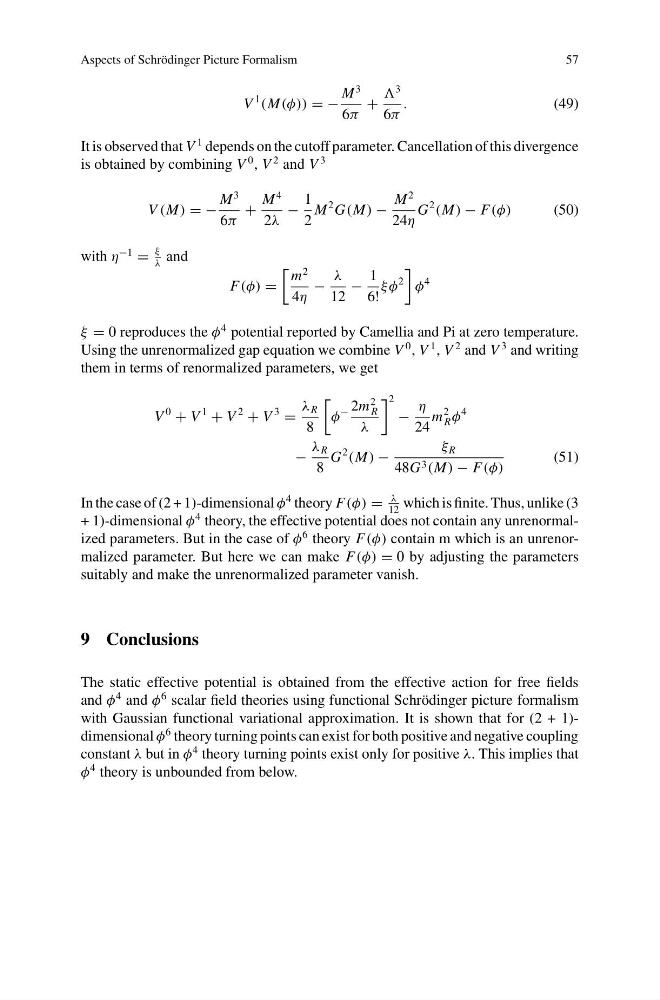
It is observed that V
1 depends on the cutoff parameter. Cancellation of this divergence
is obtained by combining V
0 , V
2 and V
3
V (M) = −
M
3
6π
+
M
4
2λ
−
1
2
M
2 G(M) −
M
2
24η
G
2
(M) − F(φ)
(50)
with η
−1
=
ξ
λ
and
F(φ) =
m
2
4η
−
λ
12
−
1
6!
ξφ
2
φ
4
ξ = 0 reproduces the φ
4 potential reported by Camellia and Pi at zero temperature.
Using the unrenormalized gap equation we combine V
0 , V
1 , V
2 and V
3 and writing
them in terms of renormalized parameters, we get
V
0
+ V
1
+ V
2
+ V
3
=
λ R
8
φ
− 2m
2
R
λ
2
−
η
24
m
2
R φ
4
−
λ R
8
G
2
(M) −
ξ R
48G 3 (M) − F(φ)
(51)
In the case of (2 + 1)-dimensional φ
4 theory F(φ) =
λ
12
which is finite. Thus, unlike (3
+ 1)-dimensional φ
4 theory, the effective potential does not contain any unrenormalized parameters. But in the case of φ
6 theory F(φ) contain m which is an unrenormalized parameter. But here we can make F(φ) = 0 by adjusting the parameters
suitably and make the unrenormalized parameter vanish.
9 Conclusions
The static effective potential is obtained from the effective action for free fields
and φ
4 and φ
6 scalar field theories using functional Schrödinger picture formalism
with Gaussian functional variational approximation. It is shown that for (2 + 1)dimensional φ
6 theory turning points can exist for both positive and negative coupling
constant λ but in φ
4 theory turning points exist only for positive λ. This implies that
φ
4 theory is unbounded from below.
57
V
1
(M(φ)) = −
M
3
6π
+
3
6π
.
(49)
It is observed that V
1 depends on the cutoff parameter. Cancellation of this divergence
is obtained by combining V
0 , V
2 and V
3
V (M) = −
M
3
6π
+
M
4
2λ
−
1
2
M
2 G(M) −
M
2
24η
G
2
(M) − F(φ)
(50)
with η
−1
=
ξ
λ
and
F(φ) =
m
2
4η
−
λ
12
−
1
6!
ξφ
2
φ
4
ξ = 0 reproduces the φ
4 potential reported by Camellia and Pi at zero temperature.
Using the unrenormalized gap equation we combine V
0 , V
1 , V
2 and V
3 and writing
them in terms of renormalized parameters, we get
V
0
+ V
1
+ V
2
+ V
3
=
λ R
8
φ
− 2m
2
R
λ
2
−
η
24
m
2
R φ
4
−
λ R
8
G
2
(M) −
ξ R
48G 3 (M) − F(φ)
(51)
In the case of (2 + 1)-dimensional φ
4 theory F(φ) =
λ
12
which is finite. Thus, unlike (3
+ 1)-dimensional φ
4 theory, the effective potential does not contain any unrenormalized parameters. But in the case of φ
6 theory F(φ) contain m which is an unrenormalized parameter. But here we can make F(φ) = 0 by adjusting the parameters
suitably and make the unrenormalized parameter vanish.
9 Conclusions
The static effective potential is obtained from the effective action for free fields
and φ
4 and φ
6 scalar field theories using functional Schrödinger picture formalism
with Gaussian functional variational approximation. It is shown that for (2 + 1)dimensional φ
6 theory turning points can exist for both positive and negative coupling
constant λ but in φ
4 theory turning points exist only for positive λ. This implies that
φ
4 theory is unbounded from below.