

58
K. P. Satheesh
Appendix
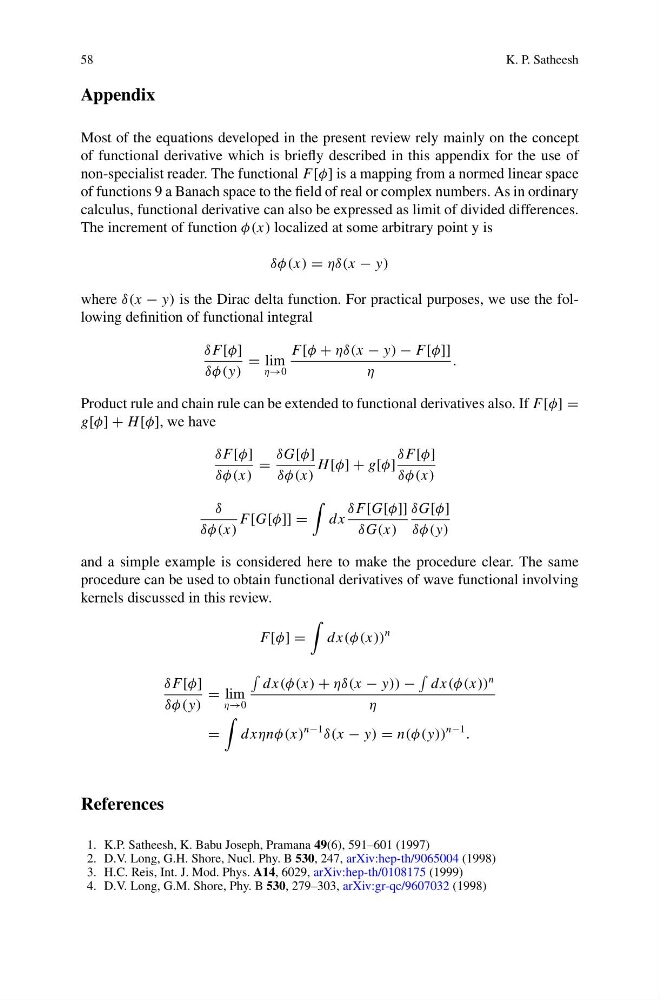
Most of the equations developed in the present review rely mainly on the concept
of functional derivative which is briefly described in this appendix for the use of
non-specialist reader. The functional F[φ] is a mapping from a normed linear space
of functions 9 a Banach space to the field of real or complex numbers. As in ordinary
calculus, functional derivative can also be expressed as limit of divided differences.
The increment of function φ(x) localized at some arbitrary point y is
δφ(x) = ηδ(x − y)
where δ(x − y) is the Dirac delta function. For practical purposes, we use the following definition of functional integral
δ F[φ]
δφ(y)
= lim
η→0
F[φ + ηδ(x − y) − F[φ]]
η
.
Product rule and chain rule can be extended to functional derivatives also. If F[φ] =
g[φ] + H [φ], we have
δ F[φ]
δφ(x)
=
δG[φ]
δφ(x)
H [φ] + g[φ]
δ F[φ]
δφ(x)
δ
δφ(x)
F[G[φ]] =
dx
δ F[G[φ]]
δG(x)
δG[φ]
δφ(y)
and a simple example is considered here to make the procedure clear. The same
procedure can be used to obtain functional derivatives of wave functional involving
kernels discussed in this review.
F[φ] =
dx(φ(x))
n
δ F[φ]
δφ(y)
= lim
η→0
dx(φ(x) + ηδ(x − y)) −
dx(φ(x))
n
η
=
dxηnφ(x)
n−1
δ(x − y) = n(φ(y))
n−1
.
References
1. K.P. Satheesh, K. Babu Joseph, Pramana 49(6), 591–601 (1997)
2. D.V. Long, G.H. Shore, Nucl. Phy. B 530, 247, arXiv:hep-th/9065004 (1998)
3. H.C. Reis, Int. J. Mod. Phys. A14, 6029, arXiv:hep-th/0108175 (1999)
4. D.V. Long, G.M. Shore, Phy. B 530, 279–303, arXiv:gr-qc/9607032 (1998)
K. P. Satheesh
Appendix
Most of the equations developed in the present review rely mainly on the concept
of functional derivative which is briefly described in this appendix for the use of
non-specialist reader. The functional F[φ] is a mapping from a normed linear space
of functions 9 a Banach space to the field of real or complex numbers. As in ordinary
calculus, functional derivative can also be expressed as limit of divided differences.
The increment of function φ(x) localized at some arbitrary point y is
δφ(x) = ηδ(x − y)
where δ(x − y) is the Dirac delta function. For practical purposes, we use the following definition of functional integral
δ F[φ]
δφ(y)
= lim
η→0
F[φ + ηδ(x − y) − F[φ]]
η
.
Product rule and chain rule can be extended to functional derivatives also. If F[φ] =
g[φ] + H [φ], we have
δ F[φ]
δφ(x)
=
δG[φ]
δφ(x)
H [φ] + g[φ]
δ F[φ]
δφ(x)
δ
δφ(x)
F[G[φ]] =
dx
δ F[G[φ]]
δG(x)
δG[φ]
δφ(y)
and a simple example is considered here to make the procedure clear. The same
procedure can be used to obtain functional derivatives of wave functional involving
kernels discussed in this review.
F[φ] =
dx(φ(x))
n
δ F[φ]
δφ(y)
= lim
η→0
dx(φ(x) + ηδ(x − y)) −
dx(φ(x))
n
η
=
dxηnφ(x)
n−1
δ(x − y) = n(φ(y))
n−1
.
References
1. K.P. Satheesh, K. Babu Joseph, Pramana 49(6), 591–601 (1997)
2. D.V. Long, G.H. Shore, Nucl. Phy. B 530, 247, arXiv:hep-th/9065004 (1998)
3. H.C. Reis, Int. J. Mod. Phys. A14, 6029, arXiv:hep-th/0108175 (1999)
4. D.V. Long, G.M. Shore, Phy. B 530, 279–303, arXiv:gr-qc/9607032 (1998)