

64
2 Holographic Microscopy of Phase and Diffuse Objects …
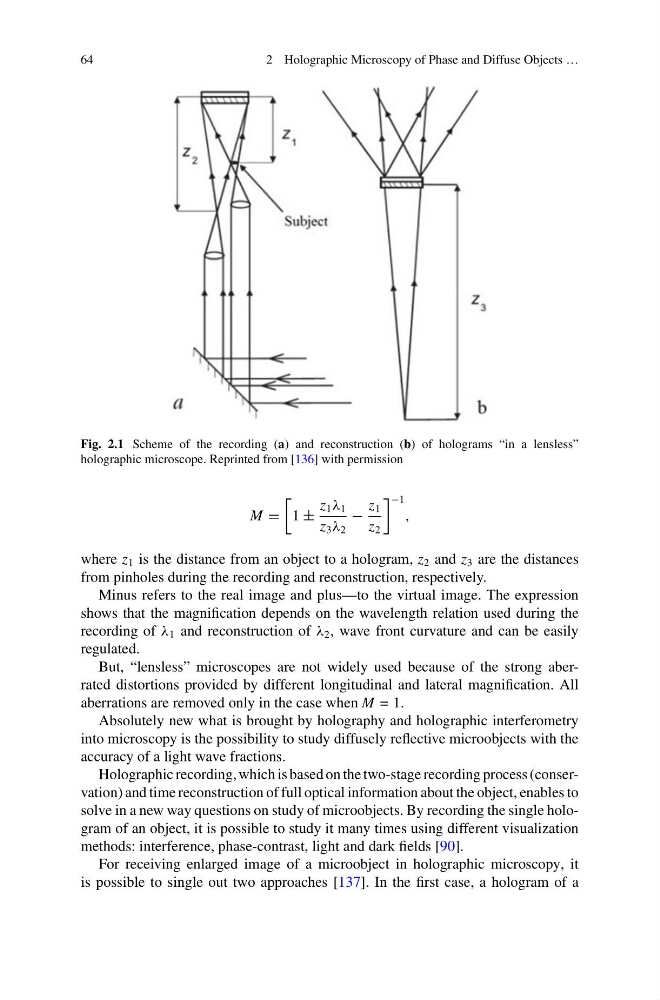
Fig. 2.1 Scheme of the recording (a) and reconstruction (b) of holograms “in a lensless”
holographic microscope. Reprinted from [136] with permission
M =
1 ±
z 1 λ 1
z 3 λ 2
−
z 1
z 2
−1
,
where z 1 is the distance from an object to a hologram, z 2 and z 3 are the distances
from pinholes during the recording and reconstruction, respectively.
Minus refers to the real image and plus—to the virtual image. The expression
shows that the magnification depends on the wavelength relation used during the
recording of λ 1 and reconstruction of λ 2 , wave front curvature and can be easily
regulated.
But, “lensless” microscopes are not widely used because of the strong aberrated distortions provided by different longitudinal and lateral magnification. All
aberrations are removed only in the case when M = 1.
Absolutely new what is brought by holography and holographic interferometry
into microscopy is the possibility to study diffusely reflective microobjects with the
accuracy of a light wave fractions.
Holographic recording, which is based on the two-stage recording process (conservation) and time reconstruction of full optical information about the object, enables to
solve in a new way questions on study of microobjects. By recording the single hologram of an object, it is possible to study it many times using different visualization
methods: interference, phase-contrast, light and dark fields [90].
For receiving enlarged image of a microobject in holographic microscopy, it
is possible to single out two approaches [137]. In the first case, a hologram of a
2 Holographic Microscopy of Phase and Diffuse Objects …
Fig. 2.1 Scheme of the recording (a) and reconstruction (b) of holograms “in a lensless”
holographic microscope. Reprinted from [136] with permission
M =
1 ±
z 1 λ 1
z 3 λ 2
−
z 1
z 2
−1
,
where z 1 is the distance from an object to a hologram, z 2 and z 3 are the distances
from pinholes during the recording and reconstruction, respectively.
Minus refers to the real image and plus—to the virtual image. The expression
shows that the magnification depends on the wavelength relation used during the
recording of λ 1 and reconstruction of λ 2 , wave front curvature and can be easily
regulated.
But, “lensless” microscopes are not widely used because of the strong aberrated distortions provided by different longitudinal and lateral magnification. All
aberrations are removed only in the case when M = 1.
Absolutely new what is brought by holography and holographic interferometry
into microscopy is the possibility to study diffusely reflective microobjects with the
accuracy of a light wave fractions.
Holographic recording, which is based on the two-stage recording process (conservation) and time reconstruction of full optical information about the object, enables to
solve in a new way questions on study of microobjects. By recording the single hologram of an object, it is possible to study it many times using different visualization
methods: interference, phase-contrast, light and dark fields [90].
For receiving enlarged image of a microobject in holographic microscopy, it
is possible to single out two approaches [137]. In the first case, a hologram of a