

1.3 Resonance Method for Increasing Interferometry Sensitivity …
31
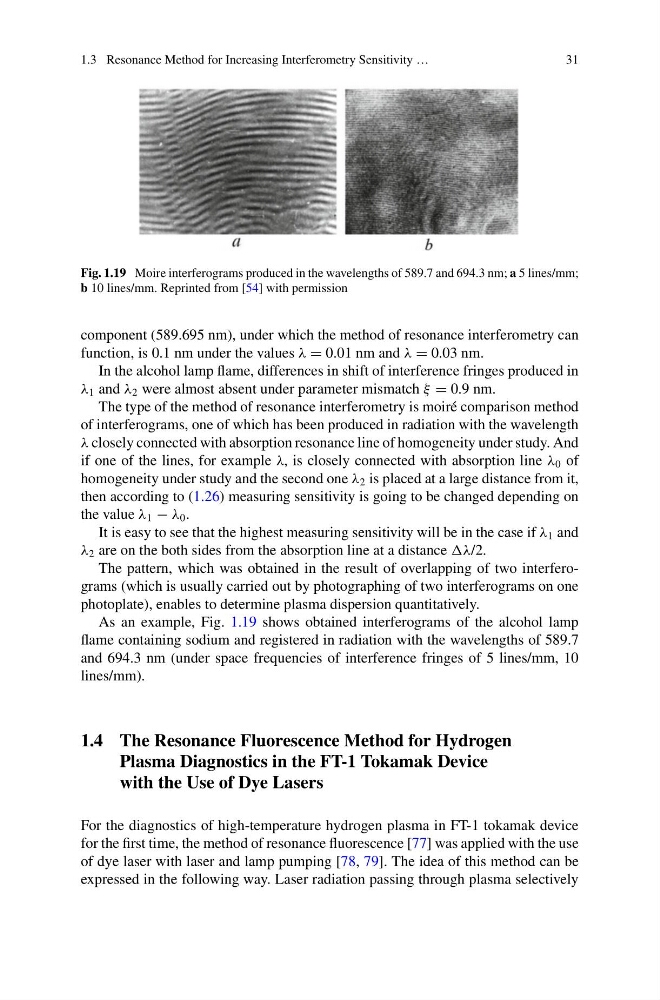
Fig. 1.19 Moire interferograms produced in the wavelengths of 589.7 and 694.3 nm; a 5 lines/mm;
b 10 lines/mm. Reprinted from [54] with permission
component (589.695 nm), under which the method of resonance interferometry can
function, is 0.1 nm under the values λ = 0.01 nm and λ = 0.03 nm.
In the alcohol lamp flame, differences in shift of interference fringes produced in
λ 1 and λ 2 were almost absent under parameter mismatch ξ = 0.9 nm.
The type of the method of resonance interferometry is moiré comparison method
of interferograms, one of which has been produced in radiation with the wavelength
λ closely connected with absorption resonance line of homogeneity under study. And
if one of the lines, for example λ, is closely connected with absorption line λ 0 of
homogeneity under study and the second one λ 2 is placed at a large distance from it,
then according to (1.26) measuring sensitivity is going to be changed depending on
the value λ 1 − λ 0 .
It is easy to see that the highest measuring sensitivity will be in the case if λ 1 and
λ 2 are on the both sides from the absorption line at a distance λ/2.
The pattern, which was obtained in the result of overlapping of two interferograms (which is usually carried out by photographing of two interferograms on one
photoplate), enables to determine plasma dispersion quantitatively.
As an example, Fig. 1.19 shows obtained interferograms of the alcohol lamp
flame containing sodium and registered in radiation with the wavelengths of 589.7
and 694.3 nm (under space frequencies of interference fringes of 5 lines/mm, 10
lines/mm).
1.4 The Resonance Fluorescence Method for Hydrogen
Plasma Diagnostics in the FT-1 Tokamak Device
with the Use of Dye Lasers
For the diagnostics of high-temperature hydrogen plasma in FT-1 tokamak device
for the first time, the method of resonance fluorescence [77] was applied with the use
of dye laser with laser and lamp pumping [78, 79]. The idea of this method can be
expressed in the following way. Laser radiation passing through plasma selectively
31
Fig. 1.19 Moire interferograms produced in the wavelengths of 589.7 and 694.3 nm; a 5 lines/mm;
b 10 lines/mm. Reprinted from [54] with permission
component (589.695 nm), under which the method of resonance interferometry can
function, is 0.1 nm under the values λ = 0.01 nm and λ = 0.03 nm.
In the alcohol lamp flame, differences in shift of interference fringes produced in
λ 1 and λ 2 were almost absent under parameter mismatch ξ = 0.9 nm.
The type of the method of resonance interferometry is moiré comparison method
of interferograms, one of which has been produced in radiation with the wavelength
λ closely connected with absorption resonance line of homogeneity under study. And
if one of the lines, for example λ, is closely connected with absorption line λ 0 of
homogeneity under study and the second one λ 2 is placed at a large distance from it,
then according to (1.26) measuring sensitivity is going to be changed depending on
the value λ 1 − λ 0 .
It is easy to see that the highest measuring sensitivity will be in the case if λ 1 and
λ 2 are on the both sides from the absorption line at a distance λ/2.
The pattern, which was obtained in the result of overlapping of two interferograms (which is usually carried out by photographing of two interferograms on one
photoplate), enables to determine plasma dispersion quantitatively.
As an example, Fig. 1.19 shows obtained interferograms of the alcohol lamp
flame containing sodium and registered in radiation with the wavelengths of 589.7
and 694.3 nm (under space frequencies of interference fringes of 5 lines/mm, 10
lines/mm).
1.4 The Resonance Fluorescence Method for Hydrogen
Plasma Diagnostics in the FT-1 Tokamak Device
with the Use of Dye Lasers
For the diagnostics of high-temperature hydrogen plasma in FT-1 tokamak device
for the first time, the method of resonance fluorescence [77] was applied with the use
of dye laser with laser and lamp pumping [78, 79]. The idea of this method can be
expressed in the following way. Laser radiation passing through plasma selectively