

30
1 Resonance Methods for Increasing Sensitivity of Interferometry …
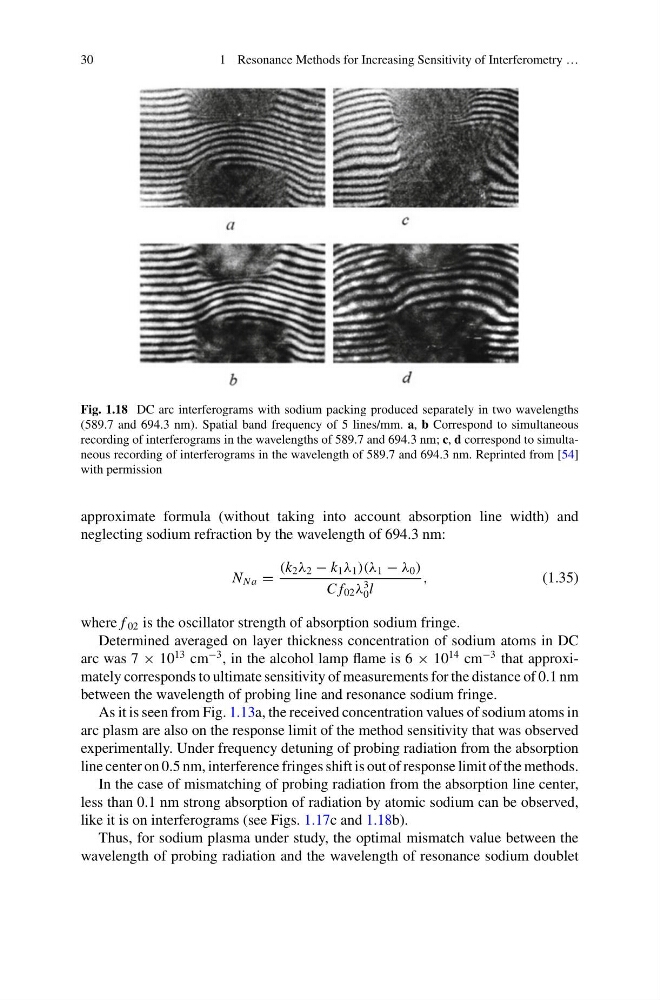
Fig. 1.18 DC arc interferograms with sodium packing produced separately in two wavelengths
(589.7 and 694.3 nm). Spatial band frequency of 5 lines/mm. a, b Correspond to simultaneous
recording of interferograms in the wavelengths of 589.7 and 694.3 nm; c, d correspond to simultaneous recording of interferograms in the wavelength of 589.7 and 694.3 nm. Reprinted from [54]
with permission
approximate formula (without taking into account absorption line width) and
neglecting sodium refraction by the wavelength of 694.3 nm:
N Na =
(k 2 λ 2 − k 1 λ 1 )(λ 1 − λ 0 )
C f 02 λ
3
0 l
,
(1.35)
where f 02 is the oscillator strength of absorption sodium fringe.
Determined averaged on layer thickness concentration of sodium atoms in DC
arc was 7 × 10
13 cm
−3 , in the alcohol lamp flame is 6 × 10
14 cm
−3 that approximately corresponds to ultimate sensitivity of measurements for the distance of 0.1 nm
between the wavelength of probing line and resonance sodium fringe.
As it is seen from Fig. 1.13a, the received concentration values of sodium atoms in
arc plasm are also on the response limit of the method sensitivity that was observed
experimentally. Under frequency detuning of probing radiation from the absorption
line center on 0.5 nm, interference fringes shift is out of response limit of the methods.
In the case of mismatching of probing radiation from the absorption line center,
less than 0.1 nm strong absorption of radiation by atomic sodium can be observed,
like it is on interferograms (see Figs. 1.17c and 1.18b).
Thus, for sodium plasma under study, the optimal mismatch value between the
wavelength of probing radiation and the wavelength of resonance sodium doublet
1 Resonance Methods for Increasing Sensitivity of Interferometry …
Fig. 1.18 DC arc interferograms with sodium packing produced separately in two wavelengths
(589.7 and 694.3 nm). Spatial band frequency of 5 lines/mm. a, b Correspond to simultaneous
recording of interferograms in the wavelengths of 589.7 and 694.3 nm; c, d correspond to simultaneous recording of interferograms in the wavelength of 589.7 and 694.3 nm. Reprinted from [54]
with permission
approximate formula (without taking into account absorption line width) and
neglecting sodium refraction by the wavelength of 694.3 nm:
N Na =
(k 2 λ 2 − k 1 λ 1 )(λ 1 − λ 0 )
C f 02 λ
3
0 l
,
(1.35)
where f 02 is the oscillator strength of absorption sodium fringe.
Determined averaged on layer thickness concentration of sodium atoms in DC
arc was 7 × 10
13 cm
−3 , in the alcohol lamp flame is 6 × 10
14 cm
−3 that approximately corresponds to ultimate sensitivity of measurements for the distance of 0.1 nm
between the wavelength of probing line and resonance sodium fringe.
As it is seen from Fig. 1.13a, the received concentration values of sodium atoms in
arc plasm are also on the response limit of the method sensitivity that was observed
experimentally. Under frequency detuning of probing radiation from the absorption
line center on 0.5 nm, interference fringes shift is out of response limit of the methods.
In the case of mismatching of probing radiation from the absorption line center,
less than 0.1 nm strong absorption of radiation by atomic sodium can be observed,
like it is on interferograms (see Figs. 1.17c and 1.18b).
Thus, for sodium plasma under study, the optimal mismatch value between the
wavelength of probing radiation and the wavelength of resonance sodium doublet