

1.3 Resonance Method for Increasing Interferometry Sensitivity …
29
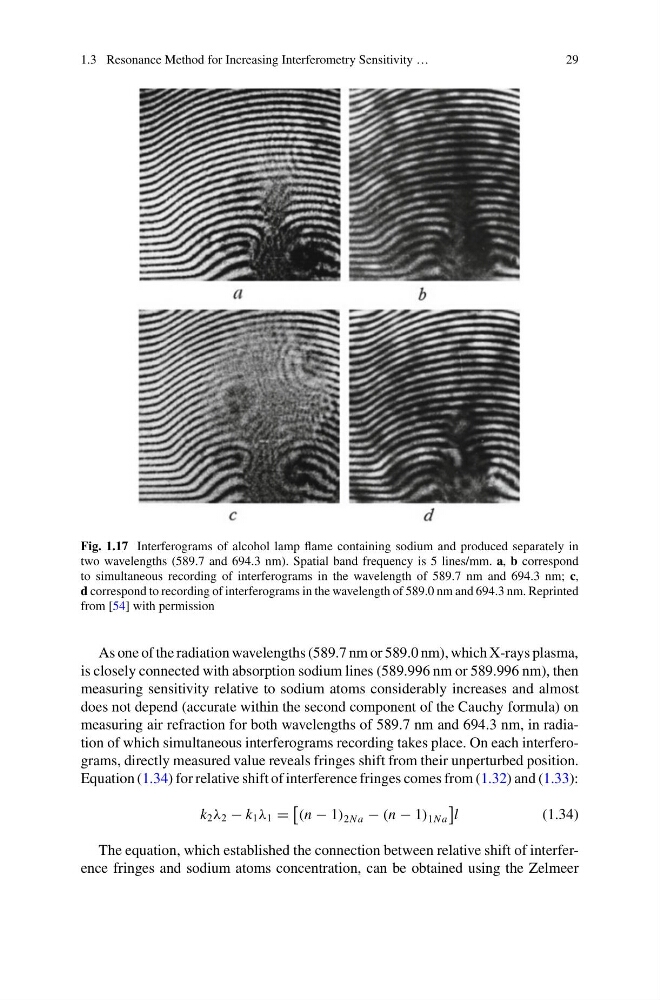
Fig. 1.17 Interferograms of alcohol lamp flame containing sodium and produced separately in
two wavelengths (589.7 and 694.3 nm). Spatial band frequency is 5 lines/mm. a, b correspond
to simultaneous recording of interferograms in the wavelength of 589.7 nm and 694.3 nm; c,
d correspond to recording of interferograms in the wavelength of 589.0 nm and 694.3 nm. Reprinted
from [54] with permission
As one of the radiation wavelengths (589.7 nm or 589.0 nm), which X-rays plasma,
is closely connected with absorption sodium lines (589.996 nm or 589.996 nm), then
measuring sensitivity relative to sodium atoms considerably increases and almost
does not depend (accurate within the second component of the Cauchy formula) on
measuring air refraction for both wavelengths of 589.7 nm and 694.3 nm, in radiation of which simultaneous interferograms recording takes place. On each interferograms, directly measured value reveals fringes shift from their unperturbed position.
Equation (1.34) for relative shift of interference fringes comes from (1.32) and (1.33):
k 2 λ 2 − k 1 λ 1 =
(n − 1) 2Na − (n − 1) 1Na
l
(1.34)
The equation, which established the connection between relative shift of interference fringes and sodium atoms concentration, can be obtained using the Zelmeer
29
Fig. 1.17 Interferograms of alcohol lamp flame containing sodium and produced separately in
two wavelengths (589.7 and 694.3 nm). Spatial band frequency is 5 lines/mm. a, b correspond
to simultaneous recording of interferograms in the wavelength of 589.7 nm and 694.3 nm; c,
d correspond to recording of interferograms in the wavelength of 589.0 nm and 694.3 nm. Reprinted
from [54] with permission
As one of the radiation wavelengths (589.7 nm or 589.0 nm), which X-rays plasma,
is closely connected with absorption sodium lines (589.996 nm or 589.996 nm), then
measuring sensitivity relative to sodium atoms considerably increases and almost
does not depend (accurate within the second component of the Cauchy formula) on
measuring air refraction for both wavelengths of 589.7 nm and 694.3 nm, in radiation of which simultaneous interferograms recording takes place. On each interferograms, directly measured value reveals fringes shift from their unperturbed position.
Equation (1.34) for relative shift of interference fringes comes from (1.32) and (1.33):
k 2 λ 2 − k 1 λ 1 =
(n − 1) 2Na − (n − 1) 1Na
l
(1.34)
The equation, which established the connection between relative shift of interference fringes and sodium atoms concentration, can be obtained using the Zelmeer