

24
1 Resonance Methods for Increasing Sensitivity of Interferometry …
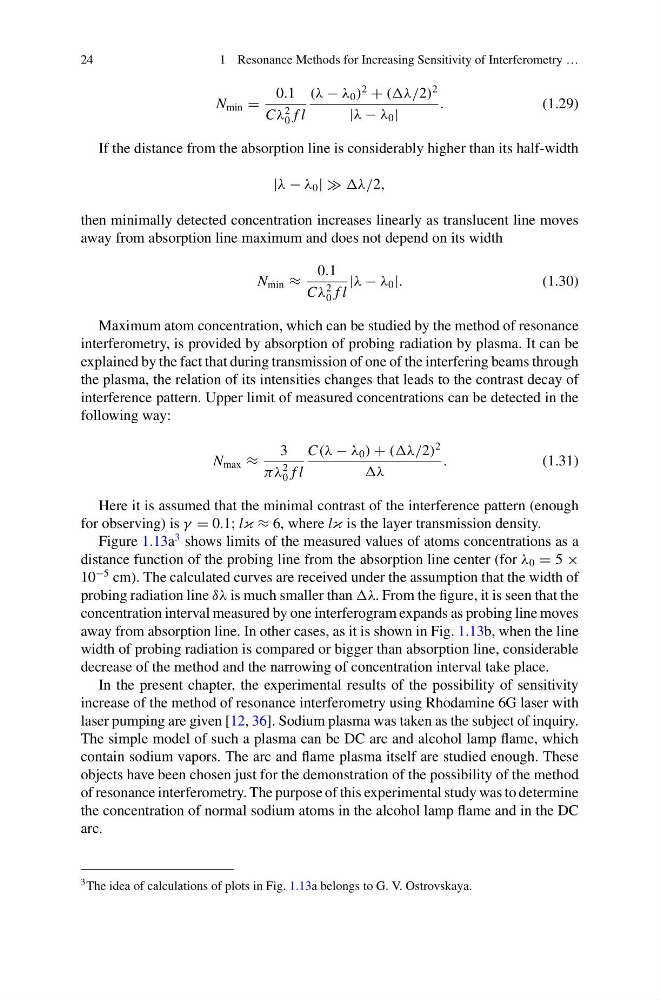
N min =
0.1
Cλ
2
0 f l
(λ − λ 0 )
2
+ ((λ/2)
2
|λ − λ 0 |
.
(1.29)
If the distance from the absorption line is considerably higher than its half-width
|λ − λ 0 |
then minimally detected concentration increases linearly as translucent line moves
away from absorption line maximum and does not depend on its width
N min ≈
0.1
Cλ
2
0 f l
|λ − λ 0 |.
(1.30)
Maximum atom concentration, which can be studied by the method of resonance
interferometry, is provided by absorption of probing radiation by plasma. It can be
explained by the fact that during transmission of one of the interfering beams through
the plasma, the relation of its intensities changes that leads to the contrast decay of
interference pattern. Upper limit of measured concentrations can be detected in the
following way:
N max ≈
3
πλ
2
0 f l
C(λ − λ 0 ) + ((λ/2)
2
λ
.
(1.31)
Here it is assumed that the minimal contrast of the interference pattern (enough
for observing) is γ = 0.1; lκ ≈ 6, where lκ is the layer transmission density.
Figure 1.13a
3 shows limits of the measured values of atoms concentrations as a
distance function of the probing line from the absorption line center (for λ 0 = 5 ×
10
−5 cm). The calculated curves are received under the assumption that the width of
probing radiation line δλ is much smaller than λ. From the figure, it is seen that the
concentration interval measured by one interferogram expands as probing line moves
away from absorption line. In other cases, as it is shown in Fig. 1.13b, when the line
width of probing radiation is compared or bigger than absorption line, considerable
decrease of the method and the narrowing of concentration interval take place.
In the present chapter, the experimental results of the possibility of sensitivity
increase of the method of resonance interferometry using Rhodamine 6G laser with
laser pumping are given [12, 36]. Sodium plasma was taken as the subject of inquiry.
The simple model of such a plasma can be DC arc and alcohol lamp flame, which
contain sodium vapors. The arc and flame plasma itself are studied enough. These
objects have been chosen just for the demonstration of the possibility of the method
of resonance interferometry. The purpose of this experimental study was to determine
the concentration of normal sodium atoms in the alcohol lamp flame and in the DC
arc.
3 The idea of calculations of plots in Fig. 1.13a belongs to G. V. Ostrovskaya.
1 Resonance Methods for Increasing Sensitivity of Interferometry …
N min =
0.1
Cλ
2
0 f l
(λ − λ 0 )
2
+ ((λ/2)
2
|λ − λ 0 |
.
(1.29)
If the distance from the absorption line is considerably higher than its half-width
|λ − λ 0 |
then minimally detected concentration increases linearly as translucent line moves
away from absorption line maximum and does not depend on its width
N min ≈
0.1
Cλ
2
0 f l
|λ − λ 0 |.
(1.30)
Maximum atom concentration, which can be studied by the method of resonance
interferometry, is provided by absorption of probing radiation by plasma. It can be
explained by the fact that during transmission of one of the interfering beams through
the plasma, the relation of its intensities changes that leads to the contrast decay of
interference pattern. Upper limit of measured concentrations can be detected in the
following way:
N max ≈
3
πλ
2
0 f l
C(λ − λ 0 ) + ((λ/2)
2
λ
.
(1.31)
Here it is assumed that the minimal contrast of the interference pattern (enough
for observing) is γ = 0.1; lκ ≈ 6, where lκ is the layer transmission density.
Figure 1.13a
3 shows limits of the measured values of atoms concentrations as a
distance function of the probing line from the absorption line center (for λ 0 = 5 ×
10
−5 cm). The calculated curves are received under the assumption that the width of
probing radiation line δλ is much smaller than λ. From the figure, it is seen that the
concentration interval measured by one interferogram expands as probing line moves
away from absorption line. In other cases, as it is shown in Fig. 1.13b, when the line
width of probing radiation is compared or bigger than absorption line, considerable
decrease of the method and the narrowing of concentration interval take place.
In the present chapter, the experimental results of the possibility of sensitivity
increase of the method of resonance interferometry using Rhodamine 6G laser with
laser pumping are given [12, 36]. Sodium plasma was taken as the subject of inquiry.
The simple model of such a plasma can be DC arc and alcohol lamp flame, which
contain sodium vapors. The arc and flame plasma itself are studied enough. These
objects have been chosen just for the demonstration of the possibility of the method
of resonance interferometry. The purpose of this experimental study was to determine
the concentration of normal sodium atoms in the alcohol lamp flame and in the DC
arc.
3 The idea of calculations of plots in Fig. 1.13a belongs to G. V. Ostrovskaya.