

1.3 Resonance Method for Increasing Interferometry Sensitivity …
25
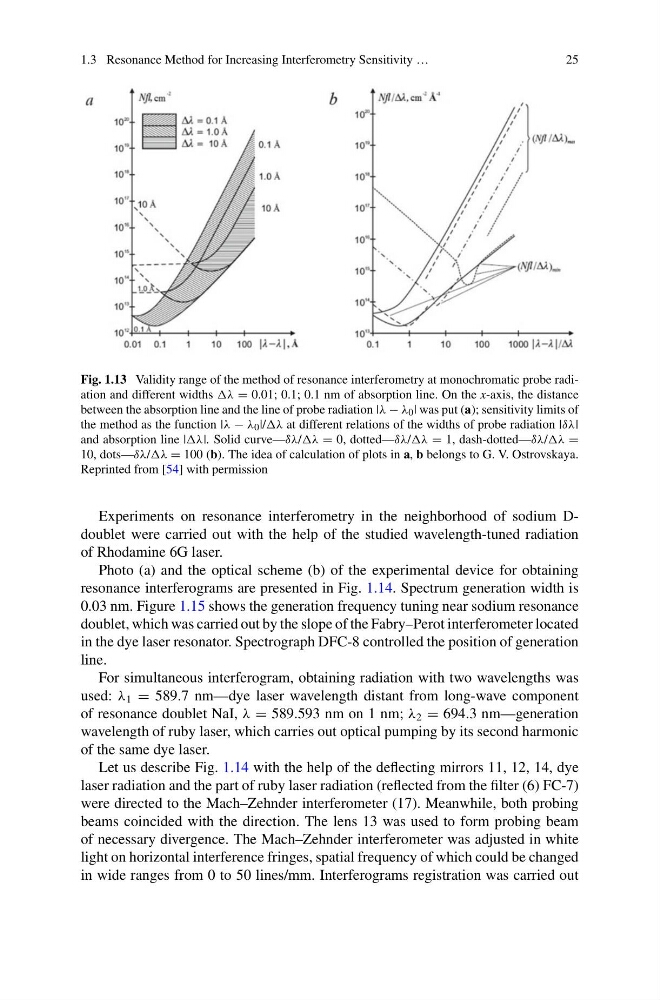
Fig. 1.13 Validity range of the method of resonance interferometry at monochromatic probe radiation and different widths λ = 0.01; 0.1; 0.1 nm of absorption line. On the x-axis, the distance
between the absorption line and the line of probe radiation |λ − λ 0 | was put (a); sensitivity limits of
the method as the function |λ − λ 0 |/λ at different relations of the widths of probe radiation |δλ|
and absorption line |λ|. Solid curve—δλ/λ = 0, dotted—δλ/λ = 1, dash-dotted—δλ/λ =
10, dots—δλ/λ = 100 (b). The idea of calculation of plots in a, b belongs to G. V. Ostrovskaya.
Reprinted from [54] with permission
Experiments on resonance interferometry in the neighborhood of sodium Ddoublet were carried out with the help of the studied wavelength-tuned radiation
of Rhodamine 6G laser.
Photo (a) and the optical scheme (b) of the experimental device for obtaining
resonance interferograms are presented in Fig. 1.14. Spectrum generation width is
0.03 nm. Figure 1.15 shows the generation frequency tuning near sodium resonance
doublet, which was carried out by the slope of the Fabry–Perot interferometer located
in the dye laser resonator. Spectrograph DFC-8 controlled the position of generation
line.
For simultaneous interferogram, obtaining radiation with two wavelengths was
used: λ 1 = 589.7 nm—dye laser wavelength distant from long-wave component
of resonance doublet NaI, λ = 589.593 nm on 1 nm; λ 2 = 694.3 nm—generation
wavelength of ruby laser, which carries out optical pumping by its second harmonic
of the same dye laser.
Let us describe Fig. 1.14 with the help of the deflecting mirrors 11, 12, 14, dye
laser radiation and the part of ruby laser radiation (reflected from the filter (6) FC-7)
were directed to the Mach–Zehnder interferometer (17). Meanwhile, both probing
beams coincided with the direction. The lens 13 was used to form probing beam
of necessary divergence. The Mach–Zehnder interferometer was adjusted in white
light on horizontal interference fringes, spatial frequency of which could be changed
in wide ranges from 0 to 50 lines/mm. Interferograms registration was carried out
25
Fig. 1.13 Validity range of the method of resonance interferometry at monochromatic probe radiation and different widths λ = 0.01; 0.1; 0.1 nm of absorption line. On the x-axis, the distance
between the absorption line and the line of probe radiation |λ − λ 0 | was put (a); sensitivity limits of
the method as the function |λ − λ 0 |/λ at different relations of the widths of probe radiation |δλ|
and absorption line |λ|. Solid curve—δλ/λ = 0, dotted—δλ/λ = 1, dash-dotted—δλ/λ =
10, dots—δλ/λ = 100 (b). The idea of calculation of plots in a, b belongs to G. V. Ostrovskaya.
Reprinted from [54] with permission
Experiments on resonance interferometry in the neighborhood of sodium Ddoublet were carried out with the help of the studied wavelength-tuned radiation
of Rhodamine 6G laser.
Photo (a) and the optical scheme (b) of the experimental device for obtaining
resonance interferograms are presented in Fig. 1.14. Spectrum generation width is
0.03 nm. Figure 1.15 shows the generation frequency tuning near sodium resonance
doublet, which was carried out by the slope of the Fabry–Perot interferometer located
in the dye laser resonator. Spectrograph DFC-8 controlled the position of generation
line.
For simultaneous interferogram, obtaining radiation with two wavelengths was
used: λ 1 = 589.7 nm—dye laser wavelength distant from long-wave component
of resonance doublet NaI, λ = 589.593 nm on 1 nm; λ 2 = 694.3 nm—generation
wavelength of ruby laser, which carries out optical pumping by its second harmonic
of the same dye laser.
Let us describe Fig. 1.14 with the help of the deflecting mirrors 11, 12, 14, dye
laser radiation and the part of ruby laser radiation (reflected from the filter (6) FC-7)
were directed to the Mach–Zehnder interferometer (17). Meanwhile, both probing
beams coincided with the direction. The lens 13 was used to form probing beam
of necessary divergence. The Mach–Zehnder interferometer was adjusted in white
light on horizontal interference fringes, spatial frequency of which could be changed
in wide ranges from 0 to 50 lines/mm. Interferograms registration was carried out