

1.3 Resonance Method for Increasing Interferometry Sensitivity …
23
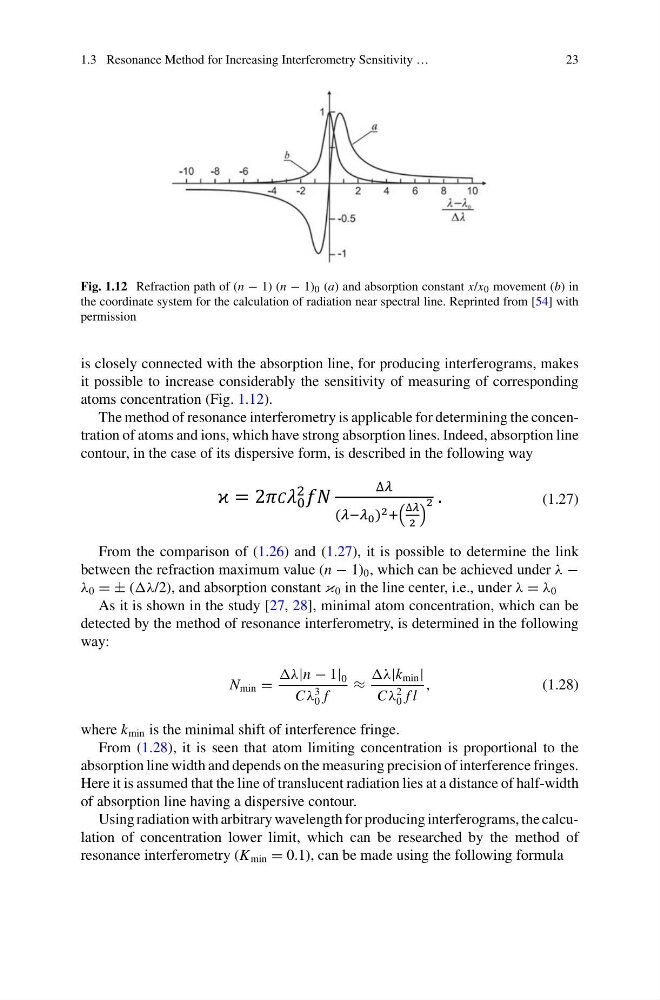
Fig. 1.12 Refraction path of (n − 1) (n − 1) 0 (a) and absorption constant x/x 0 movement (b) in
the coordinate system for the calculation of radiation near spectral line. Reprinted from [54] with
permission
is closely connected with the absorption line, for producing interferograms, makes
it possible to increase considerably the sensitivity of measuring of corresponding
atoms concentration (Fig. 1.12).
The method of resonance interferometry is applicable for determining the concentration of atoms and ions, which have strong absorption lines. Indeed, absorption line
contour, in the case of its dispersive form, is described in the following way
(1.27)
From the comparison of (1.26) and (1.27), it is possible to determine the link
between the refraction maximum value (n − 1) 0 , which can be achieved under λ −
λ 0 = ± (λ/2), and absorption constant κ 0 in the line center, i.e., under λ = λ 0
As it is shown in the study [27, 28], minimal atom concentration, which can be
detected by the method of resonance interferometry, is determined in the following
way:
N min =
λ|n − 1| 0
Cλ
3
0 f
≈
λ|k min |
Cλ
2
0 f l
,
(1.28)
where k min is the minimal shift of interference fringe.
From (1.28), it is seen that atom limiting concentration is proportional to the
absorption line width and depends on the measuring precision of interference fringes.
Here it is assumed that the line of translucent radiation lies at a distance of half-width
of absorption line having a dispersive contour.
Using radiation with arbitrary wavelength for producing interferograms, the calculation of concentration lower limit, which can be researched by the method of
resonance interferometry (K min = 0.1), can be made using the following formula
23
Fig. 1.12 Refraction path of (n − 1) (n − 1) 0 (a) and absorption constant x/x 0 movement (b) in
the coordinate system for the calculation of radiation near spectral line. Reprinted from [54] with
permission
is closely connected with the absorption line, for producing interferograms, makes
it possible to increase considerably the sensitivity of measuring of corresponding
atoms concentration (Fig. 1.12).
The method of resonance interferometry is applicable for determining the concentration of atoms and ions, which have strong absorption lines. Indeed, absorption line
contour, in the case of its dispersive form, is described in the following way
(1.27)
From the comparison of (1.26) and (1.27), it is possible to determine the link
between the refraction maximum value (n − 1) 0 , which can be achieved under λ −
λ 0 = ± (λ/2), and absorption constant κ 0 in the line center, i.e., under λ = λ 0
As it is shown in the study [27, 28], minimal atom concentration, which can be
detected by the method of resonance interferometry, is determined in the following
way:
N min =
λ|n − 1| 0
Cλ
3
0 f
≈
λ|k min |
Cλ
2
0 f l
,
(1.28)
where k min is the minimal shift of interference fringe.
From (1.28), it is seen that atom limiting concentration is proportional to the
absorption line width and depends on the measuring precision of interference fringes.
Here it is assumed that the line of translucent radiation lies at a distance of half-width
of absorption line having a dispersive contour.
Using radiation with arbitrary wavelength for producing interferograms, the calculation of concentration lower limit, which can be researched by the method of
resonance interferometry (K min = 0.1), can be made using the following formula