

432
5 Laser Specklometer, Speckle-Optical Diagnostics and Laser …
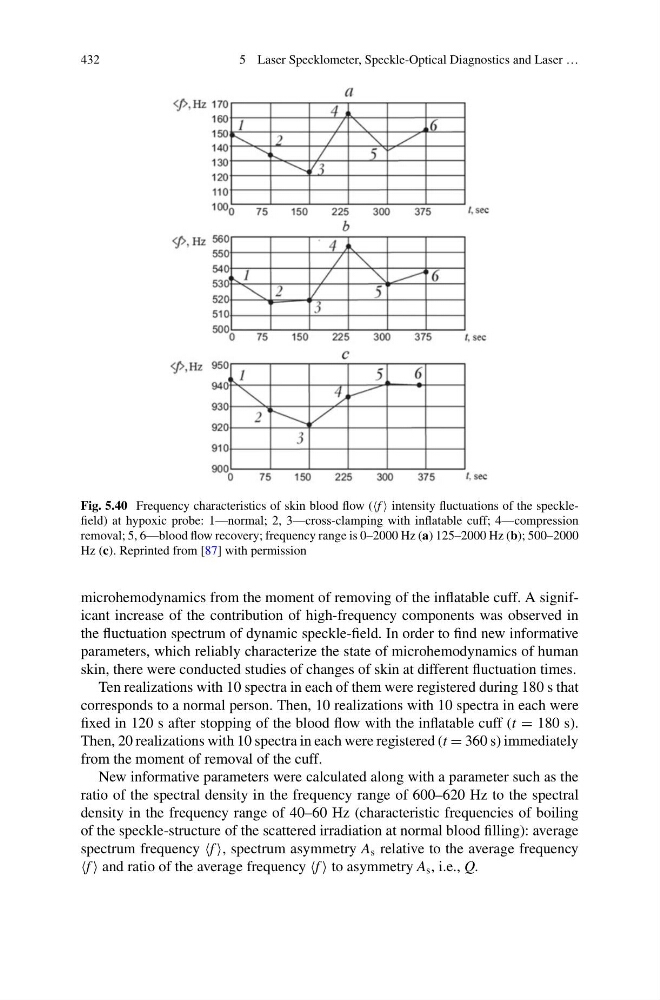
Fig. 5.40 Frequency characteristics of skin blood flow (f intensity fluctuations of the specklefield) at hypoxic probe: 1—normal; 2, 3—cross-clamping with inflatable cuff; 4—compression
removal; 5, 6—blood flow recovery; frequency range is 0–2000 Hz (a) 125–2000 Hz (b); 500–2000
Hz (c). Reprinted from [87] with permission
microhemodynamics from the moment of removing of the inflatable cuff. A significant increase of the contribution of high-frequency components was observed in
the fluctuation spectrum of dynamic speckle-field. In order to find new informative
parameters, which reliably characterize the state of microhemodynamics of human
skin, there were conducted studies of changes of skin at different fluctuation times.
Ten realizations with 10 spectra in each of them were registered during 180 s that
corresponds to a normal person. Then, 10 realizations with 10 spectra in each were
fixed in 120 s after stopping of the blood flow with the inflatable cuff (t = 180 s).
Then, 20 realizations with 10 spectra in each were registered (t = 360 s) immediately
from the moment of removal of the cuff.
New informative parameters were calculated along with a parameter such as the
ratio of the spectral density in the frequency range of 600–620 Hz to the spectral
density in the frequency range of 40–60 Hz (characteristic frequencies of boiling
of the speckle-structure of the scattered irradiation at normal blood filling): average
spectrum frequency f , spectrum asymmetry A s relative to the average frequency
f and ratio of the average frequency f to asymmetry A s , i.e., Q.
5 Laser Specklometer, Speckle-Optical Diagnostics and Laser …
Fig. 5.40 Frequency characteristics of skin blood flow (f intensity fluctuations of the specklefield) at hypoxic probe: 1—normal; 2, 3—cross-clamping with inflatable cuff; 4—compression
removal; 5, 6—blood flow recovery; frequency range is 0–2000 Hz (a) 125–2000 Hz (b); 500–2000
Hz (c). Reprinted from [87] with permission
microhemodynamics from the moment of removing of the inflatable cuff. A significant increase of the contribution of high-frequency components was observed in
the fluctuation spectrum of dynamic speckle-field. In order to find new informative
parameters, which reliably characterize the state of microhemodynamics of human
skin, there were conducted studies of changes of skin at different fluctuation times.
Ten realizations with 10 spectra in each of them were registered during 180 s that
corresponds to a normal person. Then, 10 realizations with 10 spectra in each were
fixed in 120 s after stopping of the blood flow with the inflatable cuff (t = 180 s).
Then, 20 realizations with 10 spectra in each were registered (t = 360 s) immediately
from the moment of removal of the cuff.
New informative parameters were calculated along with a parameter such as the
ratio of the spectral density in the frequency range of 600–620 Hz to the spectral
density in the frequency range of 40–60 Hz (characteristic frequencies of boiling
of the speckle-structure of the scattered irradiation at normal blood filling): average
spectrum frequency f , spectrum asymmetry A s relative to the average frequency
f and ratio of the average frequency f to asymmetry A s , i.e., Q.