

5.9 Investigation of Microhemodynamics of Human Skin Using …
433
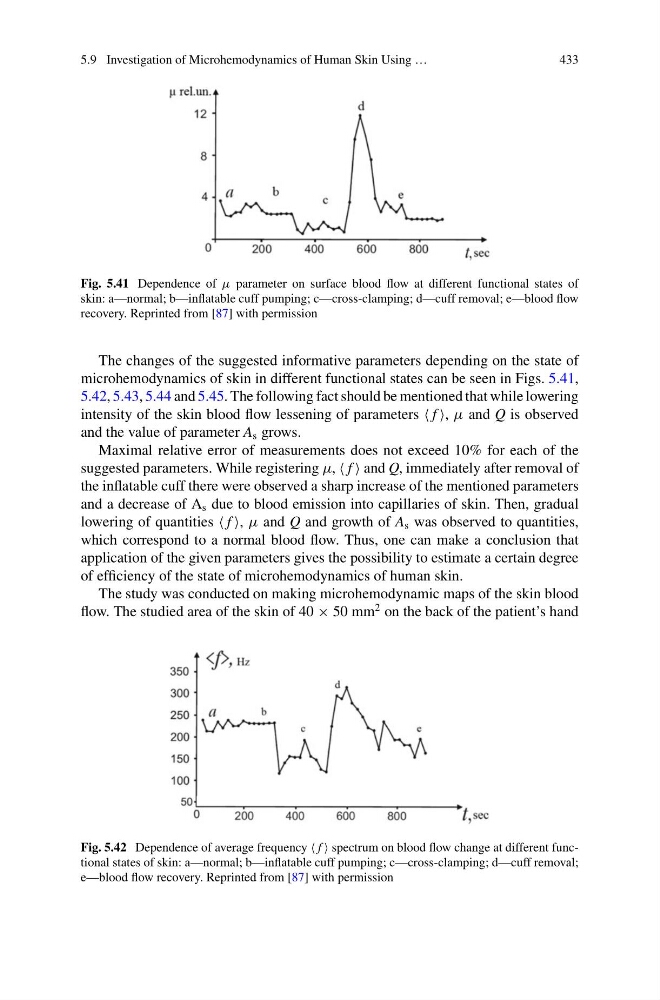
Fig. 5.41 Dependence of μ parameter on surface blood flow at different functional states of
skin: a—normal; b—inflatable cuff pumping; c—cross-clamping; d—cuff removal; e—blood flow
recovery. Reprinted from [87] with permission
The changes of the suggested informative parameters depending on the state of
microhemodynamics of skin in different functional states can be seen in Figs. 5.41,
5.42, 5.43, 5.44 and 5.45. The following fact should be mentioned that while lowering
intensity of the skin blood flow lessening of parameters f , μ and Q is observed
and the value of parameter A s grows.
Maximal relative error of measurements does not exceed 10% for each of the
suggested parameters. While registering μ, f and Q, immediately after removal of
the inflatable cuff there were observed a sharp increase of the mentioned parameters
and a decrease of A s due to blood emission into capillaries of skin. Then, gradual
lowering of quantities f , μ and Q and growth of A s was observed to quantities,
which correspond to a normal blood flow. Thus, one can make a conclusion that
application of the given parameters gives the possibility to estimate a certain degree
of efficiency of the state of microhemodynamics of human skin.
The study was conducted on making microhemodynamic maps of the skin blood
flow. The studied area of the skin of 40 × 50 mm
2 on the back of the patient’s hand
Fig. 5.42 Dependence of average frequency f spectrum on blood flow change at different functional states of skin: a—normal; b—inflatable cuff pumping; c—cross-clamping; d—cuff removal;
e—blood flow recovery. Reprinted from [87] with permission
433
Fig. 5.41 Dependence of μ parameter on surface blood flow at different functional states of
skin: a—normal; b—inflatable cuff pumping; c—cross-clamping; d—cuff removal; e—blood flow
recovery. Reprinted from [87] with permission
The changes of the suggested informative parameters depending on the state of
microhemodynamics of skin in different functional states can be seen in Figs. 5.41,
5.42, 5.43, 5.44 and 5.45. The following fact should be mentioned that while lowering
intensity of the skin blood flow lessening of parameters f , μ and Q is observed
and the value of parameter A s grows.
Maximal relative error of measurements does not exceed 10% for each of the
suggested parameters. While registering μ, f and Q, immediately after removal of
the inflatable cuff there were observed a sharp increase of the mentioned parameters
and a decrease of A s due to blood emission into capillaries of skin. Then, gradual
lowering of quantities f , μ and Q and growth of A s was observed to quantities,
which correspond to a normal blood flow. Thus, one can make a conclusion that
application of the given parameters gives the possibility to estimate a certain degree
of efficiency of the state of microhemodynamics of human skin.
The study was conducted on making microhemodynamic maps of the skin blood
flow. The studied area of the skin of 40 × 50 mm
2 on the back of the patient’s hand
Fig. 5.42 Dependence of average frequency f spectrum on blood flow change at different functional states of skin: a—normal; b—inflatable cuff pumping; c—cross-clamping; d—cuff removal;
e—blood flow recovery. Reprinted from [87] with permission