

342
4 Speckle-Optical Methods and Devices for Studying …
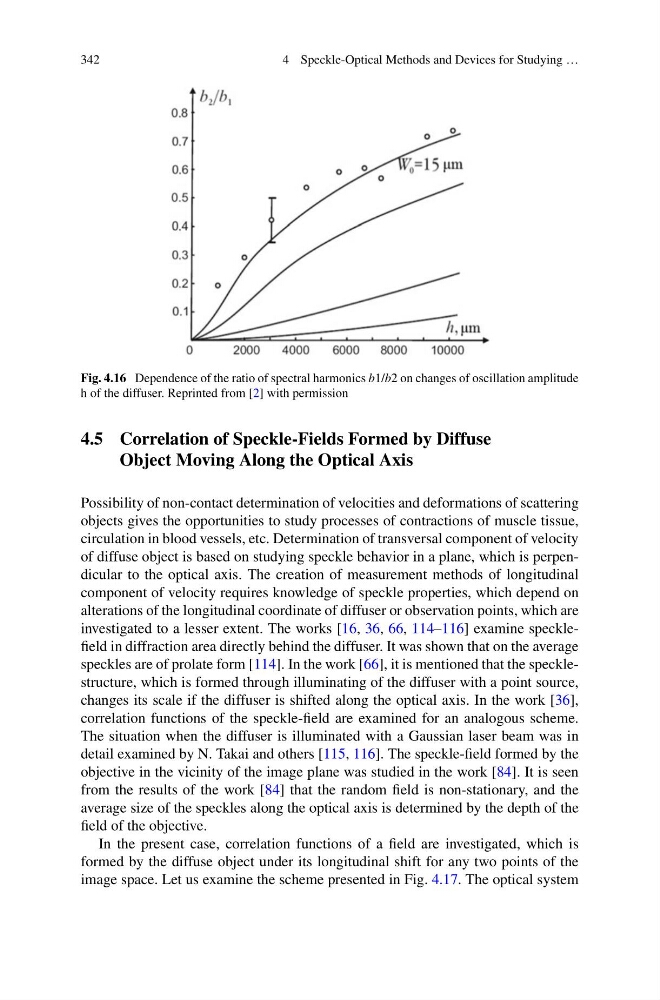
Fig. 4.16 Dependence of the ratio of spectral harmonics b1/b2 on changes of oscillation amplitude
h of the diffuser. Reprinted from [2] with permission
4.5 Correlation of Speckle-Fields Formed by Diffuse
Object Moving Along the Optical Axis
Possibility of non-contact determination of velocities and deformations of scattering
objects gives the opportunities to study processes of contractions of muscle tissue,
circulation in blood vessels, etc. Determination of transversal component of velocity
of diffuse object is based on studying speckle behavior in a plane, which is perpendicular to the optical axis. The creation of measurement methods of longitudinal
component of velocity requires knowledge of speckle properties, which depend on
alterations of the longitudinal coordinate of diffuser or observation points, which are
investigated to a lesser extent. The works [16, 36, 66, 114–116] examine specklefield in diffraction area directly behind the diffuser. It was shown that on the average
speckles are of prolate form [114]. In the work [66], it is mentioned that the specklestructure, which is formed through illuminating of the diffuser with a point source,
changes its scale if the diffuser is shifted along the optical axis. In the work [36],
correlation functions of the speckle-field are examined for an analogous scheme.
The situation when the diffuser is illuminated with a Gaussian laser beam was in
detail examined by N. Takai and others [115, 116]. The speckle-field formed by the
objective in the vicinity of the image plane was studied in the work [84]. It is seen
from the results of the work [84] that the random field is non-stationary, and the
average size of the speckles along the optical axis is determined by the depth of the
field of the objective.
In the present case, correlation functions of a field are investigated, which is
formed by the diffuse object under its longitudinal shift for any two points of the
image space. Let us examine the scheme presented in Fig. 4.17. The optical system
4 Speckle-Optical Methods and Devices for Studying …
Fig. 4.16 Dependence of the ratio of spectral harmonics b1/b2 on changes of oscillation amplitude
h of the diffuser. Reprinted from [2] with permission
4.5 Correlation of Speckle-Fields Formed by Diffuse
Object Moving Along the Optical Axis
Possibility of non-contact determination of velocities and deformations of scattering
objects gives the opportunities to study processes of contractions of muscle tissue,
circulation in blood vessels, etc. Determination of transversal component of velocity
of diffuse object is based on studying speckle behavior in a plane, which is perpendicular to the optical axis. The creation of measurement methods of longitudinal
component of velocity requires knowledge of speckle properties, which depend on
alterations of the longitudinal coordinate of diffuser or observation points, which are
investigated to a lesser extent. The works [16, 36, 66, 114–116] examine specklefield in diffraction area directly behind the diffuser. It was shown that on the average
speckles are of prolate form [114]. In the work [66], it is mentioned that the specklestructure, which is formed through illuminating of the diffuser with a point source,
changes its scale if the diffuser is shifted along the optical axis. In the work [36],
correlation functions of the speckle-field are examined for an analogous scheme.
The situation when the diffuser is illuminated with a Gaussian laser beam was in
detail examined by N. Takai and others [115, 116]. The speckle-field formed by the
objective in the vicinity of the image plane was studied in the work [84]. It is seen
from the results of the work [84] that the random field is non-stationary, and the
average size of the speckles along the optical axis is determined by the depth of the
field of the objective.
In the present case, correlation functions of a field are investigated, which is
formed by the diffuse object under its longitudinal shift for any two points of the
image space. Let us examine the scheme presented in Fig. 4.17. The optical system