

276
3 Holographic Interferometry for Studying …
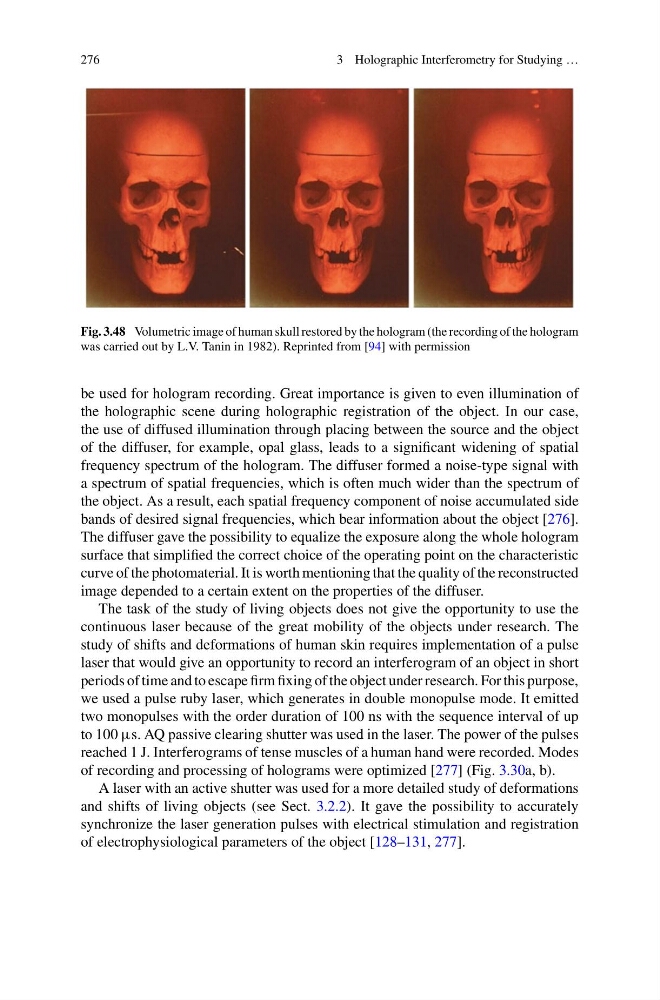
Fig. 3.48 Volumetric image of human skull restored by the hologram (the recording of the hologram
was carried out by L.V. Tanin in 1982). Reprinted from [94] with permission
be used for hologram recording. Great importance is given to even illumination of
the holographic scene during holographic registration of the object. In our case,
the use of diffused illumination through placing between the source and the object
of the diffuser, for example, opal glass, leads to a significant widening of spatial
frequency spectrum of the hologram. The diffuser formed a noise-type signal with
a spectrum of spatial frequencies, which is often much wider than the spectrum of
the object. As a result, each spatial frequency component of noise accumulated side
bands of desired signal frequencies, which bear information about the object [276].
The diffuser gave the possibility to equalize the exposure along the whole hologram
surface that simplified the correct choice of the operating point on the characteristic
curve of the photomaterial. It is worth mentioning that the quality of the reconstructed
image depended to a certain extent on the properties of the diffuser.
The task of the study of living objects does not give the opportunity to use the
continuous laser because of the great mobility of the objects under research. The
study of shifts and deformations of human skin requires implementation of a pulse
laser that would give an opportunity to record an interferogram of an object in short
periods of time and to escape firm fixing of the object under research. For this purpose,
we used a pulse ruby laser, which generates in double monopulse mode. It emitted
two monopulses with the order duration of 100 ns with the sequence interval of up
to 100 μs. AQ passive clearing shutter was used in the laser. The power of the pulses
reached 1 J. Interferograms of tense muscles of a human hand were recorded. Modes
of recording and processing of holograms were optimized [277] (Fig. 3.30a, b).
A laser with an active shutter was used for a more detailed study of deformations
and shifts of living objects (see Sect. 3.2.2). It gave the possibility to accurately
synchronize the laser generation pulses with electrical stimulation and registration
of electrophysiological parameters of the object [128–131, 277].
3 Holographic Interferometry for Studying …
Fig. 3.48 Volumetric image of human skull restored by the hologram (the recording of the hologram
was carried out by L.V. Tanin in 1982). Reprinted from [94] with permission
be used for hologram recording. Great importance is given to even illumination of
the holographic scene during holographic registration of the object. In our case,
the use of diffused illumination through placing between the source and the object
of the diffuser, for example, opal glass, leads to a significant widening of spatial
frequency spectrum of the hologram. The diffuser formed a noise-type signal with
a spectrum of spatial frequencies, which is often much wider than the spectrum of
the object. As a result, each spatial frequency component of noise accumulated side
bands of desired signal frequencies, which bear information about the object [276].
The diffuser gave the possibility to equalize the exposure along the whole hologram
surface that simplified the correct choice of the operating point on the characteristic
curve of the photomaterial. It is worth mentioning that the quality of the reconstructed
image depended to a certain extent on the properties of the diffuser.
The task of the study of living objects does not give the opportunity to use the
continuous laser because of the great mobility of the objects under research. The
study of shifts and deformations of human skin requires implementation of a pulse
laser that would give an opportunity to record an interferogram of an object in short
periods of time and to escape firm fixing of the object under research. For this purpose,
we used a pulse ruby laser, which generates in double monopulse mode. It emitted
two monopulses with the order duration of 100 ns with the sequence interval of up
to 100 μs. AQ passive clearing shutter was used in the laser. The power of the pulses
reached 1 J. Interferograms of tense muscles of a human hand were recorded. Modes
of recording and processing of holograms were optimized [277] (Fig. 3.30a, b).
A laser with an active shutter was used for a more detailed study of deformations
and shifts of living objects (see Sect. 3.2.2). It gave the possibility to accurately
synchronize the laser generation pulses with electrical stimulation and registration
of electrophysiological parameters of the object [128–131, 277].