

3.4 Holographic Research Methods in Biology and Medicine
275
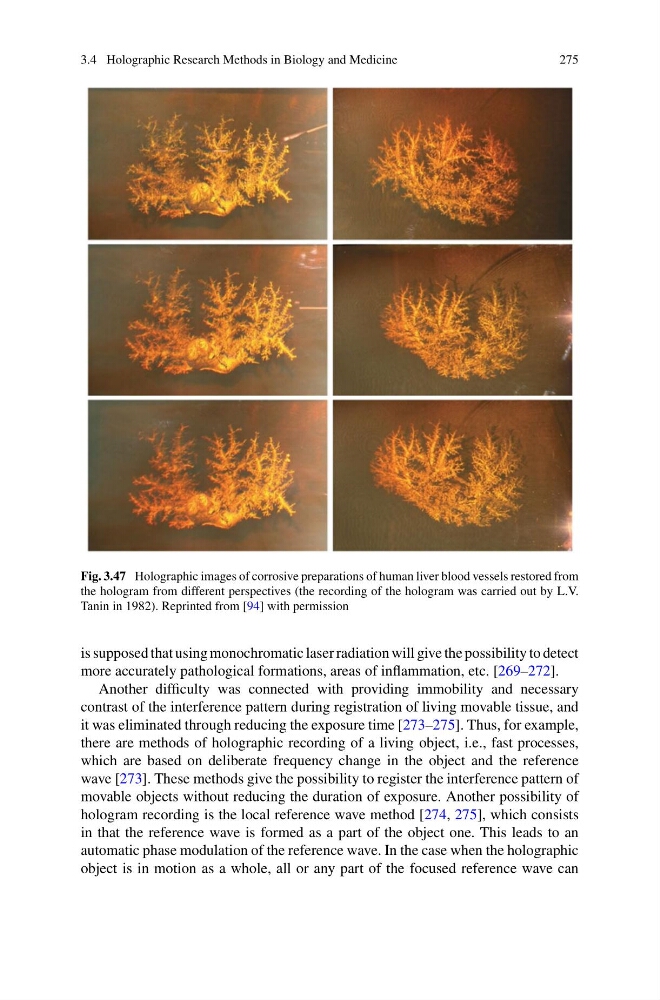
Fig. 3.47 Holographic images of corrosive preparations of human liver blood vessels restored from
the hologram from different perspectives (the recording of the hologram was carried out by L.V.
Tanin in 1982). Reprinted from [94] with permission
is supposed that using monochromatic laser radiation will give the possibility to detect
more accurately pathological formations, areas of inflammation, etc. [269–272].
Another difficulty was connected with providing immobility and necessary
contrast of the interference pattern during registration of living movable tissue, and
it was eliminated through reducing the exposure time [273–275]. Thus, for example,
there are methods of holographic recording of a living object, i.e., fast processes,
which are based on deliberate frequency change in the object and the reference
wave [273]. These methods give the possibility to register the interference pattern of
movable objects without reducing the duration of exposure. Another possibility of
hologram recording is the local reference wave method [274, 275], which consists
in that the reference wave is formed as a part of the object one. This leads to an
automatic phase modulation of the reference wave. In the case when the holographic
object is in motion as a whole, all or any part of the focused reference wave can
275
Fig. 3.47 Holographic images of corrosive preparations of human liver blood vessels restored from
the hologram from different perspectives (the recording of the hologram was carried out by L.V.
Tanin in 1982). Reprinted from [94] with permission
is supposed that using monochromatic laser radiation will give the possibility to detect
more accurately pathological formations, areas of inflammation, etc. [269–272].
Another difficulty was connected with providing immobility and necessary
contrast of the interference pattern during registration of living movable tissue, and
it was eliminated through reducing the exposure time [273–275]. Thus, for example,
there are methods of holographic recording of a living object, i.e., fast processes,
which are based on deliberate frequency change in the object and the reference
wave [273]. These methods give the possibility to register the interference pattern of
movable objects without reducing the duration of exposure. Another possibility of
hologram recording is the local reference wave method [274, 275], which consists
in that the reference wave is formed as a part of the object one. This leads to an
automatic phase modulation of the reference wave. In the case when the holographic
object is in motion as a whole, all or any part of the focused reference wave can