

274
3 Holographic Interferometry for Studying …
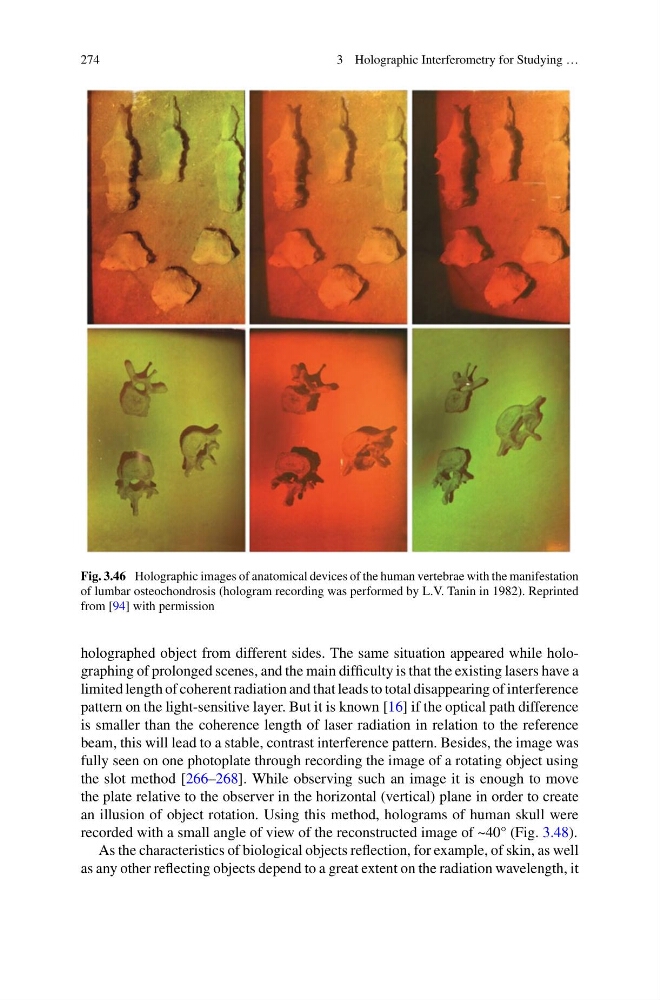
Fig. 3.46 Holographic images of anatomical devices of the human vertebrae with the manifestation
of lumbar osteochondrosis (hologram recording was performed by L.V. Tanin in 1982). Reprinted
from [94] with permission
holographed object from different sides. The same situation appeared while holographing of prolonged scenes, and the main difficulty is that the existing lasers have a
limited length of coherent radiation and that leads to total disappearing of interference
pattern on the light-sensitive layer. But it is known [16] if the optical path difference
is smaller than the coherence length of laser radiation in relation to the reference
beam, this will lead to a stable, contrast interference pattern. Besides, the image was
fully seen on one photoplate through recording the image of a rotating object using
the slot method [266–268]. While observing such an image it is enough to move
the plate relative to the observer in the horizontal (vertical) plane in order to create
an illusion of object rotation. Using this method, holograms of human skull were
recorded with a small angle of view of the reconstructed image of ~40° (Fig. 3.48).
As the characteristics of biological objects reflection, for example, of skin, as well
as any other reflecting objects depend to a great extent on the radiation wavelength, it
3 Holographic Interferometry for Studying …
Fig. 3.46 Holographic images of anatomical devices of the human vertebrae with the manifestation
of lumbar osteochondrosis (hologram recording was performed by L.V. Tanin in 1982). Reprinted
from [94] with permission
holographed object from different sides. The same situation appeared while holographing of prolonged scenes, and the main difficulty is that the existing lasers have a
limited length of coherent radiation and that leads to total disappearing of interference
pattern on the light-sensitive layer. But it is known [16] if the optical path difference
is smaller than the coherence length of laser radiation in relation to the reference
beam, this will lead to a stable, contrast interference pattern. Besides, the image was
fully seen on one photoplate through recording the image of a rotating object using
the slot method [266–268]. While observing such an image it is enough to move
the plate relative to the observer in the horizontal (vertical) plane in order to create
an illusion of object rotation. Using this method, holograms of human skull were
recorded with a small angle of view of the reconstructed image of ~40° (Fig. 3.48).
As the characteristics of biological objects reflection, for example, of skin, as well
as any other reflecting objects depend to a great extent on the radiation wavelength, it