

3.4 Holographic Research Methods in Biology and Medicine
277
The given holograms evoked great interest at exhibitions in our country and abroad
(Austria, Germany, Great Britain, Japan, Finland, Australia, India, Czechoslovakia,
etc.) in 1985–1995.
3.4.2 Methods of Formation of Combined Images
Methods of formation of images were created, which are in obtaining of combined
complementary three-dimensional and plane images, which can be used for visualization of structural changes of medical–biological objects as well. The possibility
was studied for formation of coherent and non-coherent images. The ways of image
forming enhance the effect of perception of optical information. Enhancement of the
perception effect is reached at the expense of obtaining complementary combined
plane and three-dimensional images. This method gives the possibility to form and
reconstruct combined images in color, motion and bulk. It provides continuous visible
information with simultaneous volume regulation. The continuous information is
provided by the plane image of the object and the holographic image contains the
additional information about the object.
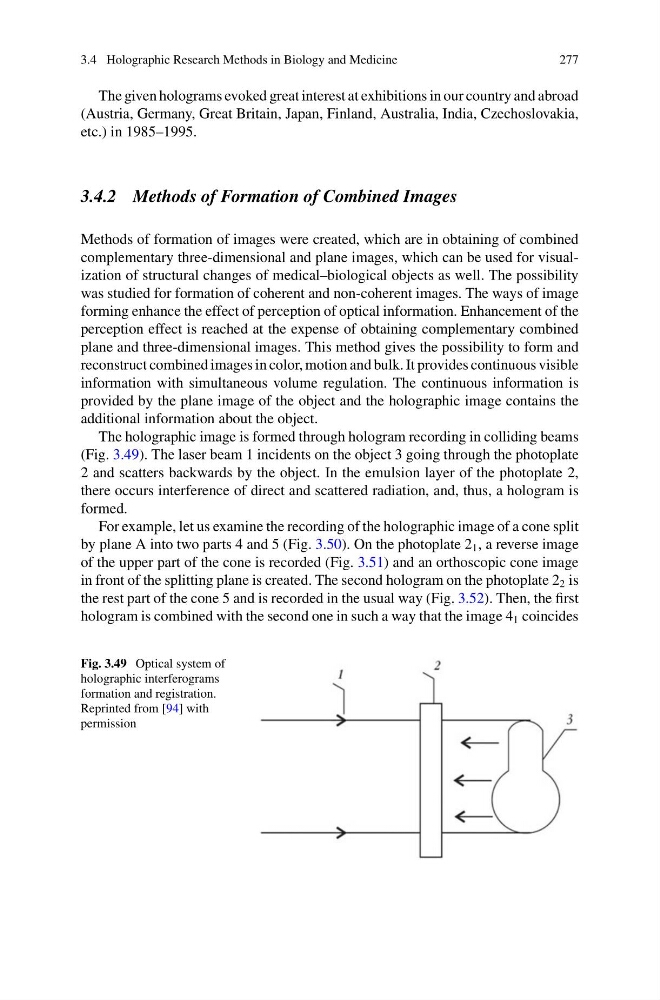
The holographic image is formed through hologram recording in colliding beams
(Fig. 3.49). The laser beam 1 incidents on the object 3 going through the photoplate
2 and scatters backwards by the object. In the emulsion layer of the photoplate 2,
there occurs interference of direct and scattered radiation, and, thus, a hologram is
formed.
For example, let us examine the recording of the holographic image of a cone split
by plane A into two parts 4 and 5 (Fig. 3.50). On the photoplate 2 1 , a reverse image
of the upper part of the cone is recorded (Fig. 3.51) and an orthoscopic cone image
in front of the splitting plane is created. The second hologram on the photoplate 2 2 is
the rest part of the cone 5 and is recorded in the usual way (Fig. 3.52). Then, the first
hologram is combined with the second one in such a way that the image 4 1 coincides
Fig. 3.49 Optical system of
holographic interferograms
formation and registration.
Reprinted from [94] with
permission
277
The given holograms evoked great interest at exhibitions in our country and abroad
(Austria, Germany, Great Britain, Japan, Finland, Australia, India, Czechoslovakia,
etc.) in 1985–1995.
3.4.2 Methods of Formation of Combined Images
Methods of formation of images were created, which are in obtaining of combined
complementary three-dimensional and plane images, which can be used for visualization of structural changes of medical–biological objects as well. The possibility
was studied for formation of coherent and non-coherent images. The ways of image
forming enhance the effect of perception of optical information. Enhancement of the
perception effect is reached at the expense of obtaining complementary combined
plane and three-dimensional images. This method gives the possibility to form and
reconstruct combined images in color, motion and bulk. It provides continuous visible
information with simultaneous volume regulation. The continuous information is
provided by the plane image of the object and the holographic image contains the
additional information about the object.
The holographic image is formed through hologram recording in colliding beams
(Fig. 3.49). The laser beam 1 incidents on the object 3 going through the photoplate
2 and scatters backwards by the object. In the emulsion layer of the photoplate 2,
there occurs interference of direct and scattered radiation, and, thus, a hologram is
formed.
For example, let us examine the recording of the holographic image of a cone split
by plane A into two parts 4 and 5 (Fig. 3.50). On the photoplate 2 1 , a reverse image
of the upper part of the cone is recorded (Fig. 3.51) and an orthoscopic cone image
in front of the splitting plane is created. The second hologram on the photoplate 2 2 is
the rest part of the cone 5 and is recorded in the usual way (Fig. 3.52). Then, the first
hologram is combined with the second one in such a way that the image 4 1 coincides
Fig. 3.49 Optical system of
holographic interferograms
formation and registration.
Reprinted from [94] with
permission