

3.3 Laser-Holographic Complex …
259
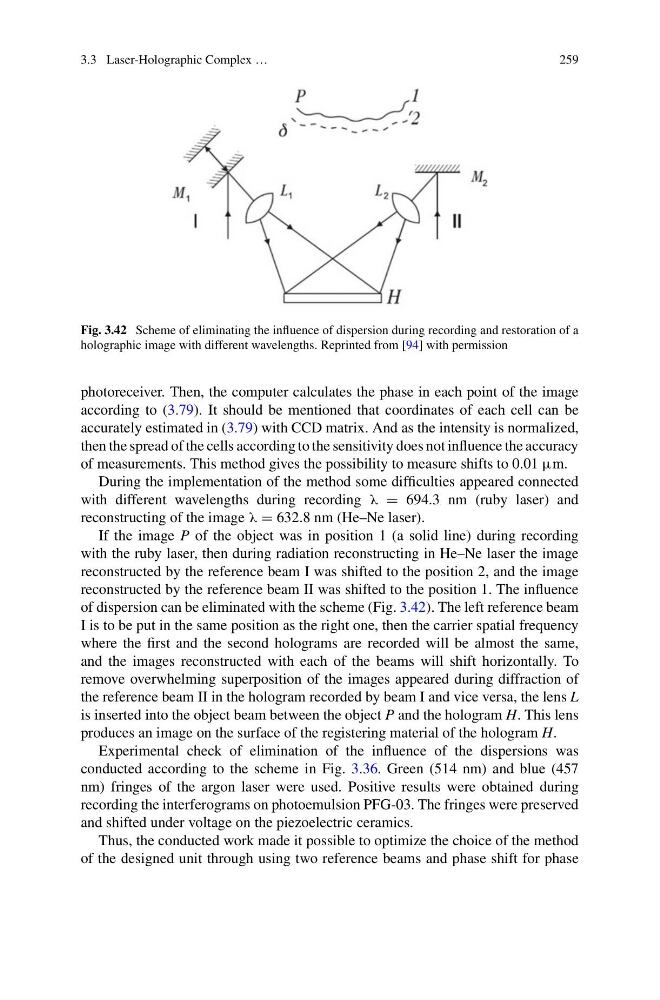
Fig. 3.42 Scheme of eliminating the influence of dispersion during recording and restoration of a
holographic image with different wavelengths. Reprinted from [94] with permission
photoreceiver. Then, the computer calculates the phase in each point of the image
according to (3.79). It should be mentioned that coordinates of each cell can be
accurately estimated in (3.79) with CCD matrix. And as the intensity is normalized,
then the spread of the cells according to the sensitivity does not influence the accuracy
of measurements. This method gives the possibility to measure shifts to 0.01 μm.
During the implementation of the method some difficulties appeared connected
with different wavelengths during recording λ = 694.3 nm (ruby laser) and
reconstructing of the image λ = 632.8 nm (He–Ne laser).
If the image P of the object was in position 1 (a solid line) during recording
with the ruby laser, then during radiation reconstructing in He–Ne laser the image
reconstructed by the reference beam I was shifted to the position 2, and the image
reconstructed by the reference beam II was shifted to the position 1. The influence
of dispersion can be eliminated with the scheme (Fig. 3.42). The left reference beam
I is to be put in the same position as the right one, then the carrier spatial frequency
where the first and the second holograms are recorded will be almost the same,
and the images reconstructed with each of the beams will shift horizontally. To
remove overwhelming superposition of the images appeared during diffraction of
the reference beam II in the hologram recorded by beam I and vice versa, the lens L
is inserted into the object beam between the object P and the hologram H. This lens
produces an image on the surface of the registering material of the hologram H.
Experimental check of elimination of the influence of the dispersions was
conducted according to the scheme in Fig. 3.36. Green (514 nm) and blue (457
nm) fringes of the argon laser were used. Positive results were obtained during
recording the interferograms on photoemulsion PFG-03. The fringes were preserved
and shifted under voltage on the piezoelectric ceramics.
Thus, the conducted work made it possible to optimize the choice of the method
of the designed unit through using two reference beams and phase shift for phase
259
Fig. 3.42 Scheme of eliminating the influence of dispersion during recording and restoration of a
holographic image with different wavelengths. Reprinted from [94] with permission
photoreceiver. Then, the computer calculates the phase in each point of the image
according to (3.79). It should be mentioned that coordinates of each cell can be
accurately estimated in (3.79) with CCD matrix. And as the intensity is normalized,
then the spread of the cells according to the sensitivity does not influence the accuracy
of measurements. This method gives the possibility to measure shifts to 0.01 μm.
During the implementation of the method some difficulties appeared connected
with different wavelengths during recording λ = 694.3 nm (ruby laser) and
reconstructing of the image λ = 632.8 nm (He–Ne laser).
If the image P of the object was in position 1 (a solid line) during recording
with the ruby laser, then during radiation reconstructing in He–Ne laser the image
reconstructed by the reference beam I was shifted to the position 2, and the image
reconstructed by the reference beam II was shifted to the position 1. The influence
of dispersion can be eliminated with the scheme (Fig. 3.42). The left reference beam
I is to be put in the same position as the right one, then the carrier spatial frequency
where the first and the second holograms are recorded will be almost the same,
and the images reconstructed with each of the beams will shift horizontally. To
remove overwhelming superposition of the images appeared during diffraction of
the reference beam II in the hologram recorded by beam I and vice versa, the lens L
is inserted into the object beam between the object P and the hologram H. This lens
produces an image on the surface of the registering material of the hologram H.
Experimental check of elimination of the influence of the dispersions was
conducted according to the scheme in Fig. 3.36. Green (514 nm) and blue (457
nm) fringes of the argon laser were used. Positive results were obtained during
recording the interferograms on photoemulsion PFG-03. The fringes were preserved
and shifted under voltage on the piezoelectric ceramics.
Thus, the conducted work made it possible to optimize the choice of the method
of the designed unit through using two reference beams and phase shift for phase