

252
3 Holographic Interferometry for Studying …
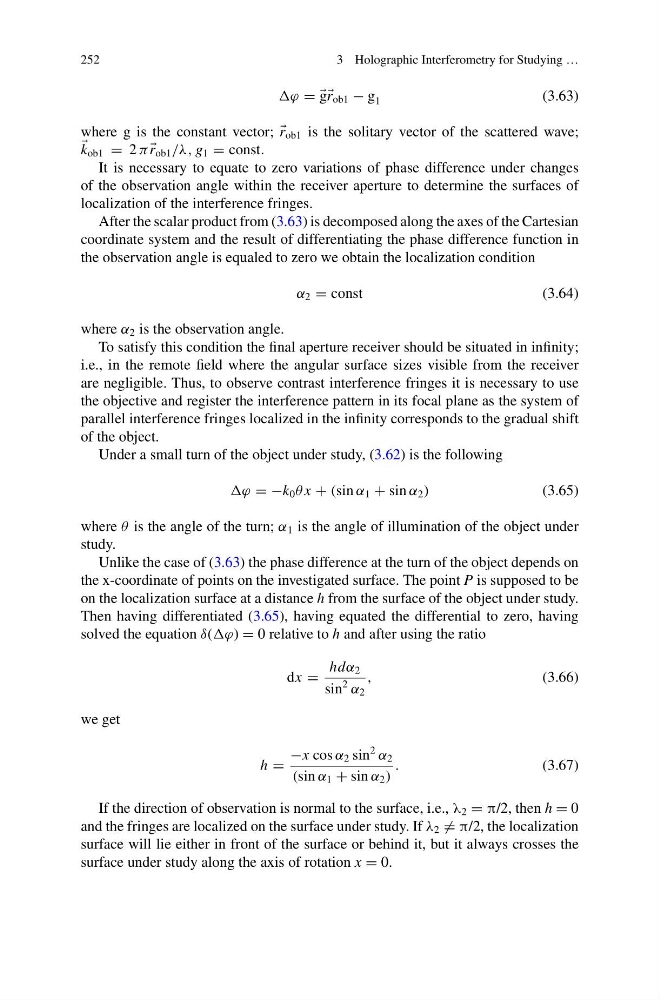
ϕ = =
g r ob1 − g 1
(3.63)
where g is the constant vector;
r ob1 is the solitary vector of the scattered wave;
k ob1 = 2 π
r ob1 /λ, g 1 = const.
It is necessary to equate to zero variations of phase difference under changes
of the observation angle within the receiver aperture to determine the surfaces of
localization of the interference fringes.
After the scalar product from (3.63) is decomposed along the axes of the Cartesian
coordinate system and the result of differentiating the phase difference function in
the observation angle is equaled to zero we obtain the localization condition
α 2 = const
(3.64)
where α 2 is the observation angle.
To satisfy this condition the final aperture receiver should be situated in infinity;
i.e., in the remote field where the angular surface sizes visible from the receiver
are negligible. Thus, to observe contrast interference fringes it is necessary to use
the objective and register the interference pattern in its focal plane as the system of
parallel interference fringes localized in the infinity corresponds to the gradual shift
of the object.
Under a small turn of the object under study, (3.62) is the following
ϕ = −k 0 θ x + (sin α 1 + sin α 2 )
(3.65)
where θ is the angle of the turn; α 1 is the angle of illumination of the object under
study.
Unlike the case of (3.63) the phase difference at the turn of the object depends on
the x-coordinate of points on the investigated surface. The point P is supposed to be
on the localization surface at a distance h from the surface of the object under study.
Then having differentiated (3.65), having equated the differential to zero, having
solved the equation δ(ϕ) = 0 relative to h and after using the ratio
dx =
hdα 2
sin
2
α 2
,
(3.66)
we get
h =
−x cos α 2 sin
2
α 2
(sin α 1 + sin α 2 )
.
(3.67)
If the direction of observation is normal to the surface, i.e., λ 2 = π/2, then h = 0
and the fringes are localized on the surface under study. If λ 2 = π/2, the localization
surface will lie either in front of the surface or behind it, but it always crosses the
surface under study along the axis of rotation x = 0.
3 Holographic Interferometry for Studying …
ϕ = =
g r ob1 − g 1
(3.63)
where g is the constant vector;
r ob1 is the solitary vector of the scattered wave;
k ob1 = 2 π
r ob1 /λ, g 1 = const.
It is necessary to equate to zero variations of phase difference under changes
of the observation angle within the receiver aperture to determine the surfaces of
localization of the interference fringes.
After the scalar product from (3.63) is decomposed along the axes of the Cartesian
coordinate system and the result of differentiating the phase difference function in
the observation angle is equaled to zero we obtain the localization condition
α 2 = const
(3.64)
where α 2 is the observation angle.
To satisfy this condition the final aperture receiver should be situated in infinity;
i.e., in the remote field where the angular surface sizes visible from the receiver
are negligible. Thus, to observe contrast interference fringes it is necessary to use
the objective and register the interference pattern in its focal plane as the system of
parallel interference fringes localized in the infinity corresponds to the gradual shift
of the object.
Under a small turn of the object under study, (3.62) is the following
ϕ = −k 0 θ x + (sin α 1 + sin α 2 )
(3.65)
where θ is the angle of the turn; α 1 is the angle of illumination of the object under
study.
Unlike the case of (3.63) the phase difference at the turn of the object depends on
the x-coordinate of points on the investigated surface. The point P is supposed to be
on the localization surface at a distance h from the surface of the object under study.
Then having differentiated (3.65), having equated the differential to zero, having
solved the equation δ(ϕ) = 0 relative to h and after using the ratio
dx =
hdα 2
sin
2
α 2
,
(3.66)
we get
h =
−x cos α 2 sin
2
α 2
(sin α 1 + sin α 2 )
.
(3.67)
If the direction of observation is normal to the surface, i.e., λ 2 = π/2, then h = 0
and the fringes are localized on the surface under study. If λ 2 = π/2, the localization
surface will lie either in front of the surface or behind it, but it always crosses the
surface under study along the axis of rotation x = 0.