

3.2 Holographic Interferometry Using Generation Regime …
231
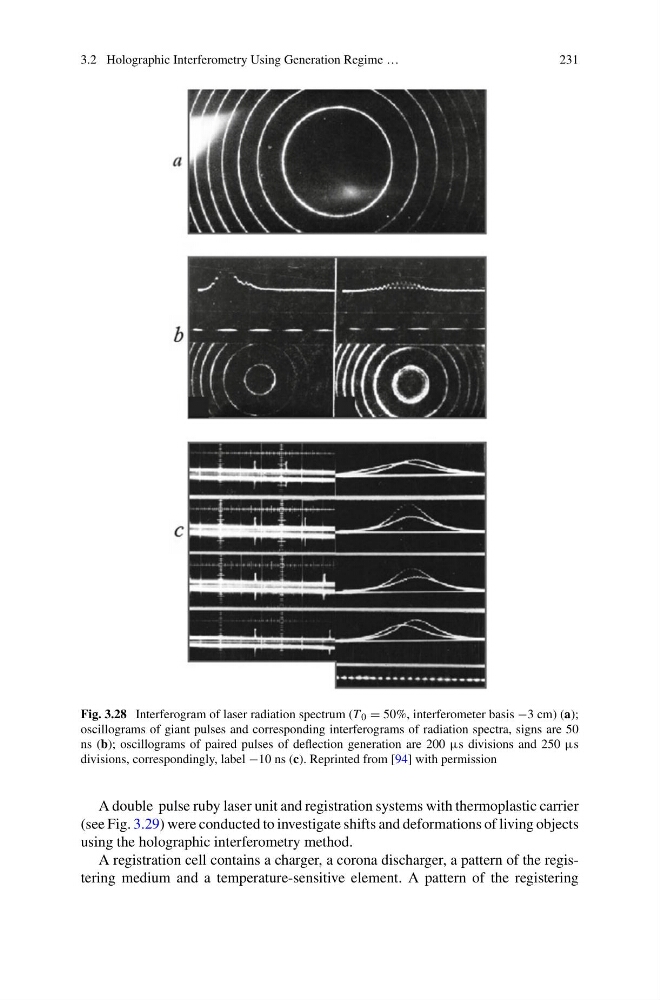
Fig. 3.28 Interferogram of laser radiation spectrum (T 0 = 50%, interferometer basis −3 cm) (a);
oscillograms of giant pulses and corresponding interferograms of radiation spectra, signs are 50
ns (b); oscillograms of paired pulses of deflection generation are 200 μs divisions and 250 μs
divisions, correspondingly, label −10 ns (c). Reprinted from [94] with permission
A double pulse ruby laser unit and registration systems with thermoplastic carrier
(see Fig. 3.29) were conducted to investigate shifts and deformations of living objects
using the holographic interferometry method.
A registration cell contains a charger, a corona discharger, a pattern of the registering medium and a temperature-sensitive element. A pattern of the registering
231
Fig. 3.28 Interferogram of laser radiation spectrum (T 0 = 50%, interferometer basis −3 cm) (a);
oscillograms of giant pulses and corresponding interferograms of radiation spectra, signs are 50
ns (b); oscillograms of paired pulses of deflection generation are 200 μs divisions and 250 μs
divisions, correspondingly, label −10 ns (c). Reprinted from [94] with permission
A double pulse ruby laser unit and registration systems with thermoplastic carrier
(see Fig. 3.29) were conducted to investigate shifts and deformations of living objects
using the holographic interferometry method.
A registration cell contains a charger, a corona discharger, a pattern of the registering medium and a temperature-sensitive element. A pattern of the registering