

232
3 Holographic Interferometry for Studying …
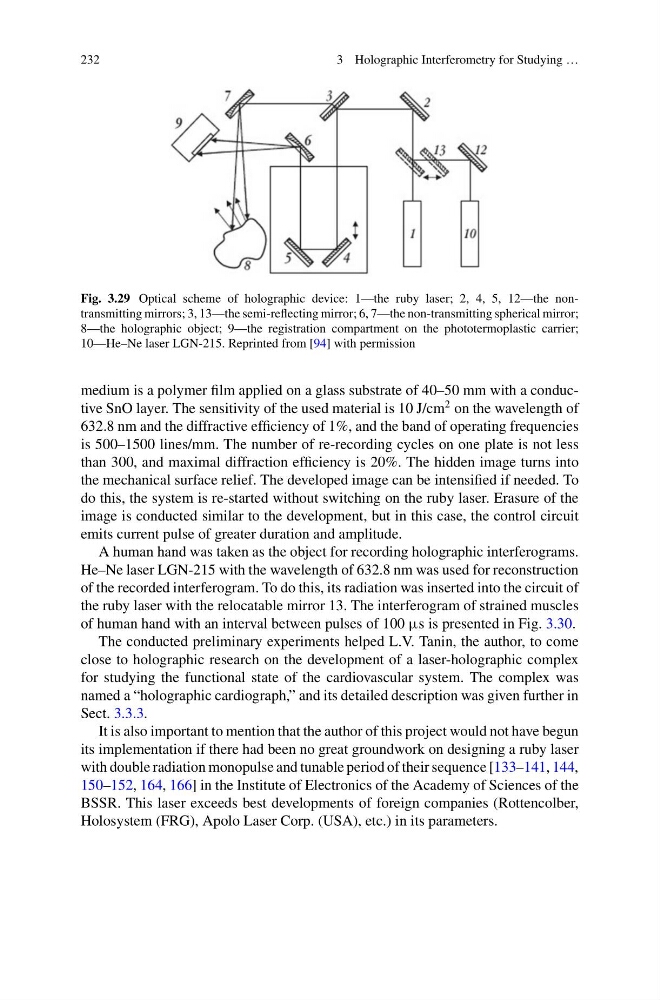
Fig. 3.29 Optical scheme of holographic device: 1—the ruby laser; 2, 4, 5, 12—the nontransmitting mirrors; 3, 13—the semi-reflecting mirror; 6, 7—the non-transmitting spherical mirror;
8—the holographic object; 9—the registration compartment on the phototermoplastic carrier;
10—He–Ne laser LGN-215. Reprinted from [94] with permission
medium is a polymer film applied on a glass substrate of 40–50 mm with a conductive SnO layer. The sensitivity of the used material is 10 J/cm
2 on the wavelength of
632.8 nm and the diffractive efficiency of 1%, and the band of operating frequencies
is 500–1500 lines/mm. The number of re-recording cycles on one plate is not less
than 300, and maximal diffraction efficiency is 20%. The hidden image turns into
the mechanical surface relief. The developed image can be intensified if needed. To
do this, the system is re-started without switching on the ruby laser. Erasure of the
image is conducted similar to the development, but in this case, the control circuit
emits current pulse of greater duration and amplitude.
A human hand was taken as the object for recording holographic interferograms.
He–Ne laser LGN-215 with the wavelength of 632.8 nm was used for reconstruction
of the recorded interferogram. To do this, its radiation was inserted into the circuit of
the ruby laser with the relocatable mirror 13. The interferogram of strained muscles
of human hand with an interval between pulses of 100 μs is presented in Fig. 3.30.
The conducted preliminary experiments helped L.V. Tanin, the author, to come
close to holographic research on the development of a laser-holographic complex
for studying the functional state of the cardiovascular system. The complex was
named a “holographic cardiograph,” and its detailed description was given further in
Sect. 3.3.3.
It is also important to mention that the author of this project would not have begun
its implementation if there had been no great groundwork on designing a ruby laser
with double radiation monopulse and tunable period of their sequence [133–141, 144,
150–152, 164, 166] in the Institute of Electronics of the Academy of Sciences of the
BSSR. This laser exceeds best developments of foreign companies (Rottencolber,
Holosystem (FRG), Apolo Laser Corp. (USA), etc.) in its parameters.
3 Holographic Interferometry for Studying …
Fig. 3.29 Optical scheme of holographic device: 1—the ruby laser; 2, 4, 5, 12—the nontransmitting mirrors; 3, 13—the semi-reflecting mirror; 6, 7—the non-transmitting spherical mirror;
8—the holographic object; 9—the registration compartment on the phototermoplastic carrier;
10—He–Ne laser LGN-215. Reprinted from [94] with permission
medium is a polymer film applied on a glass substrate of 40–50 mm with a conductive SnO layer. The sensitivity of the used material is 10 J/cm
2 on the wavelength of
632.8 nm and the diffractive efficiency of 1%, and the band of operating frequencies
is 500–1500 lines/mm. The number of re-recording cycles on one plate is not less
than 300, and maximal diffraction efficiency is 20%. The hidden image turns into
the mechanical surface relief. The developed image can be intensified if needed. To
do this, the system is re-started without switching on the ruby laser. Erasure of the
image is conducted similar to the development, but in this case, the control circuit
emits current pulse of greater duration and amplitude.
A human hand was taken as the object for recording holographic interferograms.
He–Ne laser LGN-215 with the wavelength of 632.8 nm was used for reconstruction
of the recorded interferogram. To do this, its radiation was inserted into the circuit of
the ruby laser with the relocatable mirror 13. The interferogram of strained muscles
of human hand with an interval between pulses of 100 μs is presented in Fig. 3.30.
The conducted preliminary experiments helped L.V. Tanin, the author, to come
close to holographic research on the development of a laser-holographic complex
for studying the functional state of the cardiovascular system. The complex was
named a “holographic cardiograph,” and its detailed description was given further in
Sect. 3.3.3.
It is also important to mention that the author of this project would not have begun
its implementation if there had been no great groundwork on designing a ruby laser
with double radiation monopulse and tunable period of their sequence [133–141, 144,
150–152, 164, 166] in the Institute of Electronics of the Academy of Sciences of the
BSSR. This laser exceeds best developments of foreign companies (Rottencolber,
Holosystem (FRG), Apolo Laser Corp. (USA), etc.) in its parameters.