

210
3 Holographic Interferometry for Studying …
Fig. 3.12 Dependence of the intensity at the maxima of the interference pattern on the number of
exposures. Reprinted from [94] with permission
Fig. 3.12). But it is supposed that hologram registration is conducted on the linear
section of the characteristic curve. In reality, it is not like this: A part of the exposure
does not get in this area. It is likely to be the key factor, which leads to deviation
of the experimental curve from the theoretical one. But despite this deviation the
preservation of the number of exposures as a constant during one exposure in the
experiment improves the diffractive effectiveness.
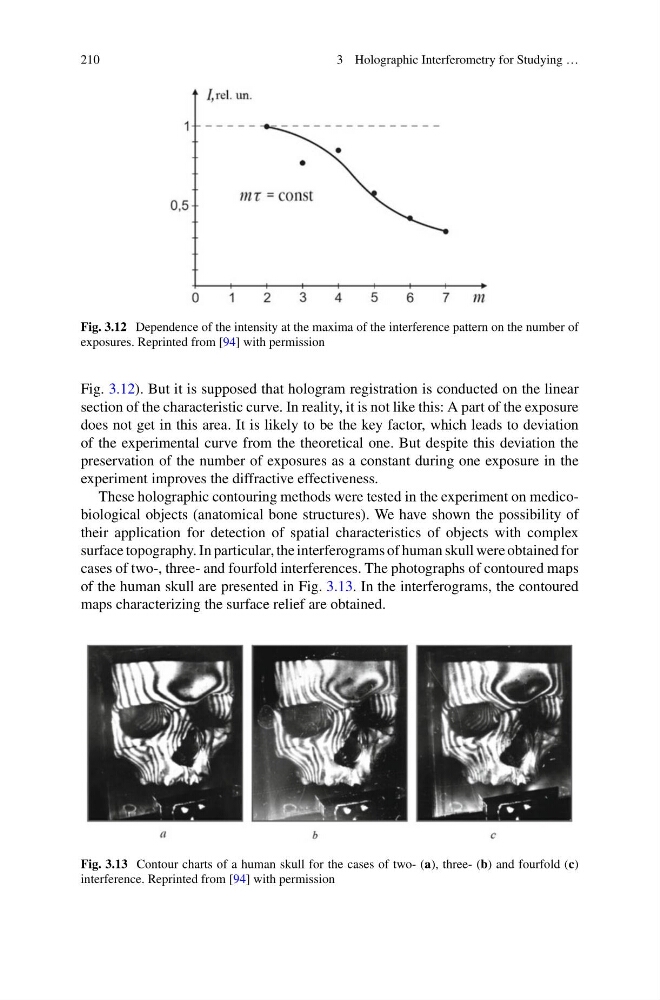
These holographic contouring methods were tested in the experiment on medicobiological objects (anatomical bone structures). We have shown the possibility of
their application for detection of spatial characteristics of objects with complex
surface topography. In particular, the interferograms of human skull were obtained for
cases of two-, three- and fourfold interferences. The photographs of contoured maps
of the human skull are presented in Fig. 3.13. In the interferograms, the contoured
maps characterizing the surface relief are obtained.
Fig. 3.13 Contour charts of a human skull for the cases of two- (a), three- (b) and fourfold (c)
interference. Reprinted from [94] with permission
3 Holographic Interferometry for Studying …
Fig. 3.12 Dependence of the intensity at the maxima of the interference pattern on the number of
exposures. Reprinted from [94] with permission
Fig. 3.12). But it is supposed that hologram registration is conducted on the linear
section of the characteristic curve. In reality, it is not like this: A part of the exposure
does not get in this area. It is likely to be the key factor, which leads to deviation
of the experimental curve from the theoretical one. But despite this deviation the
preservation of the number of exposures as a constant during one exposure in the
experiment improves the diffractive effectiveness.
These holographic contouring methods were tested in the experiment on medicobiological objects (anatomical bone structures). We have shown the possibility of
their application for detection of spatial characteristics of objects with complex
surface topography. In particular, the interferograms of human skull were obtained for
cases of two-, three- and fourfold interferences. The photographs of contoured maps
of the human skull are presented in Fig. 3.13. In the interferograms, the contoured
maps characterizing the surface relief are obtained.
Fig. 3.13 Contour charts of a human skull for the cases of two- (a), three- (b) and fourfold (c)
interference. Reprinted from [94] with permission