

3.1 The Holographic Method of Contouring of Static …
205
registered depth of the contoured surface, the relation of intensity in the illuminating
beam under different exposures is changed in a way to set the greater intensity of
the illuminating beam for a greater relation κ/λ. The accurate correlation between
the intensities is selected according to exact values κ/λ and the required growth of
the registered depth. Collimated beams with homogeneous intensity distribution are
also implemented on the reconstruction stage. The relative relief is estimated due to
the distribution between the bands of the image and the known depth interval.
Information about absolute surface relief is obtained through the comparison of
intensities in the interference fringe maxima. Greater maxima intensity corresponds
to the points on the object, which are situated nearer to the window of the immersion
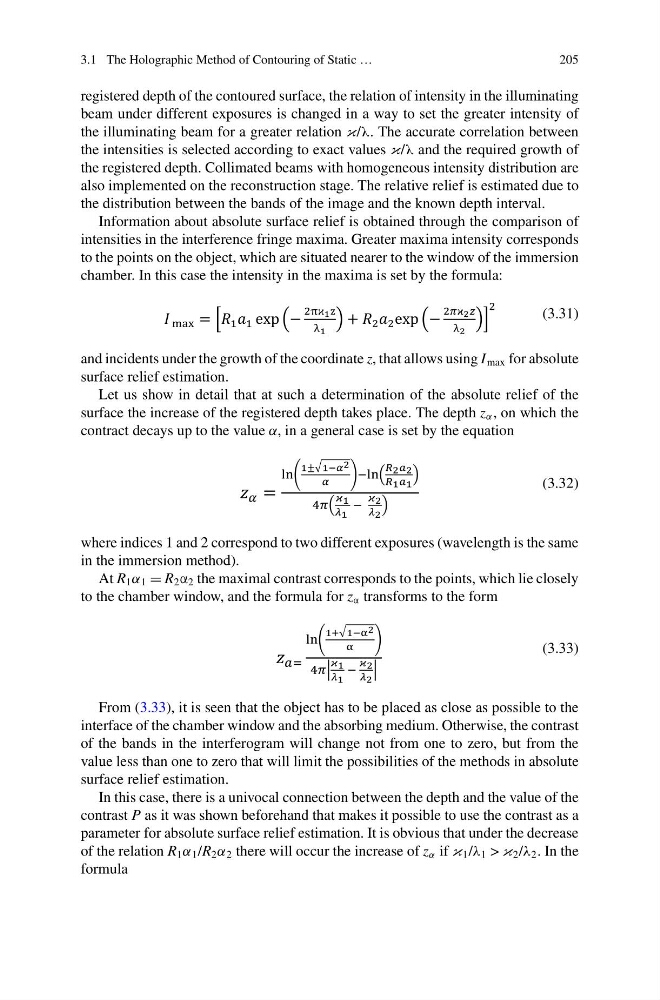
chamber. In this case the intensity in the maxima is set by the formula:
(3.31)
and incidents under the growth of the coordinate z, that allows using I max for absolute
surface relief estimation.
Let us show in detail that at such a determination of the absolute relief of the
surface the increase of the registered depth takes place. The depth z α , on which the
contract decays up to the value α, in a general case is set by the equation
(3.32)
where indices 1 and 2 correspond to two different exposures (wavelength is the same
in the immersion method).
At R 1 α 1 = R 2 α 2 the maximal contrast corresponds to the points, which lie closely
to the chamber window, and the formula for z α transforms to the form
(3.33)
From (3.33), it is seen that the object has to be placed as close as possible to the
interface of the chamber window and the absorbing medium. Otherwise, the contrast
of the bands in the interferogram will change not from one to zero, but from the
value less than one to zero that will limit the possibilities of the methods in absolute
surface relief estimation.
In this case, there is a univocal connection between the depth and the value of the
contrast P as it was shown beforehand that makes it possible to use the contrast as a
parameter for absolute surface relief estimation. It is obvious that under the decrease
of the relation R 1 α 1 /R 2 α 2 there will occur the increase of z α if κ 1 /λ 1 > κ 2 /λ 2 . In the
formula
205
registered depth of the contoured surface, the relation of intensity in the illuminating
beam under different exposures is changed in a way to set the greater intensity of
the illuminating beam for a greater relation κ/λ. The accurate correlation between
the intensities is selected according to exact values κ/λ and the required growth of
the registered depth. Collimated beams with homogeneous intensity distribution are
also implemented on the reconstruction stage. The relative relief is estimated due to
the distribution between the bands of the image and the known depth interval.
Information about absolute surface relief is obtained through the comparison of
intensities in the interference fringe maxima. Greater maxima intensity corresponds
to the points on the object, which are situated nearer to the window of the immersion
chamber. In this case the intensity in the maxima is set by the formula:
(3.31)
and incidents under the growth of the coordinate z, that allows using I max for absolute
surface relief estimation.
Let us show in detail that at such a determination of the absolute relief of the
surface the increase of the registered depth takes place. The depth z α , on which the
contract decays up to the value α, in a general case is set by the equation
(3.32)
where indices 1 and 2 correspond to two different exposures (wavelength is the same
in the immersion method).
At R 1 α 1 = R 2 α 2 the maximal contrast corresponds to the points, which lie closely
to the chamber window, and the formula for z α transforms to the form
(3.33)
From (3.33), it is seen that the object has to be placed as close as possible to the
interface of the chamber window and the absorbing medium. Otherwise, the contrast
of the bands in the interferogram will change not from one to zero, but from the
value less than one to zero that will limit the possibilities of the methods in absolute
surface relief estimation.
In this case, there is a univocal connection between the depth and the value of the
contrast P as it was shown beforehand that makes it possible to use the contrast as a
parameter for absolute surface relief estimation. It is obvious that under the decrease
of the relation R 1 α 1 /R 2 α 2 there will occur the increase of z α if κ 1 /λ 1 > κ 2 /λ 2 . In the
formula