

204
3 Holographic Interferometry for Studying …
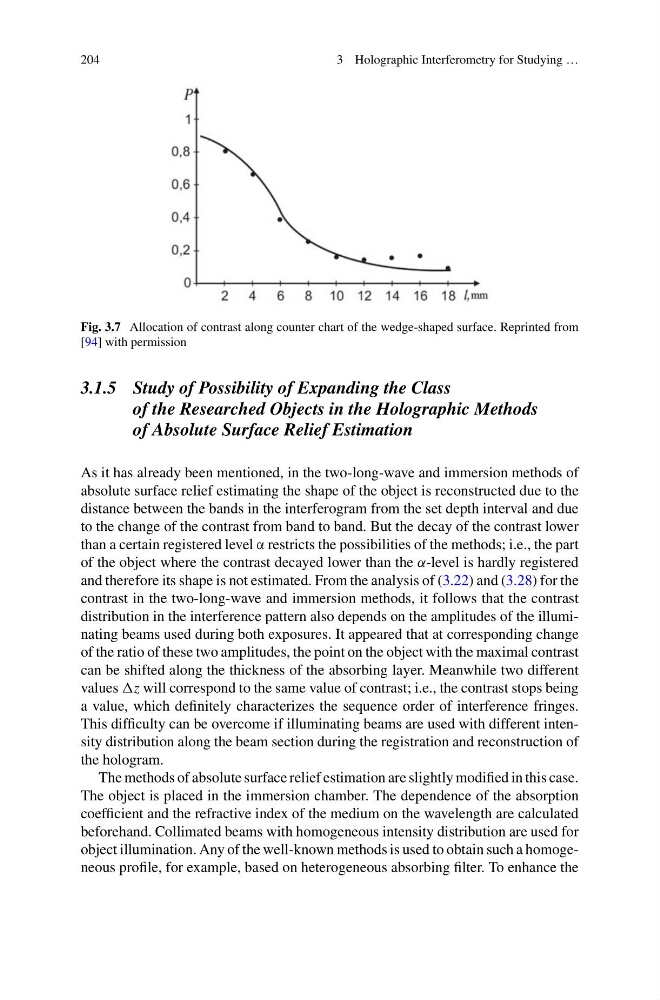
Fig. 3.7 Allocation of contrast along counter chart of the wedge-shaped surface. Reprinted from
[94] with permission
3.1.5 Study of Possibility of Expanding the Class
of the Researched Objects in the Holographic Methods
of Absolute Surface Relief Estimation
As it has already been mentioned, in the two-long-wave and immersion methods of
absolute surface relief estimating the shape of the object is reconstructed due to the
distance between the bands in the interferogram from the set depth interval and due
to the change of the contrast from band to band. But the decay of the contrast lower
than a certain registered level α restricts the possibilities of the methods; i.e., the part
of the object where the contrast decayed lower than the α-level is hardly registered
and therefore its shape is not estimated. From the analysis of (3.22) and (3.28) for the
contrast in the two-long-wave and immersion methods, it follows that the contrast
distribution in the interference pattern also depends on the amplitudes of the illuminating beams used during both exposures. It appeared that at corresponding change
of the ratio of these two amplitudes, the point on the object with the maximal contrast
can be shifted along the thickness of the absorbing layer. Meanwhile two different
values z will correspond to the same value of contrast; i.e., the contrast stops being
a value, which definitely characterizes the sequence order of interference fringes.
This difficulty can be overcome if illuminating beams are used with different intensity distribution along the beam section during the registration and reconstruction of
the hologram.
The methods of absolute surface relief estimation are slightly modified in this case.
The object is placed in the immersion chamber. The dependence of the absorption
coefficient and the refractive index of the medium on the wavelength are calculated
beforehand. Collimated beams with homogeneous intensity distribution are used for
object illumination. Any of the well-known methods is used to obtain such a homogeneous profile, for example, based on heterogeneous absorbing filter. To enhance the
3 Holographic Interferometry for Studying …
Fig. 3.7 Allocation of contrast along counter chart of the wedge-shaped surface. Reprinted from
[94] with permission
3.1.5 Study of Possibility of Expanding the Class
of the Researched Objects in the Holographic Methods
of Absolute Surface Relief Estimation
As it has already been mentioned, in the two-long-wave and immersion methods of
absolute surface relief estimating the shape of the object is reconstructed due to the
distance between the bands in the interferogram from the set depth interval and due
to the change of the contrast from band to band. But the decay of the contrast lower
than a certain registered level α restricts the possibilities of the methods; i.e., the part
of the object where the contrast decayed lower than the α-level is hardly registered
and therefore its shape is not estimated. From the analysis of (3.22) and (3.28) for the
contrast in the two-long-wave and immersion methods, it follows that the contrast
distribution in the interference pattern also depends on the amplitudes of the illuminating beams used during both exposures. It appeared that at corresponding change
of the ratio of these two amplitudes, the point on the object with the maximal contrast
can be shifted along the thickness of the absorbing layer. Meanwhile two different
values z will correspond to the same value of contrast; i.e., the contrast stops being
a value, which definitely characterizes the sequence order of interference fringes.
This difficulty can be overcome if illuminating beams are used with different intensity distribution along the beam section during the registration and reconstruction of
the hologram.
The methods of absolute surface relief estimation are slightly modified in this case.
The object is placed in the immersion chamber. The dependence of the absorption
coefficient and the refractive index of the medium on the wavelength are calculated
beforehand. Collimated beams with homogeneous intensity distribution are used for
object illumination. Any of the well-known methods is used to obtain such a homogeneous profile, for example, based on heterogeneous absorbing filter. To enhance the