

202
3 Holographic Interferometry for Studying …
for the two-long-wave method, and for the immersion method of estimation of the
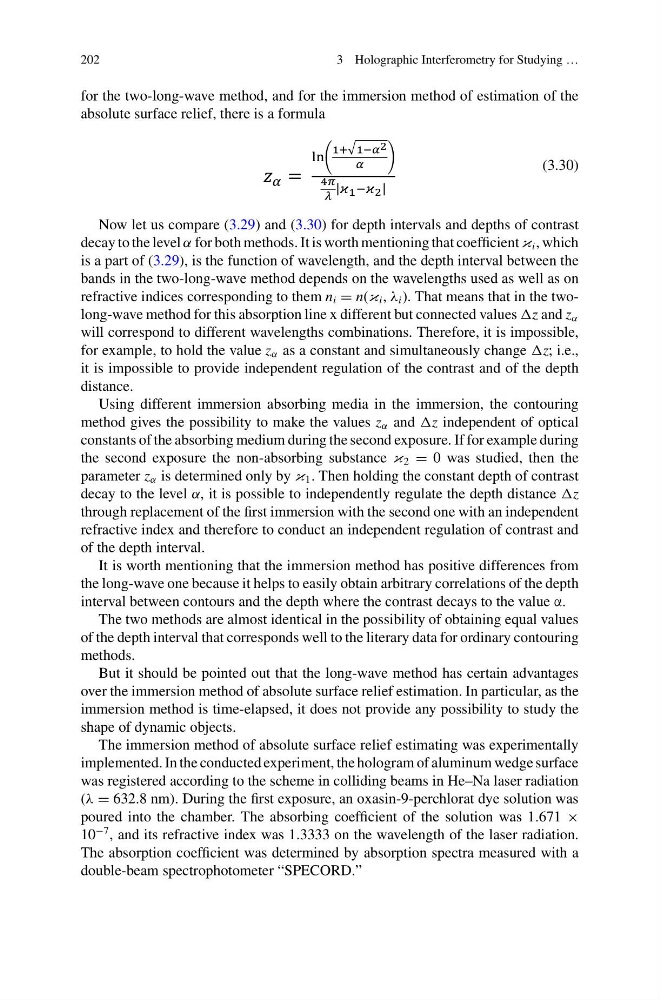
absolute surface relief, there is a formula
(3.30)
Now let us compare (3.29) and (3.30) for depth intervals and depths of contrast
decay to the level α for both methods. It is worth mentioning that coefficient κ i , which
is a part of (3.29), is the function of wavelength, and the depth interval between the
bands in the two-long-wave method depends on the wavelengths used as well as on
refractive indices corresponding to them n i = n(κ i , λ i ). That means that in the twolong-wave method for this absorption line x different but connected values and z α
will correspond to different wavelengths combinations. Therefore, it is impossible,
for example, to hold the value z α as a constant and simultaneously change i.e.,
it is impossible to provide independent regulation of the contrast and of the depth
distance.
Using different immersion absorbing media in the immersion, the contouring
method gives the possibility to make the values z α and independent of optical
constants of the absorbing medium during the second exposure. If for example during
the second exposure the non-absorbing substance κ 2 = 0 was studied, then the
parameter z α is determined only by κ 1 . Then holding the constant depth of contrast
decay to the level α, it is possible to independently regulate the depth distance
through replacement of the first immersion with the second one with an independent
refractive index and therefore to conduct an independent regulation of contrast and
of the depth interval.
It is worth mentioning that the immersion method has positive differences from
the long-wave one because it helps to easily obtain arbitrary correlations of the depth
interval between contours and the depth where the contrast decays to the value α.
The two methods are almost identical in the possibility of obtaining equal values
of the depth interval that corresponds well to the literary data for ordinary contouring
methods.
But it should be pointed out that the long-wave method has certain advantages
over the immersion method of absolute surface relief estimation. In particular, as the
immersion method is time-elapsed, it does not provide any possibility to study the
shape of dynamic objects.
The immersion method of absolute surface relief estimating was experimentally
implemented. In the conducted experiment, the hologram of aluminum wedge surface
was registered according to the scheme in colliding beams in He–Na laser radiation
(λ = 632.8 nm). During the first exposure, an oxasin-9-perchlorat dye solution was
poured into the chamber. The absorbing coefficient of the solution was 1.671 ×
10
−7 , and its refractive index was 1.3333 on the wavelength of the laser radiation.
The absorption coefficient was determined by absorption spectra measured with a
double-beam spectrophotometer “SPECORD.”
3 Holographic Interferometry for Studying …
for the two-long-wave method, and for the immersion method of estimation of the
absolute surface relief, there is a formula
(3.30)
Now let us compare (3.29) and (3.30) for depth intervals and depths of contrast
decay to the level α for both methods. It is worth mentioning that coefficient κ i , which
is a part of (3.29), is the function of wavelength, and the depth interval between the
bands in the two-long-wave method depends on the wavelengths used as well as on
refractive indices corresponding to them n i = n(κ i , λ i ). That means that in the twolong-wave method for this absorption line x different but connected values and z α
will correspond to different wavelengths combinations. Therefore, it is impossible,
for example, to hold the value z α as a constant and simultaneously change i.e.,
it is impossible to provide independent regulation of the contrast and of the depth
distance.
Using different immersion absorbing media in the immersion, the contouring
method gives the possibility to make the values z α and independent of optical
constants of the absorbing medium during the second exposure. If for example during
the second exposure the non-absorbing substance κ 2 = 0 was studied, then the
parameter z α is determined only by κ 1 . Then holding the constant depth of contrast
decay to the level α, it is possible to independently regulate the depth distance
through replacement of the first immersion with the second one with an independent
refractive index and therefore to conduct an independent regulation of contrast and
of the depth interval.
It is worth mentioning that the immersion method has positive differences from
the long-wave one because it helps to easily obtain arbitrary correlations of the depth
interval between contours and the depth where the contrast decays to the value α.
The two methods are almost identical in the possibility of obtaining equal values
of the depth interval that corresponds well to the literary data for ordinary contouring
methods.
But it should be pointed out that the long-wave method has certain advantages
over the immersion method of absolute surface relief estimation. In particular, as the
immersion method is time-elapsed, it does not provide any possibility to study the
shape of dynamic objects.
The immersion method of absolute surface relief estimating was experimentally
implemented. In the conducted experiment, the hologram of aluminum wedge surface
was registered according to the scheme in colliding beams in He–Na laser radiation
(λ = 632.8 nm). During the first exposure, an oxasin-9-perchlorat dye solution was
poured into the chamber. The absorbing coefficient of the solution was 1.671 ×
10
−7 , and its refractive index was 1.3333 on the wavelength of the laser radiation.
The absorption coefficient was determined by absorption spectra measured with a
double-beam spectrophotometer “SPECORD.”