

3.1 The Holographic Method of Contouring of Static …
201
which are proportional to
(3.25)
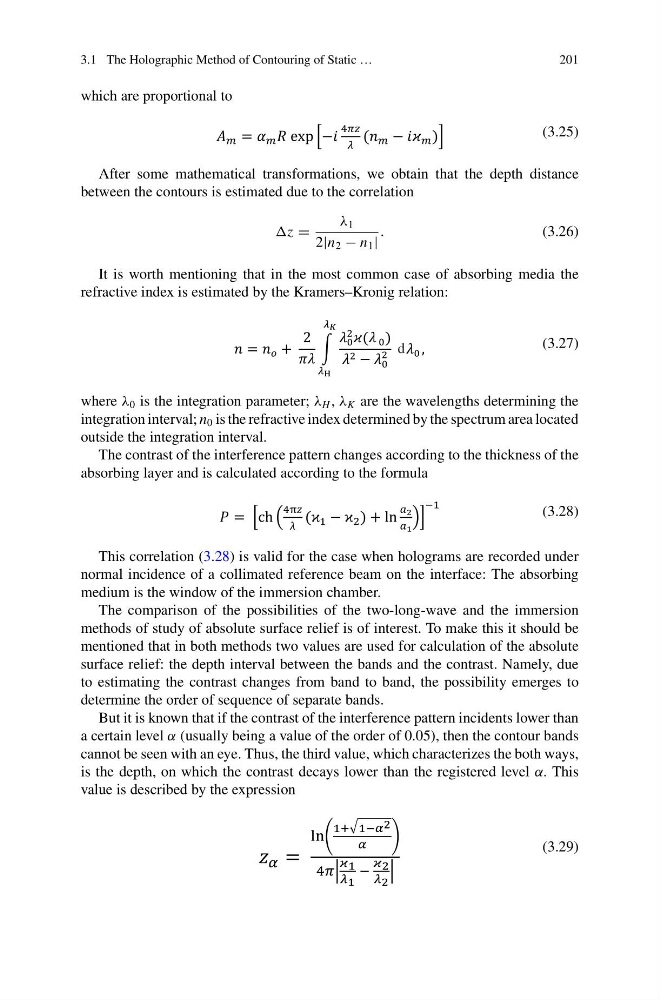
After some mathematical transformations, we obtain that the depth distance
between the contours is estimated due to the correlation
=
λ 1
2|n 2 − n 1 |
.
(3.26)
It is worth mentioning that in the most common case of absorbing media the
refractive index is estimated by the Kramers–Kronig relation:
(3.27)
where λ 0 is the integration parameter; λ H , λ K are the wavelengths determining the
integration interval; n 0 is the refractive index determined by the spectrum area located
outside the integration interval.
The contrast of the interference pattern changes according to the thickness of the
absorbing layer and is calculated according to the formula
(3.28)
This correlation (3.28) is valid for the case when holograms are recorded under
normal incidence of a collimated reference beam on the interface: The absorbing
medium is the window of the immersion chamber.
The comparison of the possibilities of the two-long-wave and the immersion
methods of study of absolute surface relief is of interest. To make this it should be
mentioned that in both methods two values are used for calculation of the absolute
surface relief: the depth interval between the bands and the contrast. Namely, due
to estimating the contrast changes from band to band, the possibility emerges to
determine the order of sequence of separate bands.
But it is known that if the contrast of the interference pattern incidents lower than
a certain level α (usually being a value of the order of 0.05), then the contour bands
cannot be seen with an eye. Thus, the third value, which characterizes the both ways,
is the depth, on which the contrast decays lower than the registered level α. This
value is described by the expression
(3.29)
201
which are proportional to
(3.25)
After some mathematical transformations, we obtain that the depth distance
between the contours is estimated due to the correlation
=
λ 1
2|n 2 − n 1 |
.
(3.26)
It is worth mentioning that in the most common case of absorbing media the
refractive index is estimated by the Kramers–Kronig relation:
(3.27)
where λ 0 is the integration parameter; λ H , λ K are the wavelengths determining the
integration interval; n 0 is the refractive index determined by the spectrum area located
outside the integration interval.
The contrast of the interference pattern changes according to the thickness of the
absorbing layer and is calculated according to the formula
(3.28)
This correlation (3.28) is valid for the case when holograms are recorded under
normal incidence of a collimated reference beam on the interface: The absorbing
medium is the window of the immersion chamber.
The comparison of the possibilities of the two-long-wave and the immersion
methods of study of absolute surface relief is of interest. To make this it should be
mentioned that in both methods two values are used for calculation of the absolute
surface relief: the depth interval between the bands and the contrast. Namely, due
to estimating the contrast changes from band to band, the possibility emerges to
determine the order of sequence of separate bands.
But it is known that if the contrast of the interference pattern incidents lower than
a certain level α (usually being a value of the order of 0.05), then the contour bands
cannot be seen with an eye. Thus, the third value, which characterizes the both ways,
is the depth, on which the contrast decays lower than the registered level α. This
value is described by the expression
(3.29)