

3.1 The Holographic Method of Contouring of Static …
197
and correspond to the two-long-wave and immersion contouring methods. Equation
(3.15) shows the connection of depth distances between contours for resonance, twolong-wave and immersion methods of surface relief detection. It allows estimates the
contribution to the depth interval for the resonance contouring method introduced by
the interval between the used wavelengths as well as by the difference of refractive
indices of the resonance medium corresponding to them.
3.1.3 Holographic Two-Long-Wave Method of Absolute
Surface Relief Determination Based on the Application
of Absorbing Media
The resonance medium gives the possibility to implement only effects connected
with dispersion dependence of the refractive index close to the absorption line and,
thus, to determine how the depth interval depends on the used wavelengths and their
adjustments to the absorption line.
Along with this the influence of the absorption coefficient on the interference
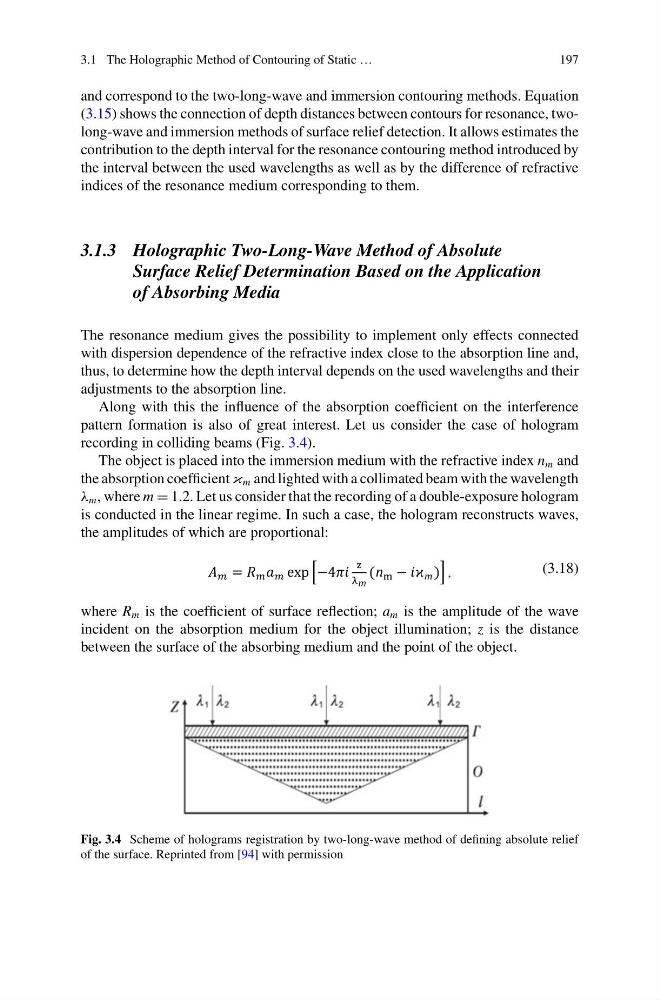
pattern formation is also of great interest. Let us consider the case of hologram
recording in colliding beams (Fig. 3.4).
The object is placed into the immersion medium with the refractive index n m and
the absorption coefficient κ m and lighted with a collimated beam with the wavelength
λ m , where m = 1.2. Let us consider that the recording of a double-exposure hologram
is conducted in the linear regime. In such a case, the hologram reconstructs waves,
the amplitudes of which are proportional:
(3.18)
where R m is the coefficient of surface reflection; a m is the amplitude of the wave
incident on the absorption medium for the object illumination; z is the distance
between the surface of the absorbing medium and the point of the object.
Fig. 3.4 Scheme of holograms registration by two-long-wave method of defining absolute relief
of the surface. Reprinted from [94] with permission
197
and correspond to the two-long-wave and immersion contouring methods. Equation
(3.15) shows the connection of depth distances between contours for resonance, twolong-wave and immersion methods of surface relief detection. It allows estimates the
contribution to the depth interval for the resonance contouring method introduced by
the interval between the used wavelengths as well as by the difference of refractive
indices of the resonance medium corresponding to them.
3.1.3 Holographic Two-Long-Wave Method of Absolute
Surface Relief Determination Based on the Application
of Absorbing Media
The resonance medium gives the possibility to implement only effects connected
with dispersion dependence of the refractive index close to the absorption line and,
thus, to determine how the depth interval depends on the used wavelengths and their
adjustments to the absorption line.
Along with this the influence of the absorption coefficient on the interference
pattern formation is also of great interest. Let us consider the case of hologram
recording in colliding beams (Fig. 3.4).
The object is placed into the immersion medium with the refractive index n m and
the absorption coefficient κ m and lighted with a collimated beam with the wavelength
λ m , where m = 1.2. Let us consider that the recording of a double-exposure hologram
is conducted in the linear regime. In such a case, the hologram reconstructs waves,
the amplitudes of which are proportional:
(3.18)
where R m is the coefficient of surface reflection; a m is the amplitude of the wave
incident on the absorption medium for the object illumination; z is the distance
between the surface of the absorbing medium and the point of the object.
Fig. 3.4 Scheme of holograms registration by two-long-wave method of defining absolute relief
of the surface. Reprinted from [94] with permission