

196
3 Holographic Interferometry for Studying …
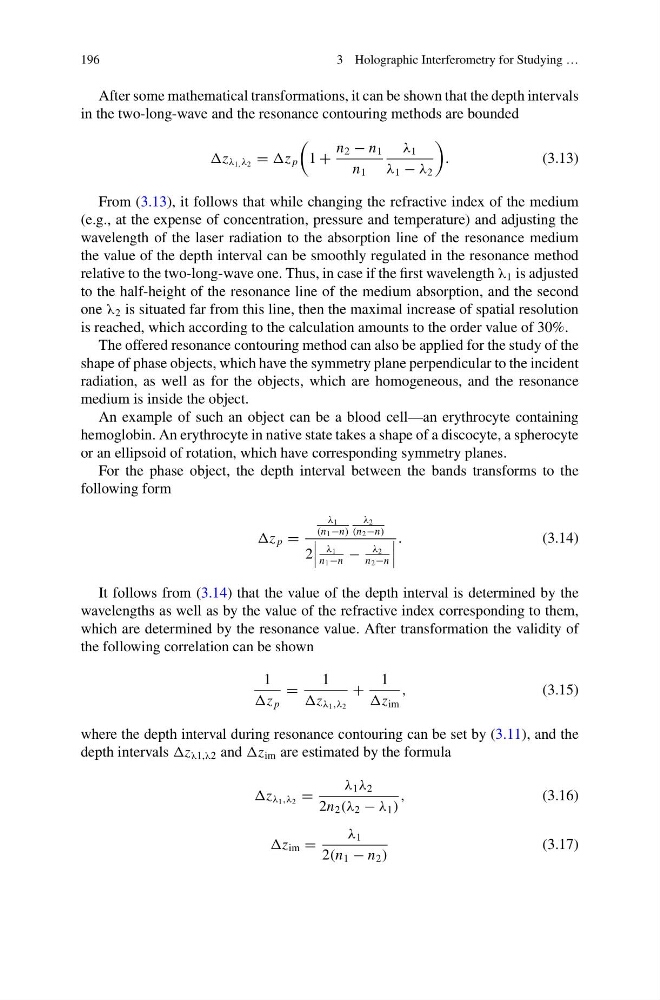
After some mathematical transformations, it can be shown that the depth intervals
in the two-long-wave and the resonance contouring methods are bounded
z λ 1, λ 2 = z p
1 +
n 2 − n 1
n 1
λ 1
λ 1 − λ 2
.
(3.13)
From (3.13), it follows that while changing the refractive index of the medium
(e.g., at the expense of concentration, pressure and temperature) and adjusting the
wavelength of the laser radiation to the absorption line of the resonance medium
the value of the depth interval can be smoothly regulated in the resonance method
relative to the two-long-wave one. Thus, in case if the first wavelength λ 1 is adjusted
to the half-height of the resonance line of the medium absorption, and the second
one λ 2 is situated far from this line, then the maximal increase of spatial resolution
is reached, which according to the calculation amounts to the order value of 30%.
The offered resonance contouring method can also be applied for the study of the
shape of phase objects, which have the symmetry plane perpendicular to the incident
radiation, as well as for the objects, which are homogeneous, and the resonance
medium is inside the object.
An example of such an object can be a blood cell—an erythrocyte containing
hemoglobin. An erythrocyte in native state takes a shape of a discocyte, a spherocyte
or an ellipsoid of rotation, which have corresponding symmetry planes.
For the phase object, the depth interval between the bands transforms to the
following form
z p =
λ 1
(n1−n)
λ 2
(n2−n)
2
λ 1
n 1 −n
−
λ 2
n 2 −n
.
(3.14)
It follows from (3.14) that the value of the depth interval is determined by the
wavelengths as well as by the value of the refractive index corresponding to them,
which are determined by the resonance value. After transformation the validity of
the following correlation can be shown
1
z p
=
1
z λ 1 ,λ 2
+
1
z im
,
(3.15)
where the depth interval during resonance contouring can be set by (3.11), and the
depth intervals z λ1,λ2 and z im are estimated by the formula
z λ 1 ,λ 2 =
λ 1 λ 2
2n 2 (λ 2 − λ 1 )
,
(3.16)
z im =
λ 1
2(n 1 − n 2 )
(3.17)
3 Holographic Interferometry for Studying …
After some mathematical transformations, it can be shown that the depth intervals
in the two-long-wave and the resonance contouring methods are bounded
z λ 1, λ 2 = z p
1 +
n 2 − n 1
n 1
λ 1
λ 1 − λ 2
.
(3.13)
From (3.13), it follows that while changing the refractive index of the medium
(e.g., at the expense of concentration, pressure and temperature) and adjusting the
wavelength of the laser radiation to the absorption line of the resonance medium
the value of the depth interval can be smoothly regulated in the resonance method
relative to the two-long-wave one. Thus, in case if the first wavelength λ 1 is adjusted
to the half-height of the resonance line of the medium absorption, and the second
one λ 2 is situated far from this line, then the maximal increase of spatial resolution
is reached, which according to the calculation amounts to the order value of 30%.
The offered resonance contouring method can also be applied for the study of the
shape of phase objects, which have the symmetry plane perpendicular to the incident
radiation, as well as for the objects, which are homogeneous, and the resonance
medium is inside the object.
An example of such an object can be a blood cell—an erythrocyte containing
hemoglobin. An erythrocyte in native state takes a shape of a discocyte, a spherocyte
or an ellipsoid of rotation, which have corresponding symmetry planes.
For the phase object, the depth interval between the bands transforms to the
following form
z p =
λ 1
(n1−n)
λ 2
(n2−n)
2
λ 1
n 1 −n
−
λ 2
n 2 −n
.
(3.14)
It follows from (3.14) that the value of the depth interval is determined by the
wavelengths as well as by the value of the refractive index corresponding to them,
which are determined by the resonance value. After transformation the validity of
the following correlation can be shown
1
z p
=
1
z λ 1 ,λ 2
+
1
z im
,
(3.15)
where the depth interval during resonance contouring can be set by (3.11), and the
depth intervals z λ1,λ2 and z im are estimated by the formula
z λ 1 ,λ 2 =
λ 1 λ 2
2n 2 (λ 2 − λ 1 )
,
(3.16)
z im =
λ 1
2(n 1 − n 2 )
(3.17)