

2.4 Development and Improvement of the Holographic Interference …
157
T =
(1 + a
∗ t av )l
a ∗ l
(2.52)
where l is the device resonator length under the temperature of t av .
The influence on the l value of the resonator thermal elongation of the semiconductor crystal constraint with the cooling vessel was considered by the appropriate
choice of the coefficient a
* [69]. During the experiment, the magnitude a
* was estimated due to the results of the holographic measurements relative to the edge shifts
of the diode and the cooling vessel [59].
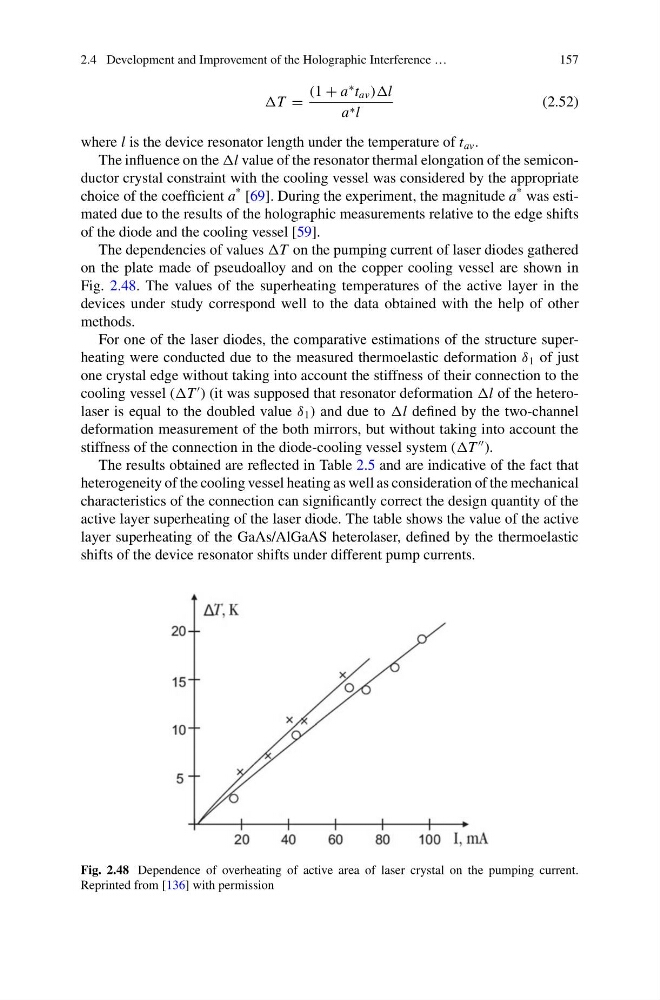
The dependencies of values T on the pumping current of laser diodes gathered
on the plate made of pseudoalloy and on the copper cooling vessel are shown in
Fig. 2.48. The values of the superheating temperatures of the active layer in the
devices under study correspond well to the data obtained with the help of other
methods.
For one of the laser diodes, the comparative estimations of the structure superheating were conducted due to the measured thermoelastic deformation δ 1 of just
one crystal edge without taking into account the stiffness of their connection to the
cooling vessel (T
) (it was supposed that resonator deformation l of the heterolaser is equal to the doubled value δ 1 ) and due to l defined by the two-channel
deformation measurement of the both mirrors, but without taking into account the
stiffness of the connection in the diode-cooling vessel system (T
).
The results obtained are reflected in Table 2.5 and are indicative of the fact that
heterogeneity of the cooling vessel heating as well as consideration of the mechanical
characteristics of the connection can significantly correct the design quantity of the
active layer superheating of the laser diode. The table shows the value of the active
layer superheating of the GaAs/AlGaAS heterolaser, defined by the thermoelastic
shifts of the device resonator shifts under different pump currents.
Fig. 2.48 Dependence of overheating of active area of laser crystal on the pumping current.
Reprinted from [136] with permission
157
T =
(1 + a
∗ t av )l
a ∗ l
(2.52)
where l is the device resonator length under the temperature of t av .
The influence on the l value of the resonator thermal elongation of the semiconductor crystal constraint with the cooling vessel was considered by the appropriate
choice of the coefficient a
* [69]. During the experiment, the magnitude a
* was estimated due to the results of the holographic measurements relative to the edge shifts
of the diode and the cooling vessel [59].
The dependencies of values T on the pumping current of laser diodes gathered
on the plate made of pseudoalloy and on the copper cooling vessel are shown in
Fig. 2.48. The values of the superheating temperatures of the active layer in the
devices under study correspond well to the data obtained with the help of other
methods.
For one of the laser diodes, the comparative estimations of the structure superheating were conducted due to the measured thermoelastic deformation δ 1 of just
one crystal edge without taking into account the stiffness of their connection to the
cooling vessel (T
) (it was supposed that resonator deformation l of the heterolaser is equal to the doubled value δ 1 ) and due to l defined by the two-channel
deformation measurement of the both mirrors, but without taking into account the
stiffness of the connection in the diode-cooling vessel system (T
).
The results obtained are reflected in Table 2.5 and are indicative of the fact that
heterogeneity of the cooling vessel heating as well as consideration of the mechanical
characteristics of the connection can significantly correct the design quantity of the
active layer superheating of the laser diode. The table shows the value of the active
layer superheating of the GaAs/AlGaAS heterolaser, defined by the thermoelastic
shifts of the device resonator shifts under different pump currents.
Fig. 2.48 Dependence of overheating of active area of laser crystal on the pumping current.
Reprinted from [136] with permission