

136
2 Holographic Microscopy of Phase and Diffuse Objects …
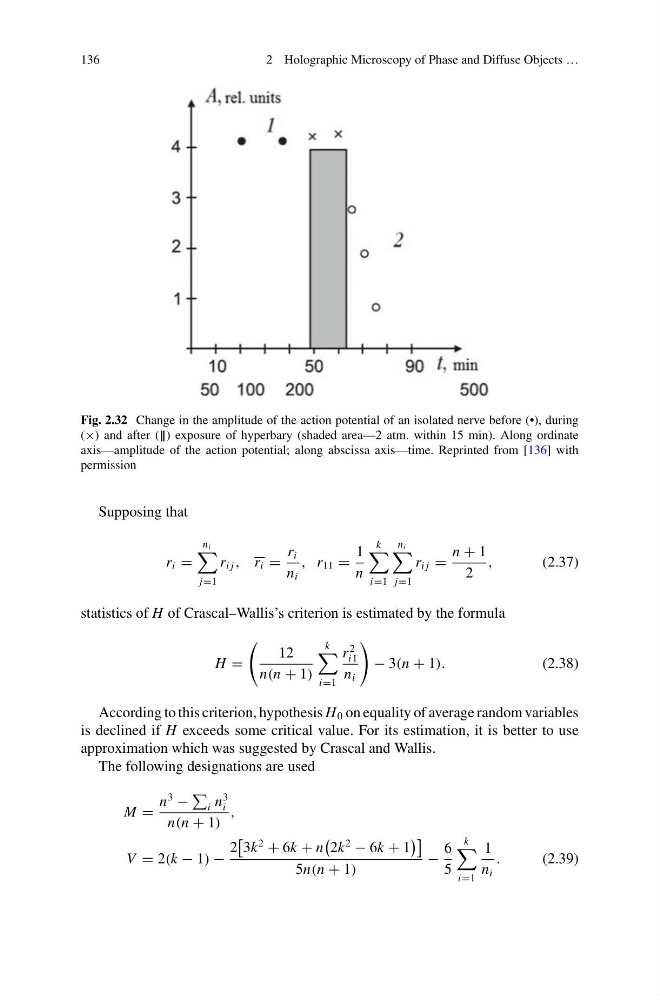
Fig. 2.32 Change in the amplitude of the action potential of an isolated nerve before (•), during
(×) and after () exposure of hyperbary (shaded area—2 atm. within 15 min). Along ordinate
axis—amplitude of the action potential; along abscissa axis—time. Reprinted from [136] with
permission
Supposing that
r i =
n i
j=1
r i j , r i =
r i
n i
, r 11 =
1
n
k
i=1
n i
j=1
r i j =
n + 1
2
,
(2.37)
statistics of H of Crascal–Wallis’s criterion is estimated by the formula
H =
12
n(n + 1)
k
i=1
r
2
i1
n i
− 3(n + 1).
(2.38)
According to this criterion, hypothesis H 0 on equality of average random variables
is declined if H exceeds some critical value. For its estimation, it is better to use
approximation which was suggested by Crascal and Wallis.
The following designations are used
M =
n
3
−
i n
3
i
n(n + 1)
,
V = 2(k − 1) −
2
3k
2
+ 6k + n
2k
2
− 6k + 1
5n(n + 1)
−
6
5
k
i=1
1
n i
.
(2.39)
2 Holographic Microscopy of Phase and Diffuse Objects …
Fig. 2.32 Change in the amplitude of the action potential of an isolated nerve before (•), during
(×) and after () exposure of hyperbary (shaded area—2 atm. within 15 min). Along ordinate
axis—amplitude of the action potential; along abscissa axis—time. Reprinted from [136] with
permission
Supposing that
r i =
n i
j=1
r i j , r i =
r i
n i
, r 11 =
1
n
k
i=1
n i
j=1
r i j =
n + 1
2
,
(2.37)
statistics of H of Crascal–Wallis’s criterion is estimated by the formula
H =
12
n(n + 1)
k
i=1
r
2
i1
n i
− 3(n + 1).
(2.38)
According to this criterion, hypothesis H 0 on equality of average random variables
is declined if H exceeds some critical value. For its estimation, it is better to use
approximation which was suggested by Crascal and Wallis.
The following designations are used
M =
n
3
−
i n
3
i
n(n + 1)
,
V = 2(k − 1) −
2
3k
2
+ 6k + n
2k
2
− 6k + 1
5n(n + 1)
−
6
5
k
i=1
1
n i
.
(2.39)