

2.2 Holographic Study of Structural and Functional Characteristics …
119
the fiber is less visible. Observations in plane L = 20 μm have shown that the nerve
fiber appendix (Fig. 2.20c) has focusing characteristics. The intensity distribution
along the line b-b
is shown in the lower part of Fig. 2.20c–e. The corresponding
refraction index distribution is shown in Fig. 2.20f.
For estimating medium refraction characteristics surrounding the fiber rat serum,
refraction index n = 1.3484 was measured as a possible intercellular fluid analog.
Having insignificant absorption and a quasi-stepped refraction index, the myelinated
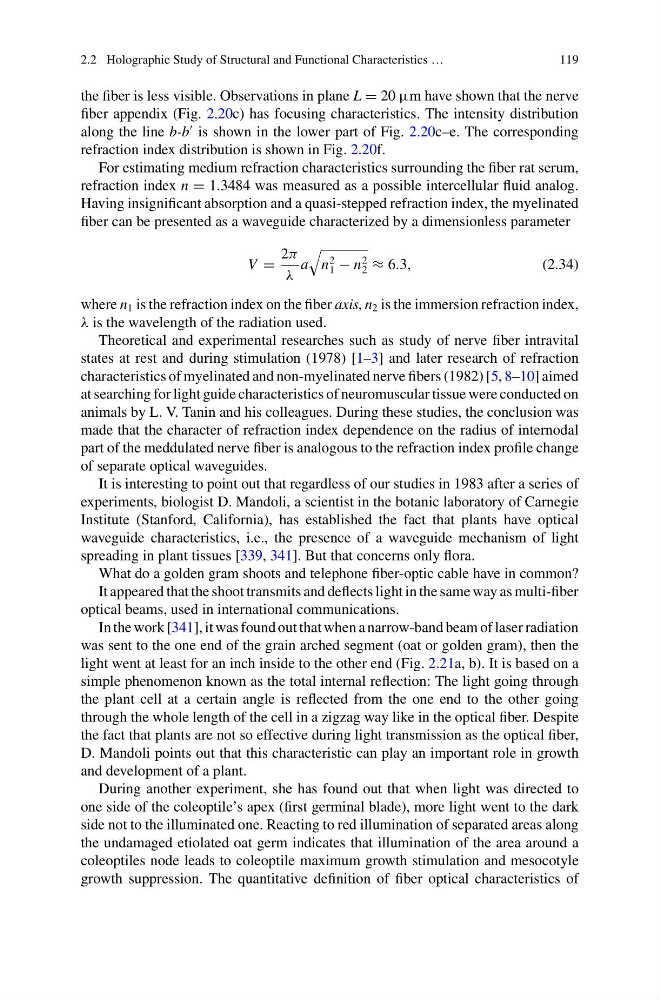
fiber can be presented as a waveguide characterized by a dimensionless parameter
V =
2π
λ
a
n
2
1 − n
2
2 ≈ 6.3,
(2.34)
where n 1 is the refraction index on the fiber axis, n 2 is the immersion refraction index,
λ is the wavelength of the radiation used.
Theoretical and experimental researches such as study of nerve fiber intravital
states at rest and during stimulation (1978) [1–3] and later research of refraction
characteristics of myelinated and non-myelinated nerve fibers (1982) [5, 8–10] aimed
at searching for light guide characteristics of neuromuscular tissue were conducted on
animals by L. V. Tanin and his colleagues. During these studies, the conclusion was
made that the character of refraction index dependence on the radius of internodal
part of the meddulated nerve fiber is analogous to the refraction index profile change
of separate optical waveguides.
It is interesting to point out that regardless of our studies in 1983 after a series of
experiments, biologist D. Mandoli, a scientist in the botanic laboratory of Carnegie
Institute (Stanford, California), has established the fact that plants have optical
waveguide characteristics, i.e., the presence of a waveguide mechanism of light
spreading in plant tissues [339, 341]. But that concerns only flora.
What do a golden gram shoots and telephone fiber-optic cable have in common?
It appeared that the shoot transmits and deflects light in the same way as multi-fiber
optical beams, used in international communications.
In the work [341], it was found out that when a narrow-band beam of laser radiation
was sent to the one end of the grain arched segment (oat or golden gram), then the
light went at least for an inch inside to the other end (Fig. 2.21a, b). It is based on a
simple phenomenon known as the total internal reflection: The light going through
the plant cell at a certain angle is reflected from the one end to the other going
through the whole length of the cell in a zigzag way like in the optical fiber. Despite
the fact that plants are not so effective during light transmission as the optical fiber,
D. Mandoli points out that this characteristic can play an important role in growth
and development of a plant.
During another experiment, she has found out that when light was directed to
one side of the coleoptile’s apex (first germinal blade), more light went to the dark
side not to the illuminated one. Reacting to red illumination of separated areas along
the undamaged etiolated oat germ indicates that illumination of the area around a
coleoptiles node leads to coleoptile maximum growth stimulation and mesocotyle
growth suppression. The quantitative definition of fiber optical characteristics of
119
the fiber is less visible. Observations in plane L = 20 μm have shown that the nerve
fiber appendix (Fig. 2.20c) has focusing characteristics. The intensity distribution
along the line b-b
is shown in the lower part of Fig. 2.20c–e. The corresponding
refraction index distribution is shown in Fig. 2.20f.
For estimating medium refraction characteristics surrounding the fiber rat serum,
refraction index n = 1.3484 was measured as a possible intercellular fluid analog.
Having insignificant absorption and a quasi-stepped refraction index, the myelinated
fiber can be presented as a waveguide characterized by a dimensionless parameter
V =
2π
λ
a
n
2
1 − n
2
2 ≈ 6.3,
(2.34)
where n 1 is the refraction index on the fiber axis, n 2 is the immersion refraction index,
λ is the wavelength of the radiation used.
Theoretical and experimental researches such as study of nerve fiber intravital
states at rest and during stimulation (1978) [1–3] and later research of refraction
characteristics of myelinated and non-myelinated nerve fibers (1982) [5, 8–10] aimed
at searching for light guide characteristics of neuromuscular tissue were conducted on
animals by L. V. Tanin and his colleagues. During these studies, the conclusion was
made that the character of refraction index dependence on the radius of internodal
part of the meddulated nerve fiber is analogous to the refraction index profile change
of separate optical waveguides.
It is interesting to point out that regardless of our studies in 1983 after a series of
experiments, biologist D. Mandoli, a scientist in the botanic laboratory of Carnegie
Institute (Stanford, California), has established the fact that plants have optical
waveguide characteristics, i.e., the presence of a waveguide mechanism of light
spreading in plant tissues [339, 341]. But that concerns only flora.
What do a golden gram shoots and telephone fiber-optic cable have in common?
It appeared that the shoot transmits and deflects light in the same way as multi-fiber
optical beams, used in international communications.
In the work [341], it was found out that when a narrow-band beam of laser radiation
was sent to the one end of the grain arched segment (oat or golden gram), then the
light went at least for an inch inside to the other end (Fig. 2.21a, b). It is based on a
simple phenomenon known as the total internal reflection: The light going through
the plant cell at a certain angle is reflected from the one end to the other going
through the whole length of the cell in a zigzag way like in the optical fiber. Despite
the fact that plants are not so effective during light transmission as the optical fiber,
D. Mandoli points out that this characteristic can play an important role in growth
and development of a plant.
During another experiment, she has found out that when light was directed to
one side of the coleoptile’s apex (first germinal blade), more light went to the dark
side not to the illuminated one. Reacting to red illumination of separated areas along
the undamaged etiolated oat germ indicates that illumination of the area around a
coleoptiles node leads to coleoptile maximum growth stimulation and mesocotyle
growth suppression. The quantitative definition of fiber optical characteristics of