

120
2 Holographic Microscopy of Phase and Diffuse Objects …
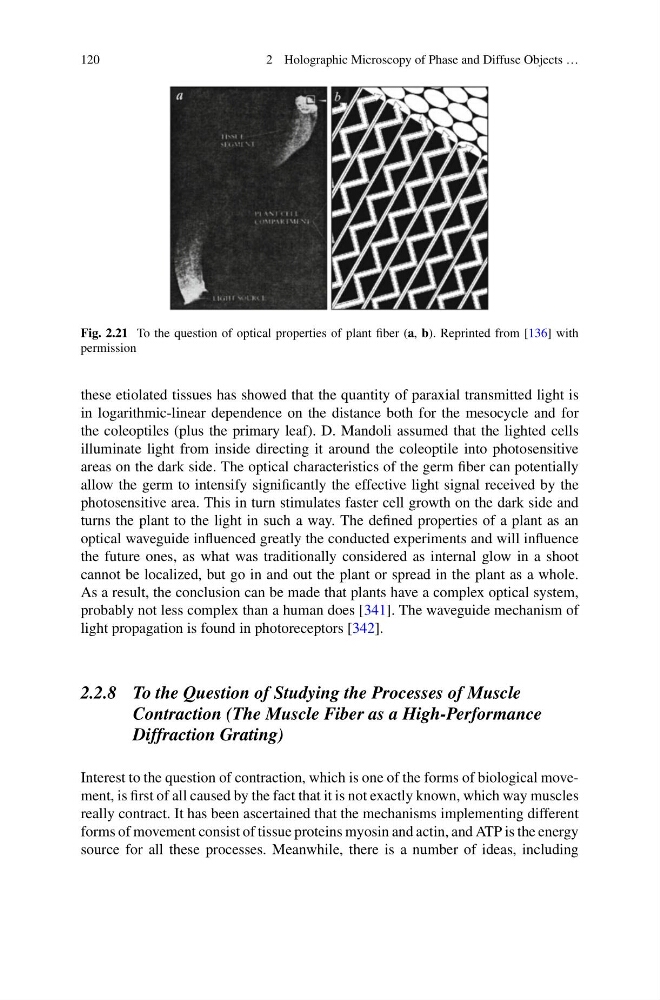
Fig. 2.21 To the question of optical properties of plant fiber (a, b). Reprinted from [136] with
permission
these etiolated tissues has showed that the quantity of paraxial transmitted light is
in logarithmic-linear dependence on the distance both for the mesocycle and for
the coleoptiles (plus the primary leaf). D. Mandoli assumed that the lighted cells
illuminate light from inside directing it around the coleoptile into photosensitive
areas on the dark side. The optical characteristics of the germ fiber can potentially
allow the germ to intensify significantly the effective light signal received by the
photosensitive area. This in turn stimulates faster cell growth on the dark side and
turns the plant to the light in such a way. The defined properties of a plant as an
optical waveguide influenced greatly the conducted experiments and will influence
the future ones, as what was traditionally considered as internal glow in a shoot
cannot be localized, but go in and out the plant or spread in the plant as a whole.
As a result, the conclusion can be made that plants have a complex optical system,
probably not less complex than a human does [341]. The waveguide mechanism of
light propagation is found in photoreceptors [342].
2.2.8 To the Question of Studying the Processes of Muscle
Contraction (The Muscle Fiber as a High-Performance
Diffraction Grating)
Interest to the question of contraction, which is one of the forms of biological movement, is first of all caused by the fact that it is not exactly known, which way muscles
really contract. It has been ascertained that the mechanisms implementing different
forms of movement consist of tissue proteins myosin and actin, and ATP is the energy
source for all these processes. Meanwhile, there is a number of ideas, including
2 Holographic Microscopy of Phase and Diffuse Objects …
Fig. 2.21 To the question of optical properties of plant fiber (a, b). Reprinted from [136] with
permission
these etiolated tissues has showed that the quantity of paraxial transmitted light is
in logarithmic-linear dependence on the distance both for the mesocycle and for
the coleoptiles (plus the primary leaf). D. Mandoli assumed that the lighted cells
illuminate light from inside directing it around the coleoptile into photosensitive
areas on the dark side. The optical characteristics of the germ fiber can potentially
allow the germ to intensify significantly the effective light signal received by the
photosensitive area. This in turn stimulates faster cell growth on the dark side and
turns the plant to the light in such a way. The defined properties of a plant as an
optical waveguide influenced greatly the conducted experiments and will influence
the future ones, as what was traditionally considered as internal glow in a shoot
cannot be localized, but go in and out the plant or spread in the plant as a whole.
As a result, the conclusion can be made that plants have a complex optical system,
probably not less complex than a human does [341]. The waveguide mechanism of
light propagation is found in photoreceptors [342].
2.2.8 To the Question of Studying the Processes of Muscle
Contraction (The Muscle Fiber as a High-Performance
Diffraction Grating)
Interest to the question of contraction, which is one of the forms of biological movement, is first of all caused by the fact that it is not exactly known, which way muscles
really contract. It has been ascertained that the mechanisms implementing different
forms of movement consist of tissue proteins myosin and actin, and ATP is the energy
source for all these processes. Meanwhile, there is a number of ideas, including