

80
2 Holographic Microscopy of Phase and Diffuse Objects …
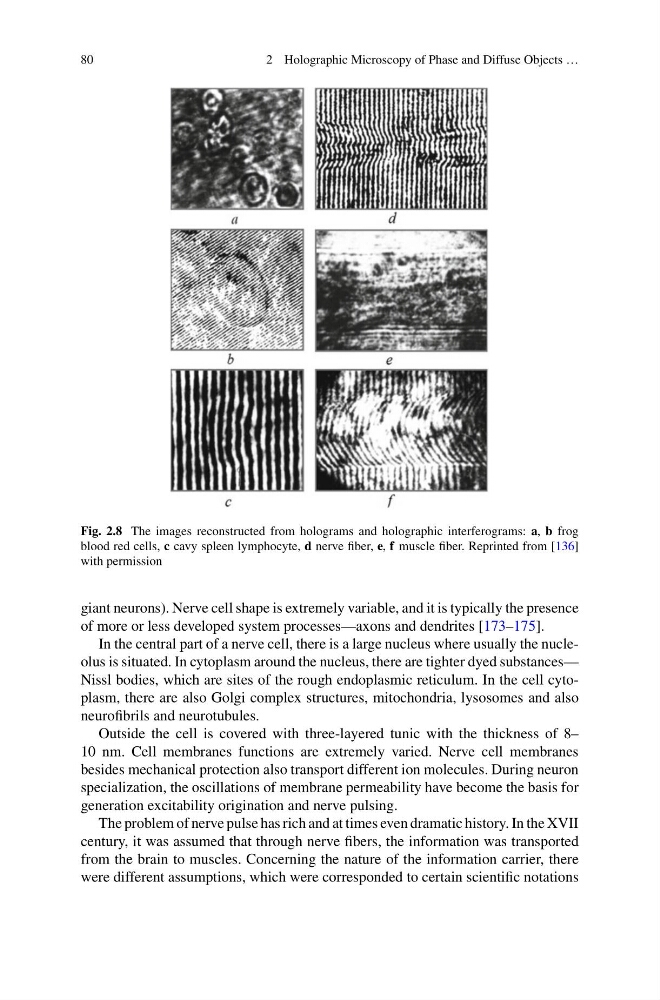
Fig. 2.8 The images reconstructed from holograms and holographic interferograms: a, b frog
blood red cells, c cavy spleen lymphocyte, d nerve fiber, e, f muscle fiber. Reprinted from [136]
with permission
giant neurons). Nerve cell shape is extremely variable, and it is typically the presence
of more or less developed system processes—axons and dendrites [173–175].
In the central part of a nerve cell, there is a large nucleus where usually the nucleolus is situated. In cytoplasm around the nucleus, there are tighter dyed substances—
Nissl bodies, which are sites of the rough endoplasmic reticulum. In the cell cytoplasm, there are also Golgi complex structures, mitochondria, lysosomes and also
neurofibrils and neurotubules.
Outside the cell is covered with three-layered tunic with the thickness of 8–
10 nm. Cell membranes functions are extremely varied. Nerve cell membranes
besides mechanical protection also transport different ion molecules. During neuron
specialization, the oscillations of membrane permeability have become the basis for
generation excitability origination and nerve pulsing.
The problem of nerve pulse has rich and at times even dramatic history. In the XVII
century, it was assumed that through nerve fibers, the information was transported
from the brain to muscles. Concerning the nature of the information carrier, there
were different assumptions, which were corresponded to certain scientific notations
2 Holographic Microscopy of Phase and Diffuse Objects …
Fig. 2.8 The images reconstructed from holograms and holographic interferograms: a, b frog
blood red cells, c cavy spleen lymphocyte, d nerve fiber, e, f muscle fiber. Reprinted from [136]
with permission
giant neurons). Nerve cell shape is extremely variable, and it is typically the presence
of more or less developed system processes—axons and dendrites [173–175].
In the central part of a nerve cell, there is a large nucleus where usually the nucleolus is situated. In cytoplasm around the nucleus, there are tighter dyed substances—
Nissl bodies, which are sites of the rough endoplasmic reticulum. In the cell cytoplasm, there are also Golgi complex structures, mitochondria, lysosomes and also
neurofibrils and neurotubules.
Outside the cell is covered with three-layered tunic with the thickness of 8–
10 nm. Cell membranes functions are extremely varied. Nerve cell membranes
besides mechanical protection also transport different ion molecules. During neuron
specialization, the oscillations of membrane permeability have become the basis for
generation excitability origination and nerve pulsing.
The problem of nerve pulse has rich and at times even dramatic history. In the XVII
century, it was assumed that through nerve fibers, the information was transported
from the brain to muscles. Concerning the nature of the information carrier, there
were different assumptions, which were corresponded to certain scientific notations