

80
3 Coupling Model and Numerical Computation Method of Keyhole and Weld Pool
where:
Subscript f free interface;
μ
density of metal liquid in weld pool.
In the following, the boundary conditions for recoil pressure and surface tension
on the free surface of keyhole are modeled. Firstly, according to Eqs. (3.35) and
(3.45), we can obtain:
σ κ = p L − p G + 2[μ] n · ∇
− →
U · ·
n
(3.57)
In order to simplify, without considering the influence of metal vapor/plasma
viscosity, the equation above can be further expressed as:
σ κ = p L − p G − 2μ n · ∇
− →
U · ·
n
(3.58)
In the process of laser welding, it is generally believed that the pressure of metal
vapor/plasma inside the keyhole is approximately equal to the recoil pressure. Then
the pressure boundary conditions caused by the existence of surface tension and
recoil pressure on the free interface of the keyhole are:
p f = p r + σ κ + 2μ n · ∇
− →
U · ·
n
(3.59)
where:
Subscript f free interface;
μ
density of metal liquid in weld pool;
p r
recoil pressure.
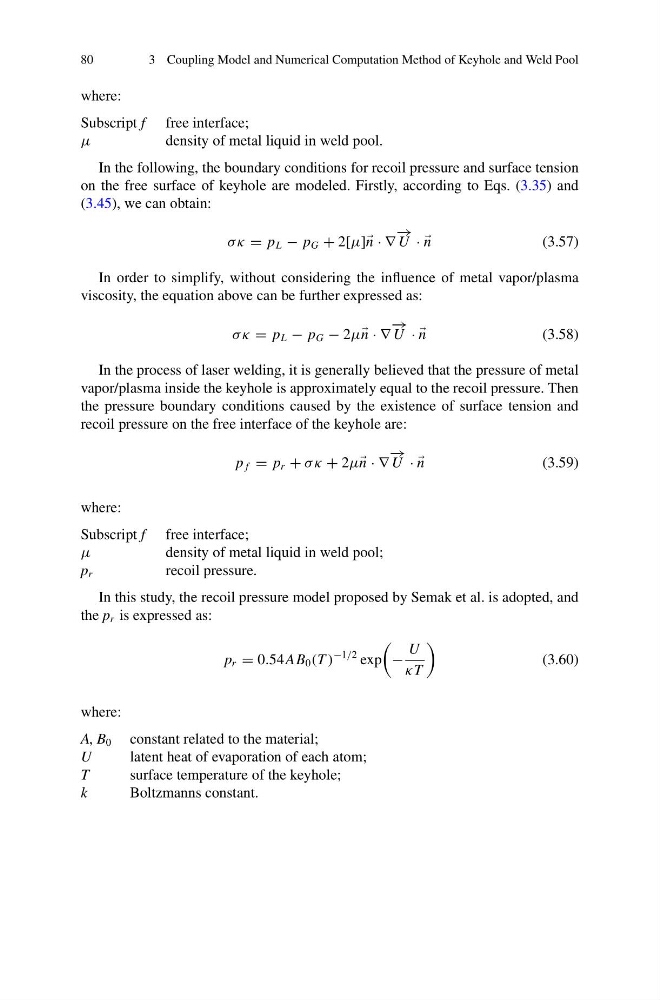
In this study, the recoil pressure model proposed by Semak et al. is adopted, and
the p r is expressed as:
p r = 0.54 AB 0 (T )
−1/2 exp
−
U
κ T
(3.60)
where:
A, B 0 constant related to the material;
U
latent heat of evaporation of each atom;
T
surface temperature of the keyhole;
k
Boltzmanns constant.
3 Coupling Model and Numerical Computation Method of Keyhole and Weld Pool
where:
Subscript f free interface;
μ
density of metal liquid in weld pool.
In the following, the boundary conditions for recoil pressure and surface tension
on the free surface of keyhole are modeled. Firstly, according to Eqs. (3.35) and
(3.45), we can obtain:
σ κ = p L − p G + 2[μ] n · ∇
− →
U · ·
n
(3.57)
In order to simplify, without considering the influence of metal vapor/plasma
viscosity, the equation above can be further expressed as:
σ κ = p L − p G − 2μ n · ∇
− →
U · ·
n
(3.58)
In the process of laser welding, it is generally believed that the pressure of metal
vapor/plasma inside the keyhole is approximately equal to the recoil pressure. Then
the pressure boundary conditions caused by the existence of surface tension and
recoil pressure on the free interface of the keyhole are:
p f = p r + σ κ + 2μ n · ∇
− →
U · ·
n
(3.59)
where:
Subscript f free interface;
μ
density of metal liquid in weld pool;
p r
recoil pressure.
In this study, the recoil pressure model proposed by Semak et al. is adopted, and
the p r is expressed as:
p r = 0.54 AB 0 (T )
−1/2 exp
−
U
κ T
(3.60)
where:
A, B 0 constant related to the material;
U
latent heat of evaporation of each atom;
T
surface temperature of the keyhole;
k
Boltzmanns constant.