

3.4 Boundary Conditions of the Coupling Model
79
=
⎛
⎜
⎝
μ n · ∇
− →
U · ·
n
0 0
0
00
0
00
⎞
⎟
⎠ +
⎛
⎜
⎜
⎝
0
0
0
μ t 1 · ∇
− →
U · ·
n
μ t 1 · ∇
− →
U ·
t 1
μ t 1 · ∇
− →
U ·
t 2
μ t 2 · ∇
− →
U · ·
n
μ t 2 · ∇
− →
U ·
t 1
μ t 2 · ∇
− →
U ·
t 2
⎞
⎟
⎟
⎠
+
⎛
⎜
⎝
0
μ n · ∇
− →
U ·
t 1
μ n · ∇
− →
U ·
t 2
0
0
0
0
0
0
⎞
⎟
⎠
−
⎛
⎜
⎝
0
μ t 1 · ∇
− →
U · ·
n
μ t 2 · ∇
− →
U · ·
n
0
0
0
0
0
0
⎞
⎟
⎠ −
⎛
⎝
0 ∇ s σ
t 1 ∇ s σ
t 2
0 0
0
0 0
0
⎞
⎠
= [μ]
n 0 0
T
∇
− →
U
n 0 0
+ [μ]
n 0 0
T
∇
− →
U
n
t 1
t 2
− [μ]
n 0 0
T
∇
− →
U
T
0
t 1
t 2
−
⎛
⎝
0 ∇ s σ
t 1 ∇ s σ
t 2
0 0
0
0 0
0
⎞
⎠
(3.54)
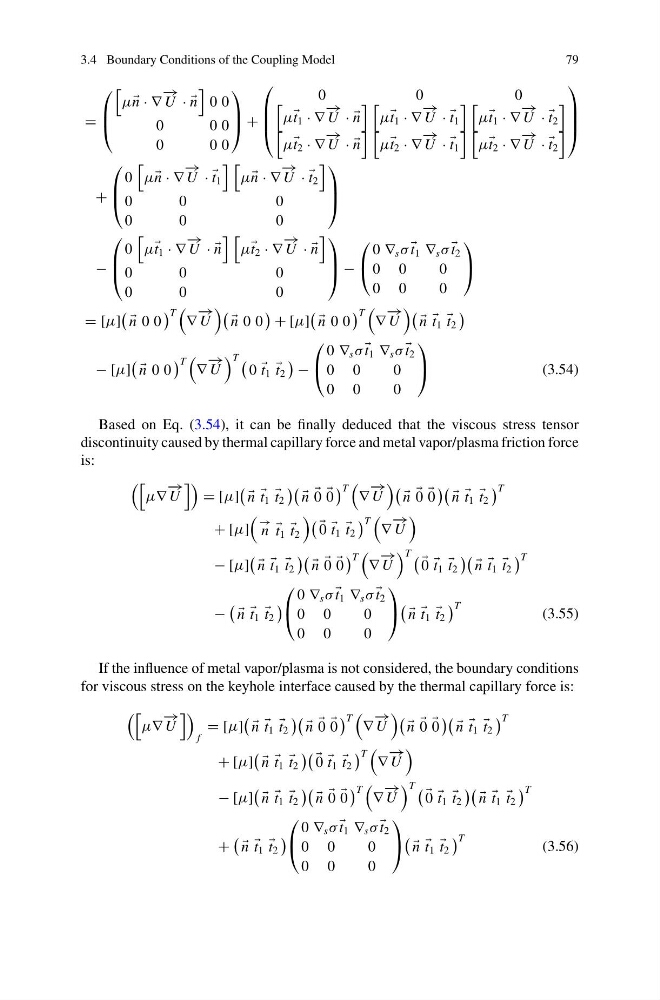
Based on Eq. (3.54), it can be finally deduced that the viscous stress tensor
discontinuity caused by thermal capillary force and metal vapor/plasma friction force
is:
μ∇
− →
U
= [μ]
n
t 1
t 2
n
0
0
T
∇
− →
U
n
0
0
n
t 1
t 2
T
+ [μ]
→
n
t 1
t 2
0
t 1
t 2
T
∇
− →
U
− [μ]
n
t 1
t 2
n
0
0
T
∇
− →
U
T
0
t 1
t 2
n
t 1
t 2
T
−
n
t 1
t 2
⎛
⎝
0 ∇ s σ
t 1 ∇ s σ
t 2
0 0
0
0 0
0
⎞
⎠
n
t 1
t 2
T
(3.55)
If the influence of metal vapor/plasma is not considered, the boundary conditions
for viscous stress on the keyhole interface caused by the thermal capillary force is:
μ∇
− →
U
f
= [μ]
n
t 1
t 2
n
0
0
T
∇
− →
U
n
0
0
n
t 1
t 2
T
+ [μ]
n
t 1
t 2
0
t 1
t 2
T
∇
− →
U
− [μ]
n
t 1
t 2
n
0
0
T
∇
− →
U
T
0
t 1
t 2
n
t 1
t 2
T
+
n
t 1
t 2
⎛
⎝
0 ∇ s σ
t 1 ∇ s σ
t 2
0 0
0
0 0
0
⎞
⎠
n
t 1
t 2
T
(3.56)
79
=
⎛
⎜
⎝
μ n · ∇
− →
U · ·
n
0 0
0
00
0
00
⎞
⎟
⎠ +
⎛
⎜
⎜
⎝
0
0
0
μ t 1 · ∇
− →
U · ·
n
μ t 1 · ∇
− →
U ·
t 1
μ t 1 · ∇
− →
U ·
t 2
μ t 2 · ∇
− →
U · ·
n
μ t 2 · ∇
− →
U ·
t 1
μ t 2 · ∇
− →
U ·
t 2
⎞
⎟
⎟
⎠
+
⎛
⎜
⎝
0
μ n · ∇
− →
U ·
t 1
μ n · ∇
− →
U ·
t 2
0
0
0
0
0
0
⎞
⎟
⎠
−
⎛
⎜
⎝
0
μ t 1 · ∇
− →
U · ·
n
μ t 2 · ∇
− →
U · ·
n
0
0
0
0
0
0
⎞
⎟
⎠ −
⎛
⎝
0 ∇ s σ
t 1 ∇ s σ
t 2
0 0
0
0 0
0
⎞
⎠
= [μ]
n 0 0
T
∇
− →
U
n 0 0
+ [μ]
n 0 0
T
∇
− →
U
n
t 1
t 2
− [μ]
n 0 0
T
∇
− →
U
T
0
t 1
t 2
−
⎛
⎝
0 ∇ s σ
t 1 ∇ s σ
t 2
0 0
0
0 0
0
⎞
⎠
(3.54)
Based on Eq. (3.54), it can be finally deduced that the viscous stress tensor
discontinuity caused by thermal capillary force and metal vapor/plasma friction force
is:
μ∇
− →
U
= [μ]
n
t 1
t 2
n
0
0
T
∇
− →
U
n
0
0
n
t 1
t 2
T
+ [μ]
→
n
t 1
t 2
0
t 1
t 2
T
∇
− →
U
− [μ]
n
t 1
t 2
n
0
0
T
∇
− →
U
T
0
t 1
t 2
n
t 1
t 2
T
−
n
t 1
t 2
⎛
⎝
0 ∇ s σ
t 1 ∇ s σ
t 2
0 0
0
0 0
0
⎞
⎠
n
t 1
t 2
T
(3.55)
If the influence of metal vapor/plasma is not considered, the boundary conditions
for viscous stress on the keyhole interface caused by the thermal capillary force is:
μ∇
− →
U
f
= [μ]
n
t 1
t 2
n
0
0
T
∇
− →
U
n
0
0
n
t 1
t 2
T
+ [μ]
n
t 1
t 2
0
t 1
t 2
T
∇
− →
U
− [μ]
n
t 1
t 2
n
0
0
T
∇
− →
U
T
0
t 1
t 2
n
t 1
t 2
T
+
n
t 1
t 2
⎛
⎝
0 ∇ s σ
t 1 ∇ s σ
t 2
0 0
0
0 0
0
⎞
⎠
n
t 1
t 2
T
(3.56)