

76
3 Coupling Model and Numerical Computation Method of Keyhole and Weld Pool
σ = −
⎛
⎝
p 0 0
0 p 0
0 0 p
⎞
⎠ +
⎛
⎝
σ xx + p σ xy
σ xz
σ yx σ yy + p σ yz
σ zx
σ zy σ zz + p
⎞
⎠
(3.32)
where:
p
Fluid pressure, p = −
1
3
σ xx + σ yy + σ zz
;
τ
Stress bias tensor.
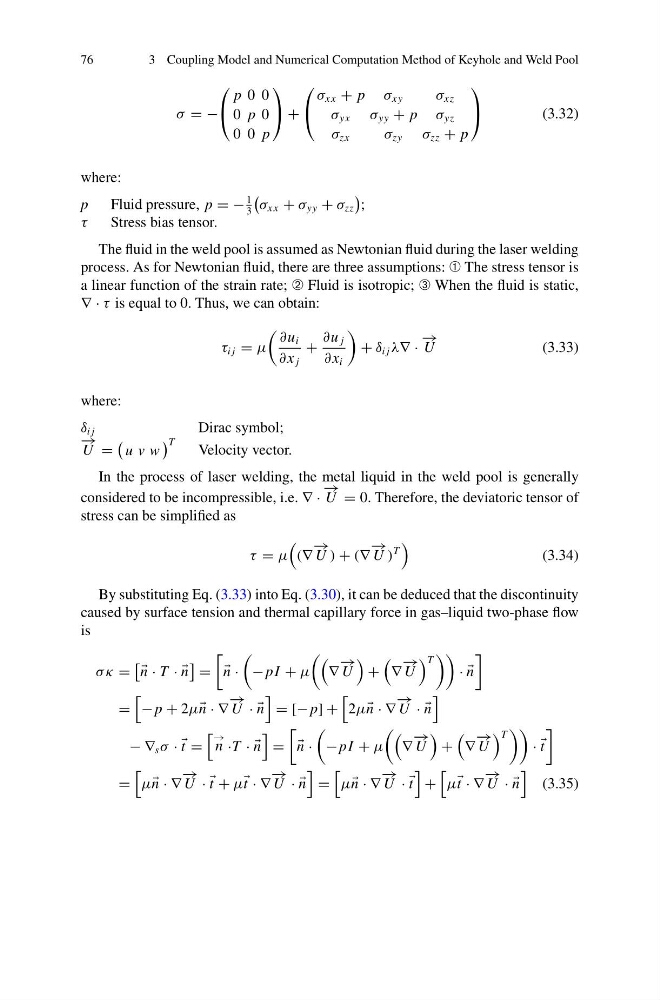
The fluid in the weld pool is assumed as Newtonian fluid during the laser welding
process. As for Newtonian fluid, there are three assumptions: ➀ The stress tensor is
a linear function of the strain rate; ➁ Fluid is isotropic; ➂ When the fluid is static,
∇ · τ is equal to 0. Thus, we can obtain:
τ i j = μ
∂u i
∂ x j
+
∂u j
∂ x i
+ δ i j λ∇ ·
− →
U
(3.33)
where:
δ i j
Dirac symbol;
− →
U =
u v w
T
Velocity vector.
In the process of laser welding, the metal liquid in the weld pool is generally
considered to be incompressible, i.e. ∇ ·
− →
U = 0. Therefore, the deviatoric tensor of
stress can be simplified as
τ = μ
(∇
− →
U ) + (∇
− →
U )
T
(3.34)
By substituting Eq. (3.33) into Eq. (3.30), it can be deduced that the discontinuity
caused by surface tension and thermal capillary force in gas–liquid two-phase flow
is
σ κ =
n · T · ·
n
=
n ·
− pI + μ
∇
− →
U
+
∇
− →
U
T
· ·
n
=
− p + 2μ n · ∇
− →
U · ·
n
= [− p] +
2μ n · ∇
− →
U · ·
n
− ∇ s σ ·
t =
→
n ·T · ·
n
=
n ·
− pI + μ
∇
− →
U
+
∇
− →
U
T
·
t
=
μ n · ∇
− →
U ·
t + μ t · ∇
− →
U · ·
n
=
μ n · ∇
− →
U ·
t
+
μ t · ∇
− →
U · ·
n
(3.35)
3 Coupling Model and Numerical Computation Method of Keyhole and Weld Pool
σ = −
⎛
⎝
p 0 0
0 p 0
0 0 p
⎞
⎠ +
⎛
⎝
σ xx + p σ xy
σ xz
σ yx σ yy + p σ yz
σ zx
σ zy σ zz + p
⎞
⎠
(3.32)
where:
p
Fluid pressure, p = −
1
3
σ xx + σ yy + σ zz
;
τ
Stress bias tensor.
The fluid in the weld pool is assumed as Newtonian fluid during the laser welding
process. As for Newtonian fluid, there are three assumptions: ➀ The stress tensor is
a linear function of the strain rate; ➁ Fluid is isotropic; ➂ When the fluid is static,
∇ · τ is equal to 0. Thus, we can obtain:
τ i j = μ
∂u i
∂ x j
+
∂u j
∂ x i
+ δ i j λ∇ ·
− →
U
(3.33)
where:
δ i j
Dirac symbol;
− →
U =
u v w
T
Velocity vector.
In the process of laser welding, the metal liquid in the weld pool is generally
considered to be incompressible, i.e. ∇ ·
− →
U = 0. Therefore, the deviatoric tensor of
stress can be simplified as
τ = μ
(∇
− →
U ) + (∇
− →
U )
T
(3.34)
By substituting Eq. (3.33) into Eq. (3.30), it can be deduced that the discontinuity
caused by surface tension and thermal capillary force in gas–liquid two-phase flow
is
σ κ =
n · T · ·
n
=
n ·
− pI + μ
∇
− →
U
+
∇
− →
U
T
· ·
n
=
− p + 2μ n · ∇
− →
U · ·
n
= [− p] +
2μ n · ∇
− →
U · ·
n
− ∇ s σ ·
t =
→
n ·T · ·
n
=
n ·
− pI + μ
∇
− →
U
+
∇
− →
U
T
·
t
=
μ n · ∇
− →
U ·
t + μ t · ∇
− →
U · ·
n
=
μ n · ∇
− →
U ·
t
+
μ t · ∇
− →
U · ·
n
(3.35)